
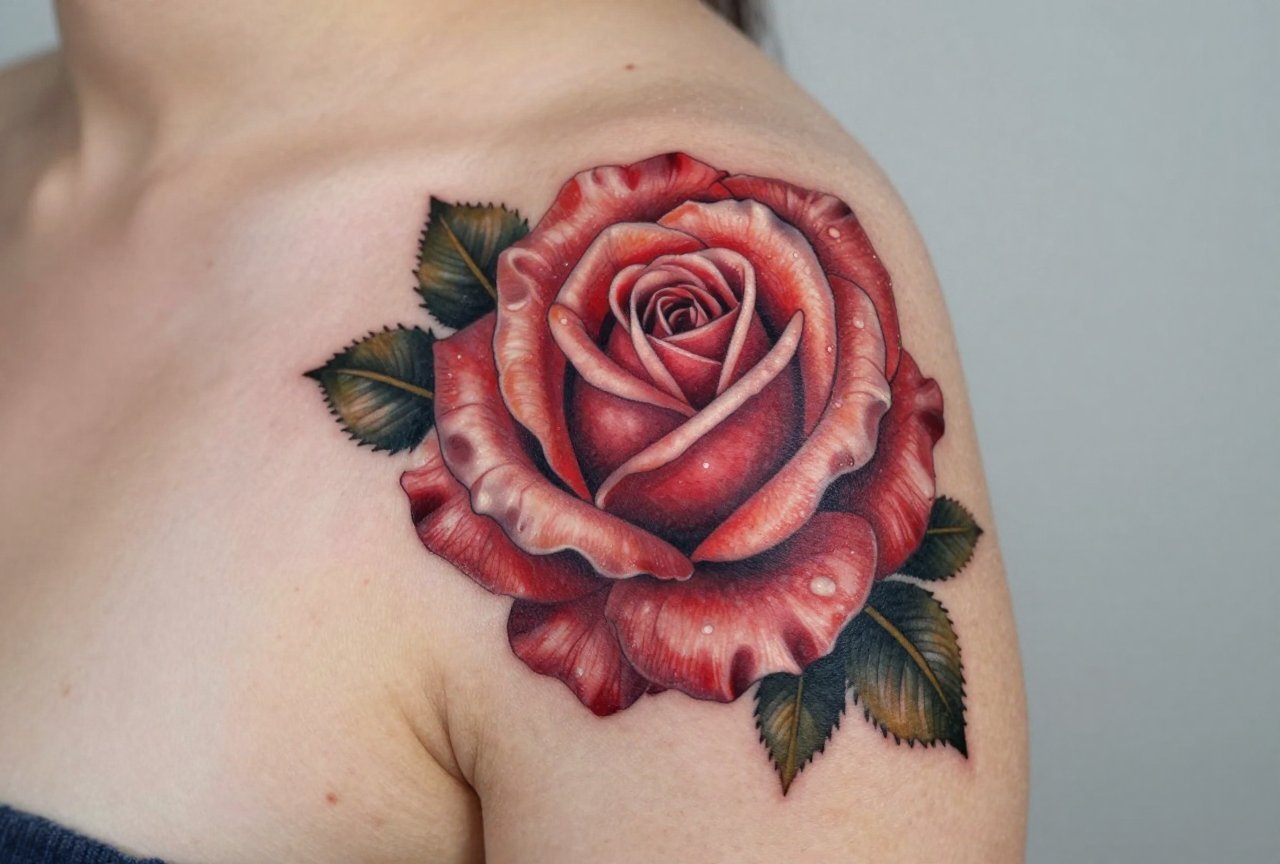
A realistic rose tattoo isn’t just a flower on skin, it’s an attempt to make something flat look alive. I’ve tattooed hundreds of roses over fifteen years, and the ones that still stop me in my tracks are the ones where you swear you could smell them. That means depth, subtle color shifts, and understanding how skin changes what you put into it. This guide breaks down what actually matters when you’re considering one.
Origins & History
From Sailor Jerry to Photorealism
Traditional rose tattoos have been shop staples since the 1940s, bold outlines, limited palettes, readable from across the room. The realistic rose came later, riding the wave of photorealism that hit tattooing in the late 1990s and early 2000s. Artists like Nikko Hurtado and Paul Acker pushed what was possible with color and detail, and clients started asking for roses that looked like they’d been clipped from a garden and pressed under glass.
I’ve got a guy in his sixties who comes in every few years. His first rose was a Sailor Jerry flash piece in 1987. His last one, done by me in 2022, is a full color realism piece on his forearm. He laughs about the difference. “That old one looks like a stamp,” he says. “This one looks like I could water it.”
Why Roses Specifically
Roses work for realism because they’re structurally complex but universally recognizable. You’ve got the spiral of the center petals, the way outer ones curl and catch light, the veining, the subtle color gradients from heart to edge. Mess up the anatomy and people notice. Get it right and it’s mesmerizing.
Key Characteristics & Motifs
What separates a realistic rose from a stylized one? Here’s what I look for when I’m drawing:
- Layered petal depth: Inner petals are tighter, darker, more shadowed. Outer ones open up, catch highlights, show their edges curling away from the light source.
- Light logic: Every realistic piece needs a consistent light direction. I pick one angle and stick to it. Mixed lighting kills the illusion.
- Soft edges: No hard cartoon outlines. Edges are created through contrast between adjacent tones, not black lines.
- Veining and texture: Subtle. Too heavy and it looks like a diagram. Too light and it reads flat.
- Background integration: Most realistic roses sit in negative space or against soft grey wash. Some artists add dewdrops, thorns, or leaves for context.
I tell clients: the best realistic roses look like they were painted with airbrush and light, not needles and ink. That’s the goal.
Color vs Black and Grey
Color Realism
Color roses are demanding. Red is the most common request, but red pigment is notoriously tricky, some brands fade pink, others go muddy brown. I’ve learned to layer: warm magenta base, deeper crimson shadows, touches of orange or even purple in the deepest folds. Yellow and white roses are harder to keep clean. White ink especially can yellow over time, and on darker skin tones it may not show at all.
The payoff is stunning when it works. A well-done color realistic rose has dimension that black and grey can’t touch. But it needs touch-ups. I warn everyone: plan on coming back in 3-5 years.
Black and Grey
This is where I do most of my rose work. Black and grey ages better, heals more predictably, and works on any skin tone. The trick is temperature control, warm blacks (browner) vs. cool blacks (bluer). I mix my own grey wash from triple black and distilled water, building value in thin passes.
Black and grey roses rely on smooth gradation. I use mag shaders, round shaders, sometimes a single needle for fine veining. The best ones look like charcoal drawings that happen to be permanent.
Best Placements
Not every spot works for realistic detail. Here’s where I’ve seen the best results:
- Outer forearm: Flat canvas, easy to show off, heals well. The classic choice.
- Upper arm/shoulder: Enough real estate for a full bloom with leaves. Muscle movement adds subtle life.
- Calf: Surprisingly good. The skin is relatively stable, and the cylindrical shape wraps the design naturally.
- Ribcage: Painful, but the large flat planes reward detailed work. I’ve done my best roses here.
- Thigh: Great for larger compositions, especially on clients who want multiple blooms or a full stem.
Avoid: fingers, tops of feet, inner wrists. These spots see too much friction and fading. I’ve watched beautiful realistic roses turn into pink blobs on hands within two years. It’s heartbreaking.
Who It Suits
Realistic rose tattoos aren’t gendered, despite what Instagram algorithms suggest. I’ve tattooed them on construction workers and ballerinas, on eighteen-year-olds getting their first piece and seventy-year-olds getting their last. The rose carries different weight for everyone, memorial, celebration, aesthetic preference.
What matters more than gender is skin condition and lifestyle. If you’re in the sun constantly without protection, color realism will disappoint you. If you have keloid tendencies, the heavy saturation in realistic work can trigger raised scarring. I always do a small test area for clients with reactive skin.
Patience matters too. A detailed realistic rose takes 3-5 hours minimum. Some of my larger pieces run 8-10 hours across multiple sessions. If you can’t sit still, consider a simpler style.
Modern Variations
Double Exposure and Surrealism
We’re seeing a lot of roses merged with other imagery, skulls inside the bloom, galaxy patterns in the petals, clock faces dissolving into leaves. These require two artists’ skills: botanical accuracy and conceptual design. I collaborate with a colleague who specializes in geometric work when clients want this hybrid approach.
Micro-Realism
Tiny realistic roses, sometimes under two inches. Popular on wrists, behind ears, along collarbones. The limitation is physics, needles have width, and at a certain scale, detail becomes impossible. I turn down micro-realism requests that I know won’t hold. Better to say no than to do work that falls apart in a year.
Biomechanical and Abstract Integration
Roses growing from mechanical stems, petals turning to gears, roots becoming circuitry. These are technically challenging but visually striking. They require the artist to understand both organic and hard-surface rendering.
Choosing an Artist
This is where I get passionate. Not every talented tattooer can do realism. It’s a specific skill set. Here’s what to look for:
- Portfolio focus: At least 30% of their work should be realistic. One or two rose photos isn’t enough.
- Healed photos: Fresh tattoos look different. Any artist worth booking will show you work at 6 months, 1 year, 5 years.
- Drawing ability: Ask to see their reference-to-stencil process. Realism requires strong custom drawing, not just tracing.
- Skin tone experience: If you have darker skin, find someone who has specifically worked on similar tones. Pigment behaves differently.
- Shop culture: Walk in. Is it clean? Do they use new needles in front of you? Is the artist rushed or attentive?
I charge more for realism than for traditional work. Most artists do. The time investment is higher, the technical demand greater. Expect to pay $150-$300 per hour in most US cities, with detailed pieces running $800-$2,500 total. Cheap realism is almost always bad realism.
Final Thoughts
A realistic rose tattoo is a commitment, to the artist, to the sitting time, to the aftercare, to future touch-ups. But done well, it’s one of the most satisfying pieces I can create. There’s something about capturing something so familiar, so everyday, and making it permanent and perfect on skin. I’ve had clients cry when they see their finished piece. Not from pain. From recognition.
If you’re considering one, take your time finding the right artist. Bring reference photos but trust their interpretation. And remember: tattoos are alive. They breathe with your skin, age with your body, change as you change. The rose that looks perfect today will soften tomorrow, and that’s not failure, that’s just time doing what time does. The best we can do is start with something true.
Frequently Asked Questions
How long does a realistic rose tattoo take to heal?
Surface healing takes 2-3 weeks, but the deeper layers settle over 2-3 months. I tell clients to expect the color to look dull for the first month, then brighten as the skin fully regenerates. Don’t judge the final result until at least six weeks out.
Will a realistic rose tattoo look good on darker skin tones?
Absolutely, but the approach changes. I use deeper saturation and stronger contrast for darker skin, and I often steer clients toward black and grey or very bold color choices. Light pastels and subtle gradients can disappear. Find an artist with specific experience in your skin tone.
Can I add a realistic rose to an existing traditional tattoo?
It’s tricky but possible. The styles clash if placed directly adjacent, traditional bold lines against soft realism can look accidental. I usually suggest a transitional element, like grey wash background, or keeping them on separate body areas. Some clients do full sleeves mixing styles intentionally, but that requires serious planning.
Why did my realistic rose lose detail after healing?
Usually it’s one of three things: the artist worked too shallow and the ink didn’t hold, the design had too much fine detail for the scale, or aftercare was compromised. I’ve seen clients pick scabs and lose entire petals. Realism is unforgiving, follow your artist’s instructions exactly, and always go back for a touch-up if needed.
Related Style Guides
- Realistic Werewolf Tattoos: A Working Artist s Guide
- Traditional Star Wars Tattoos: A Working Artist s Guide
- Traditional Banner Tattoos: Style Guide
- Explore more









