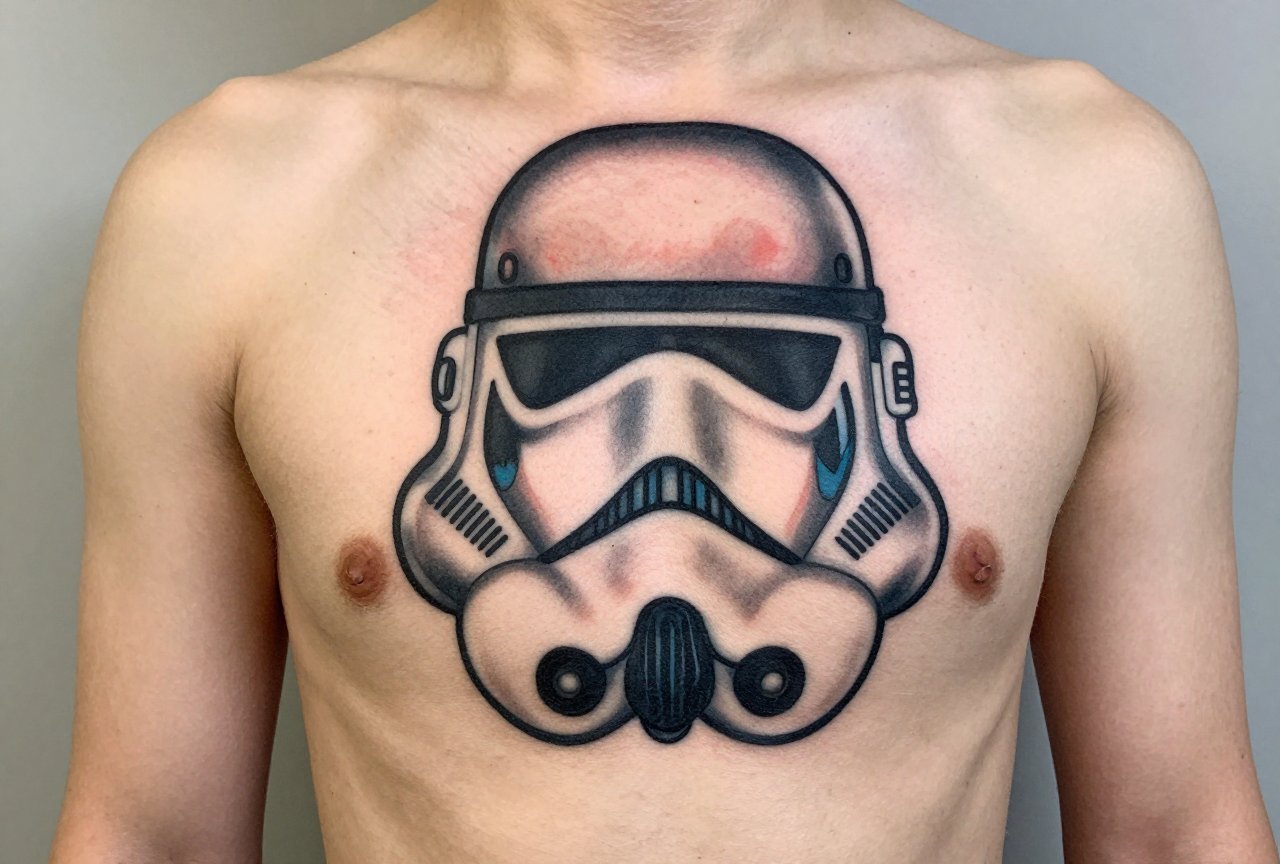
Traditional Star Wars tattoos mash up two things that were already perfect on their own: the bold, graphic punch of old-school American tattooing and the pop culture mythology that’s been living in our heads since 1977. I’m talking thick black outlines, a restrained color palette, and imagery that reads clean from ten feet away. In my chair, I’ve seen grown adults tear up getting their first X-Wing or a classic Darth Vader helmet rendered with that sailor-style weight. The style works because Star Wars iconography was already designed for silhouette and instant recognition, Lucas and his team basically built these images to be tattooed before tattooing was even thinking about them.
Origins & History
Where American Traditional Meets a Galaxy Far, Far Away
American traditional tattooing came out of the naval and carnival circuits of the early 1900s, Sailor Jerry, Bert Grimm, the whole lineage. Bold lines, limited colors, imagery that held up after years of sun and salt. Star Wars landed in ’77 right when tattooing was creeping out of the underground and into suburban consciousness. By the mid-80s, I know old-timers who were doing Darth Vader heads next to anchors and swallows, no hesitation. The crossover was natural. Both traditions trade in archetypes: the devil, the beautiful woman, the ship at sea, and now the Sith Lord, the princess, the rogue smuggler.
Why the Marriage Lasts
Here’s what I’ve noticed after years of doing these: Star Wars gives traditional tattooing fresh subject matter without asking the style to bend. You don’t need photorealism. You don’t need smooth gradients. A traditional Boba Fett helmet hits harder with a heavy black drop shadow and three colors than it would with soft airbrush technique. The style demands simplification, and Star Wars imagery simplifies beautifully. I’ve tattooed Death Stars that were basically perfect circles with a single line detail, reads instantly, heals clean, still looks like a Death Star.
Key Characteristics & Motifs
When you’re designing or choosing a traditional Star Wars piece, certain elements show up again and again. Not because we’re being lazy, because they work.
- Helmets and masks: Vader, Boba Fett, Stormtrooper, Mando. The black-and-white contrast plays perfectly with traditional line weight. I’ve done Vader helmets where the entire face is solid black with negative-space highlights, heals like a dream.
- Ships: X-Wings, TIE fighters, the Falcon. Simplified to geometric shapes. A traditional X-Wing is basically a triangle with two lines, reads immediately, ages well.
- Swords and weapons: Lightsabers rendered as straight traditional daggers or crossed swords. The glow effect becomes a simple red or blue fill.
- Pin-up hybrids: Leia or Rey in classic pin-up pose, maybe holding a blaster. This is shop staple stuff. I’ve tattooed a Leia with her hair buns as the focal point, framed by a traditional banner.
- Script and banners: “Do or do not,” “I’ve got a bad feeling about this.” Traditional lettering with Star Wars quotes hits that nostalgic nerve hard.
The rule is always the same: if it doesn’t read at twenty feet, it isn’t traditional. I’ve had clients bring in reference photos of movie stills and we strip them down to shapes. The best designs lose detail and gain power.
Color vs Black and Grey
The Classic Palette
Traditional color is red, yellow, green, blue, sometimes purple, heavy saturation, no pastels. For Star Wars, this maps beautifully. Lightsaber red. Rebel orange. Imperial grey-green. I’ve done Boba Fett helmets where the green is almost electric, the red chest symbol a single bold shape. These colors fade, sure. Everything fades. But traditional pigment sits in the skin differently than soft realism. The bold application means you still see the design even when the color mutes slightly.
Black and Grey Traditional
Not every Star Wars piece needs color. A black and grey traditional Vader, all heavy blacks and whip shading, can be more menacing than any colored version. I tell clients: black and grey ages five years better on sun-exposed skin, and it often costs less because you’re not buying multiple ink caps. The trade-off is energy. Color traditional pops off the skin. Black and grey sits into it. For a character like Kylo Ren or any Sith imagery, I often push clients toward black and grey, the mood fits.
Best Placements
Traditional tattooing was designed for the body. These designs wrap, they fit spots, they work with muscle movement.
- Forearm: The classic. A Vader helmet or X-Wing sits perfectly on the outer forearm. I’ve done hundreds. The flat plane shows the design, and the inner arm can carry a banner or secondary element.
- Thigh: Big canvas for ships or character compositions. The muscle curve gives traditional imagery a natural roundness that flat flash doesn’t always have.
- Chest: Symmetrical pieces, crossed lightsabers, a central helmet with wings or banners. Traditional chest pieces frame the pectorals. We see this a lot with military clients who want Star Wars mixed with service imagery.
- Calf: Vertical designs. A standing Boba Fett, a TIE fighter in flight. The calf’s cylinder shape suits tall compositions.
- Hands and fingers: Small symbols, Rebel or Imperial insignia, tiny lightsabers. I warn clients: hand tattoos hurt more, fade faster, and not every artist will touch them. But when they work, they’re instant conversation.
Placement affects line weight. I thicken outlines for spots that move more, elbows, knees, fingers. A traditional Star Wars piece on a knee needs that heavy black to hold.
Who It Suits
I’ve tattooed Star Wars on grandfathers who saw the original in theaters and on twenty-year-olds who grew up with the prequels. The style doesn’t discriminate. What matters is your relationship to the imagery. Traditional tattooing asks for commitment, the bold lines are permanent in a way that soft grey-wash isn’t. You need to want this on your body in twenty years, not just while the new show is hot.
The collectors who get the best results understand restraint. They don’t ask for every character in a single sleeve. They pick one icon, one moment, and let the style do its work. I’ve had clients bring in twenty reference images and we narrow to one helmet and a color scheme. That’s the discipline.
Modern Variations
Neo-Traditional Expansion
Neo-traditional keeps the bold outlines but adds more color complexity, more illustrative detail, more background elements. A neo-traditional Star Wars piece might have a Mandalorian figure with ornamental filigree behind him, or a full-color nebula rendered in traditional-adjacent technique. I enjoy doing these, they let me stretch, but I remind clients that every extra color is a future fade risk. The pure traditional approach is safer long-term.
Mashups and Humor
We see this a lot in shops now: Darth Vader as a traditional devil figure, complete with pitchfork. R2-D2 as a sailor with a pipe. The internet loves these, and honestly, they’re fun to tattoo. The traditional framework makes the joke land cleaner. A photorealistic Vader with a beer can would look weird. A traditional Vader holding a mug, rendered in three colors, looks like a classic flash piece that happens to be funny.
Choosing an Artist
Not every tattooer who can do realism can do traditional. The skillset is different. Traditional demands confidence in line weight, understanding of how black ink settles, knowledge of what will heal versus what looks good fresh.
- Look at healed photos: Any artist can post a fresh tattoo. Ask for one-year-healed work. Traditional should still read strong.
- Check their line consistency: Traditional lines should be uniform where intended, varied where designed. Wobbly outlines kill the style.
- Ask about their palette: Do they mix custom tones or pull straight from the bottle? Traditional color should be pure, not muddy.
- Shop culture matters: Artists who specialize in traditional often work in shops that value walk-ins and flash. That’s the lineage. A private studio that only does appointments might not have the same daily practice.
I tell clients: if an artist’s portfolio is 90% realism and they say they can do traditional, ask for specific examples. The styles use different muscles. I’ve been doing this fifteen years and I still practice my whip shading on fruit when I’m slow.
Final Thoughts
A traditional Star Wars tattoo isn’t a compromise between two aesthetics, it’s a genuine fusion that makes both stronger. The bold graphic language of American traditional gives Star Wars imagery permanence and weight. The cultural weight of Star Wars gives traditional tattooing subject matter that resonates across generations. In my chair, I’ve watched these pieces become people’s favorite tattoos, not because they’re the most technically complex, but because they read clean, they heal tough, and they carry meaning that goes back to childhood.
If you’re considering one, start with the icon that hit you first. The poster on your wall at eight years old. The action figure you lost and never forgot. Strip it to shapes. Trust the style. The rest is just needle and skin and time.
Frequently Asked Questions
How long does a traditional Star Wars tattoo take to heal?
Most traditional pieces heal in two to three weeks since the bold lines and limited shading cause less overall trauma than detailed realism. Keep it clean, don’t pick, and follow your artist’s specific aftercare.
Will a traditional Star Wars tattoo look good as I get older?
Traditional style is built for aging. The heavy black outlines act as a fence holding pigment in place, so even as color softens, the design remains readable for decades.
Can I combine Star Wars characters with other traditional imagery?
Absolutely. I’ve tattooed Vader with traditional roses, TIE fighters with swallows, and R2-D2 with nautical stars. The traditional framework makes unexpected combinations feel natural.
How much should I expect to pay for a quality piece?
Traditional Star Wars work ranges widely by size and artist reputation, but expect to pay for experience. A solid palm-sized helmet might run a few hours at standard shop rate, don’t bargain hunt for permanent art.
Related Style Guides
- Traditional Banner Tattoos: Style Guide
- Traditional Tattoo Outline: A Working Artist s Guide
- Trash Polka Tattoo Artists: Style Guide What to Know
- Explore more