Realistic skull tattoos are where technical skill meets raw symbolism. I’ve spent years carving bone onto skin, mapping cheek hollows, catching light on orbital sockets, making flat ink read like three-dimensional death. This style isn’t about cartoonish grinning heads or sailor Jerry simplicity. It’s about making someone look twice to confirm it’s not a photograph. The best pieces haunt you. The worst ones muddy into grey blurs within five years. Here’s what separates them, straight from the chair.
Origins & History
From Memento Mori to Machine Work
Skulls have marked human skin for millennia, Sicilian warriors, Polynesian chiefs, Japanese irezumi masters all used them. But the realistic approach? That’s newer. It emerged from the black-and-grey revolution in 1970s East Los Angeles, where Chicano artists refined photorealism on gang members and lowriders. They studied anatomy books, worked from photographs, pushed machines slower than anyone thought possible. Those pioneers proved skin could hold subtle gradations, that a skull could look like it was cast in shadow rather than drawn with lines. I still reference their foundational work when I’m planning a large piece, their understanding of light source and bone structure remains unmatched in some ways.
Photorealism Enters the Mainstream
By the 1990s, artists like Paul Booth and Bob Tyrrell were bringing horror-realism to metalheads and mainstream clients. They took the Chicano technical foundation and added European fine-art training, darker subject matter, more aggressive contrast. The skull became a proving ground. If you could render bone convincingly, you could render anything. I’ve heard older artists call it “the graduate school of tattooing”, not wrong. Every apprentice I know has sweated through dozens of practice skulls on synthetic skin before touching a client.
Key Characteristics & Motifs
What makes a skull tattoo actually read as realistic? It’s not just detail, it’s selective detail. The human eye recognizes bone through specific cues, and smart artists exploit them.
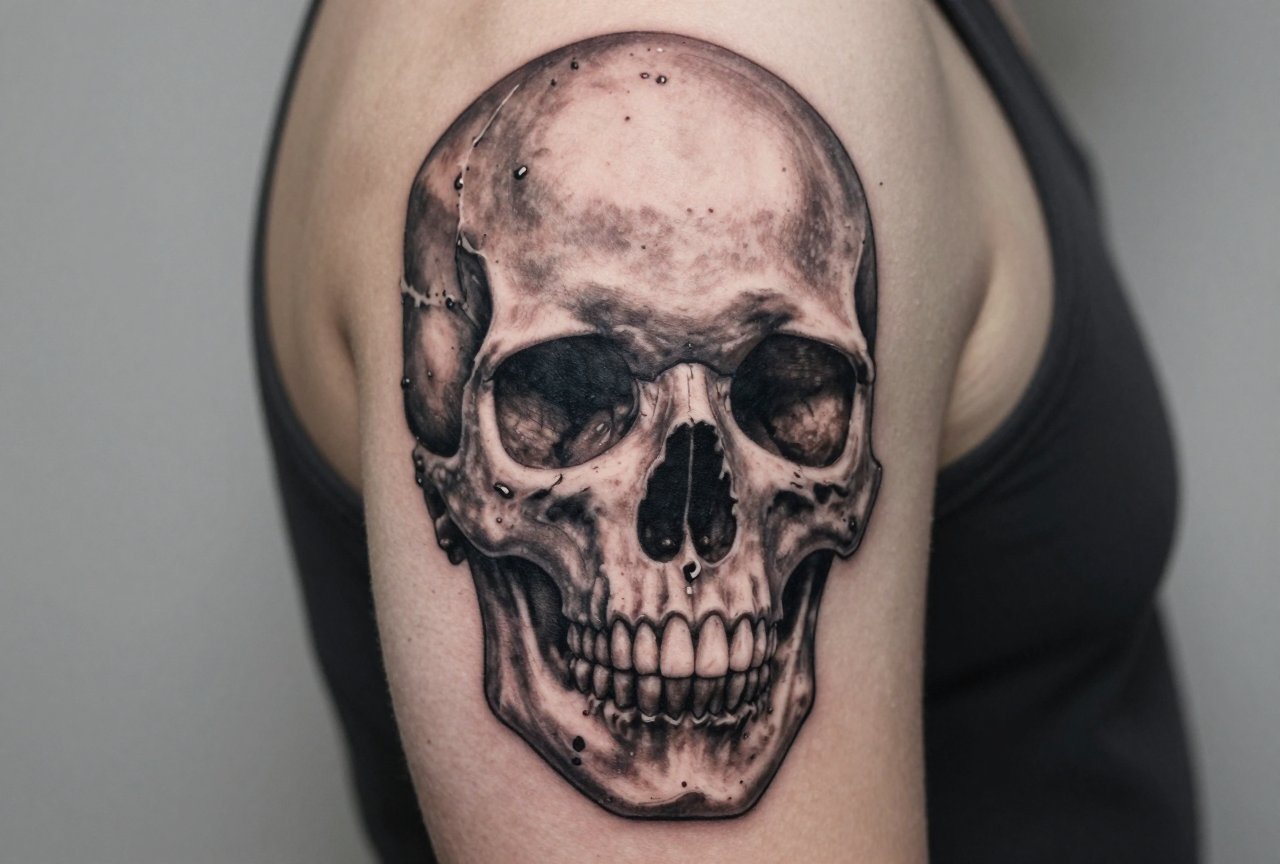
- Light logic: Every realistic skull needs a consistent light source. I map it before touching needle to skin, usually top-left or top-right, creating natural shadows under the brow ridge and inside the nasal cavity. Inconsistent light kills the illusion instantly.
- Anatomical accuracy: The zygomatic arch curves specifically. The temporal bone has a distinct depression. The mandible connects at precise angles. Clients bring me reference photos of animal skulls mislabeled as human, or fantasy art with impossible proportions. I correct gently, but I correct. Wrong anatomy never ages well.
- Texture variation: Real bone isn’t smooth. There’s porous quality, micro-cracks, weathering, staining. I build this with varied needle groupings, tight liners for hairline cracks, mag shaders for porous surfaces, soft greywash for dust and age.
- Negative space: The brightest points in a realistic skull are often untouched skin. I reserve those highlights deliberately, working around them. Once they’re gone, they’re gone. I’ve seen heavy-handed artists fill every inch, and the result looks like a grey blob, not bone catching light.
Color vs Black and Grey
Black and Grey: The Classic Approach
Most realistic skulls I tattoo are black and grey. The palette matches death itself, ash, shadow, bone white. The technique relies on smooth gradation: dark blacks in the deepest hollows, mid-tones across planes, near-white highlights on protrusions. I use a four-needle greywash series, mixing my own caps rather than relying on pre-made washes. The control matters. Skin tone affects everything, what reads as “bone” on pale Irish skin needs adjustment on deeper complexions. I add warmth sometimes, subtle brown undertones, to prevent that corpse-grey flatness that cheap black-and-grey falls into.
Color Realism: Advanced and Unforgiving
Color realistic skulls are rarer and harder. They demand understanding of how yellowed bone differs from white, how moss or rust stain, how candlelight warms the surface. I did a piece last year with a skull emerging from autumn leaves, ochres, burnt siennas, muted olive greens. Gorgeous. But the color had to serve the form, not decorate it. Every hue shift needed to read as light temperature change, not arbitrary decoration. These pieces also age faster. Color saturation drops; yellows and oranges fade quickest. I warn clients: budget for touch-ups, or accept the weathered look as intentional.
Best Placements
Skull shape and human anatomy interact constantly. Some placements enhance the form; others fight it.
- Upper arm/shoulder: The deltoid’s curve echoes the cranial dome. I’ve placed hundreds here. The muscle movement adds subtle life, clients flex, the skull seems to shift. Classic for a reason.
- Forearm: Flat plane, good visibility, but limited space for full complexity. I often do partial skulls here, cropped dramatically, or smaller compositions with single bones. The radius and ulna rotation can distort long-term, something I discuss in consultation.
- Chest: Sternum centering creates natural symmetry. The pectoral shelf gives depth. But it hurts. I mean, really hurts. I tell clients to plan shorter sessions, bring headphones, accept that we’ll break it into multiple sittings.
- Thigh: Expansive canvas, less sun exposure than arms, good fat padding for comfort. The muscle mass holds detail well over decades. I love doing large-scale pieces here, full craniums with mandibles, cervical vertebrae trailing down.
- Hand/finger: I generally refuse. The skin is different, thin, mobile, constantly exfoliating. Realistic detail blurs within months. Clients push; I explain. Some find another artist. Most thank me later when they see how hand tattoos age on friends.
Who It Suits
Not everyone. I say this with love. Realistic skulls read intense, permanent, sometimes aggressive. The guy who wants a small discreet symbol? Redirect him. The woman commemorating her father’s military service with a weathered helmet-and-skull composition? Perfect match. I’ve tattooed doctors, musicians, funeral directors, bikers. The common thread: they want substance, not decoration. They sit still. They understand that three-hour sessions become six, that realism can’t be rushed. The style also suits collectors building cohesive sleeves, skulls transition beautifully into other photorealistic elements, into smoke, into mechanical or organic surroundings.
Modern Variations
Double Exposure and Surrealism
Contemporary artists are merging realistic skulls with landscape photography, cosmic imagery, architectural elements. The skull becomes a container, forests growing through eye sockets, galaxies spiraling in temporal hollows. Technically, this is nightmare difficult. Two realistic images with different light sources, different scales, different textures, must coexist. I’ve attempted fewer than ten in my career. Each took 20+ hours. Each required extensive digital mockup before needle touched skin.
Biomechanical Fusion
HR Giger’s influence persists. Realistic bone transitions into realistic metal, tendons become cables, teeth become gears. The rendering challenge doubles: organic texture against machined precision. I enjoy these when clients commit to large scale. Small biomechanical skulls fail; the detail collapses. But a full back piece? The contrast between warm bone and cold steel, both rendered photographically, creates genuine unease. That’s the goal.
Choosing an Artist
This matters more than design choice. Realistic skulls expose technical weakness immediately. I tell clients what to look for:
- Portfolio specificity: Not just “skulls”, realistic skulls, healed, in multiple lighting conditions. Instagram photos are fresh and flattering. Ask for year-old healed shots. Good artists keep them.
- Greywash control: Look for smooth transitions without blotching, without that peppered texture that means the artist poked too fast or too shallow. In my shop, we call it “reading the skin”, knowing when to slow down, when to stretch differently, when the dermis has had enough.
- Line quality in fine detail: Sutures between skull plates, hairline cracks, delicate teeth roots. These require single-needle confidence. Shaky hands show here first.
- Consultation approach: Does the artist ask about your skin type, sun exposure, existing tattoos? Do they discuss aging, touch-ups, placement mechanics? Or do they just take your deposit and stencil? The talk matters as much as the talent.
I turn down realistic skull requests sometimes. Wrong placement, unrealistic size expectations, budget too tight for the hours required. Better a declined appointment than a disappointed client and compromised work. Reputable artists will do the same. Be suspicious of those who never say no.
Final Thoughts
Realistic skull tattoos occupy a strange space, macabre and beautiful, technically demanding, emotionally loaded. I’ve watched clients cry in my chair, not from pain, from the weight of what they’re carrying. A memorial piece. A mortality reminder. A reclaimed symbol after illness. The skull doesn’t judge; it simply is. Our job as artists is to make that existence convincing, to let bone speak on skin with the authority of actual matter. It takes time. It takes patience. It takes knowing when to stop, when the extra hour of detail would tip into overworked mud. After years, I still learn something from every skull I tattoo. The form is inexhaustible. The skin keeps teaching. And the clients keep coming, wanting something real in a world of easy images.
Frequently Asked Questions
How long does a realistic skull tattoo typically take?
A palm-sized realistic skull usually needs 4-6 hours. Larger pieces with background elements run 15-25 hours across multiple sessions. I never rush realism, skin has limits, and forcing speed destroys detail that should last decades.
Do realistic skull tattoos fade faster than other styles?
They can, if poorly executed. Heavy black saturation holds, but subtle greywash is vulnerable to sun and time. I emphasize aftercare: keep it moisturized, keep it covered from UV, accept that touch-ups maintain the nuance. Good work with good care ages gracefully.
Can you cover an old tattoo with a realistic skull?
Sometimes. Dark existing work limits options, skulls need light highlights that require bare skin. I assess case by case. Light, faded old tattoos might work. Solid black tribal? Probably needs laser fading first. Honest consultation saves everyone pain.
Why do some realistic skulls look muddy after healing?
Usually overworked skin or poor greywash technique. Poking too deep, too fast, or with dirty needle groupings blows out edges and creates scar tissue that traps ink unevenly. Proper artists read skin response in real time and adjust. The healing reveals the truth of the technical choices made.
Related Style Guides
- Realistic Bull Tattoos: A Working Artist s Guide
- Traditional Lady Tattoos: A Working Artist s Guide
- Traditional Pirate Tattoos: A Working Artist s Guide
- Explore more