A ship wheel tattoo holds steady meaning through changing styles. Direction, control, the willingness to keep steering when you can’t see the horizon. The core stays constant even as the reasons shift.
Where the Symbol Comes From
The Physical Wheel
The ship’s wheel replaced earlier steering methods in the early 1700s, giving captains direct mechanical control over the rudder. Before that, steering required shouting commands through decks to someone who could not see the water. The wheel put eyes and hands together. That physical reality, one person both seeing and deciding, translates directly to tattoo meaning.
Traditional maritime tattooing made the wheel common among sailors who had earned helm time. It was not decorative. It marked trust, responsibility, experience. That lineage still matters, even for clients who have never seen the ocean.
What People Mean by It
- Self-determination: Choosing your own course, refusing external control.
- Responsibility: Parents, caregivers, people who have stepped up after loss or diagnosis.
- Guidance: Memorial pieces, honoring someone who steered them right.
- Stability: The wheel stays fixed while everything else moves. People who have finally found footing.
- Adventure: Less common, usually paired with maps, compasses, open ocean imagery.
The wheel differs from a compass. A compass says you need to find north. A wheel says you are already turning. That distinction matters. Some clients move from compass to wheel imagery once they stop searching and start deciding.
Styles That Work
Traditional American
Thick black lines, limited color, red and yellow with maybe teal water behind. Bold enough to read from across a room. These age well on forearms and calves because the design is built for skin, not paper. Variants often include banners with names or dates. The style has history; it carries the weight of actual maritime tradition.
Realistic and Neo-Traditional
Wood grain, brass fittings, rope coiling around handles. These need space. A small realistic wheel turns to mud in five years. Minimum palm-size, or go graphic. The central area where axle meets wheel can blow out if an artist rushes; this focal point requires patience and technical control.
Neo-traditional allows softer color transitions, ornamental backgrounds, sometimes a woman’s face or ship integrated into spokes. Good neo-trad wheel work needs an artist who understands negative space; the spokes must breathe.
Minimalist and Fine Line
Single needle, geometric, sometimes just the circular rim with implied spokes. These look stunning fresh. Fine line wheels lose subtlety fast, though. Thin spokes blur together. If you want minimalist, commit to touch-ups every few years, or place it somewhere low-friction like the inner bicep rather than the wrist.
Common Pairings
- With rope: Connection, bondage, nautical authenticity. Knotwork adds complexity.
- With anchor: Stability plus direction. Often chosen by people who found home after drifting.
- With compass rose: The full navigation suite. Can feel busy; needs a larger canvas.
- Broken or splintered: Loss of control, surviving a wreck, starting over. Heavy meaning, heavy imagery.
Placement Considerations
Where the Wheel Wants to Live
The wheel’s circular nature dictates placement more than most designs. It wants flat, round-ish surfaces. Ribs distort the circle, and stretching during breathing ages it poorly. Some locations work better than others.
Forearm: Classic placement. Inner forearm for personal meaning, outer for visibility. The wheel’s diameter fits the muscle structure naturally. Lines hold well here with moderate sun exposure.
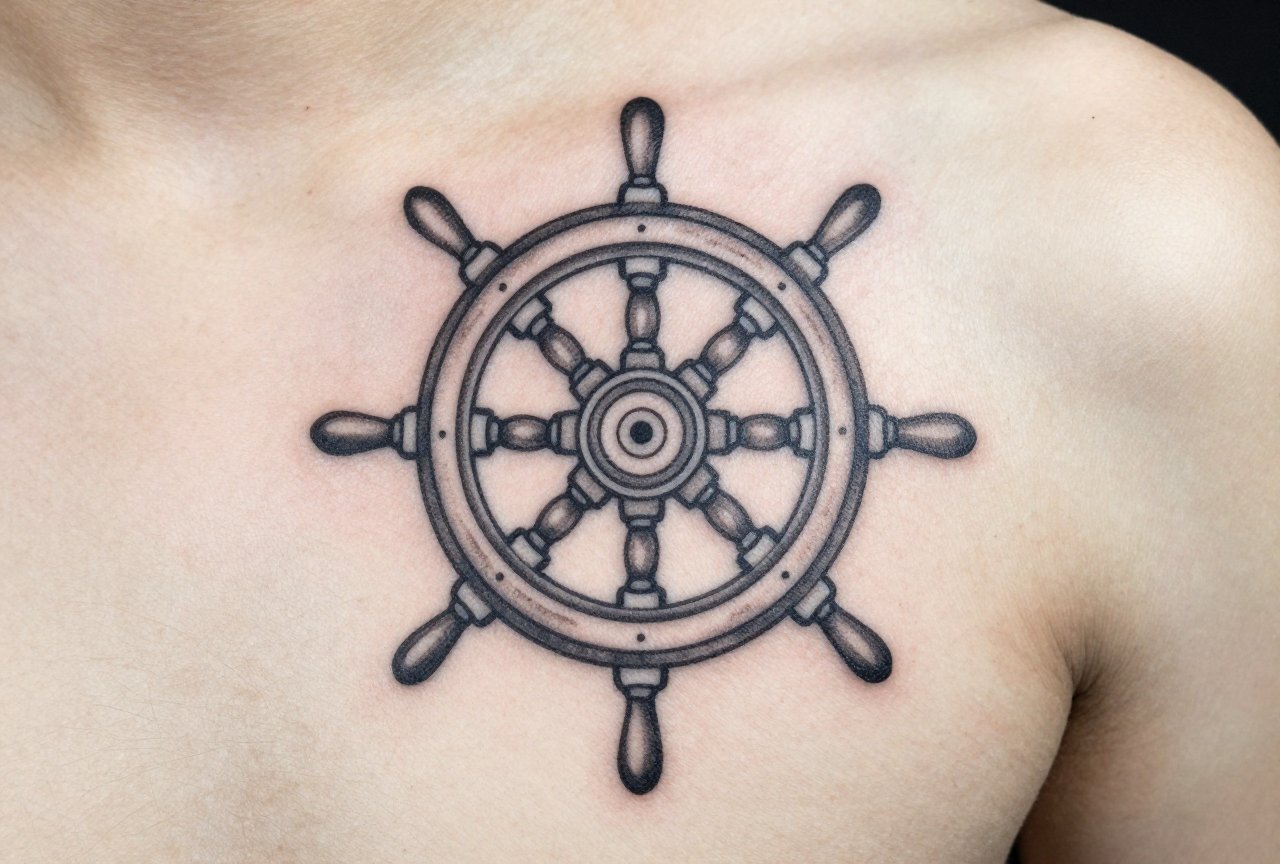
Chest, centered: The wheel over the heart. Popular with people who have come through cardiac events or who are making a commitment to self-governance. Needs to be large enough, at least four inches, or the spokes crowd together.
Upper back, between shoulder blades: The captain’s station. Holds detail well, protected from sun. Works for actual mariners and for people who need the metaphor equally.
Thigh: Underrated. Flat plane, good for larger pieces with surrounding ocean or map work. Healing is easier here than on joints; less movement, less scabbing.
Hands and fingers: Generally not advised. The wheel’s complexity does not miniaturize well. Finger wheel tattoos often become black smudges. If you must, use the simplest spoke silhouette, expect fallout, and plan for eventual cover or removal.
Who Chooses This Design
The Range of Stories
The demographic surprises people. Navy veterans, Coast Guard, merchant marine, yes. But also social workers recommitting after burnout, people transitioning, entrepreneurs leaving corporate jobs. The wheel does not belong to one narrative.
Older clients sometimes get wheels after a spouse’s death, after decades of shared decision-making. The wheel marks learning to choose alone. Younger clients often want wheels with parent names or dates, the generational handoff of guidance. That particular style has declined; more people now choose the wheel for themselves, not as tribute. That shift says something about how current culture thinks about agency.
Some traditional artists side-eye wheels on non-sailors. That attitude is gatekeeping. Symbols belong to whoever needs them. But knowing the maritime history shows respect. The wheel meant something specific before it meant something general. Both layers can coexist.
Related Symbols
How They Differ
Clients often waver between the wheel and related imagery. Each carries distinct emphasis:
- Compass: Searching, finding direction. Less active than the wheel. Good for people in transition, not yet committed to a path.
- Anchor: Staying put, stability, home. The opposite motion of the wheel. Pair them if you want both messages.
- Map or chart: The territory, the plan. Complements the wheel well; the wheel is the action, the map is the context.
- North Star: Fixed guidance, external. The wheel is internal control. Star says follow this; wheel says I turn.
- Ship itself: The vessel, the body, the journey. Larger commitment, more narrative room. The wheel is the decisive moment within the longer voyage.
Some clients combine elements: wheel and compass as a half-sleeve, wheel emerging from storm waves on a chest piece. The best designs let each element do its specific work. Do not pile symbols until they cancel each other out.
What to Remember
A ship wheel tattoo carries the weight of actual wooden wheels, actual storms, actual hands gripping through spray and darkness. It is not abstract. That is why it endures. The style has cycled through revivals, traditional, neo-traditional, fine line minimalism, and the wheel never drops out completely. It adapts because the meaning is structural, not stylistic.
If you are considering one, sit with the question: what are you steering through, or away from, or toward? The answer does not need to be dramatic. Some of the most resonant wheels mark quiet moments when someone realized they could choose their own speed. The tattoo does not have to announce a crisis. It can mark an ordinary Tuesday when you finally understood you were holding the helm.
Frequently Asked Questions
Does a ship wheel tattoo require nautical background to be meaningful?
No. The symbol has expanded beyond its maritime origins. Knowing the history adds depth, but the wheel now belongs to anyone who connects with its core meaning of self-direction and control.
How large should a ship wheel tattoo be?
For traditional styles, at least two to three inches across to preserve spoke detail. For realistic work with wood grain and brass, minimum palm-size. Fine line wheels can start smaller but will need touch-ups to maintain definition.
What is the difference between a wheel and compass tattoo?
A compass represents searching and finding direction. A wheel represents active control and decision-making. The compass is about orientation; the wheel is about action.
Do ship wheel tattoos age well?
Traditional bold-line wheels age best. Realistic detail can blur over time, especially in the central area. Fine line wheels require the most maintenance. Placement on low-friction, low-sun areas helps longevity.