
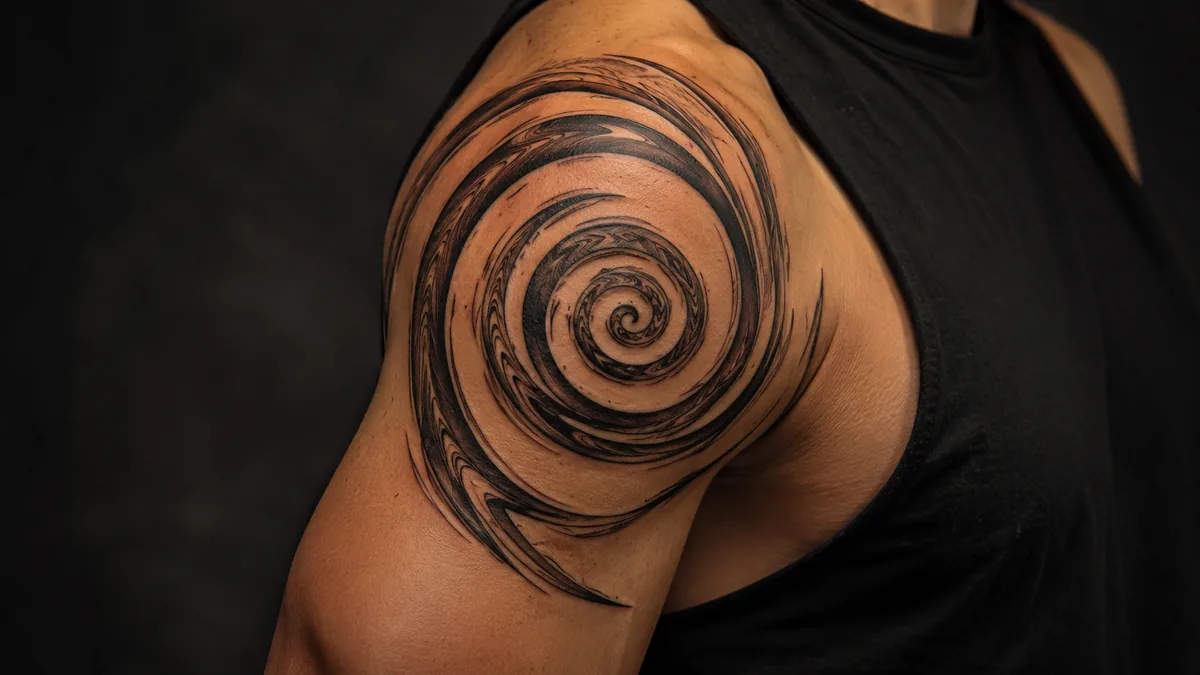
The spiral is one of the oldest symbols humans ever scratched into stone, and it still hits just as hard on skin. a spiral tattoo is about movement. Growth, change, cycles, the endless push forward. It’s not complicated, but it’s deep.
People get spirals for a hundred different reasons, and the design can carry completely different weight depending on who’s wearing it and how it’s built. Here’s what the spiral actually means, where it comes from, and how to get one that holds up for life.
Core Meaning: Growth, Change, and Cycles
The spiral’s primary meaning is evolution. The shape itself is motion. It starts at a center point and keeps expanding outward, which is why so many people connect it to personal growth, the journey of life, or moving through difficulty into something bigger. It’s not a symbol of arrival. It’s a symbol of the process.
The second big read is cycles. Nature runs in spirals: seasons, tides, birth and death. A lot of people who get a spiral tattoo are acknowledging that life doesn’t move in a straight line. It circles back, it deepens, it expands. That’s not weakness. That’s just how things actually work.
Cultural and Historical Roots
A spiral never ends where it began, neither do you.
Spirals show up across ancient cultures with striking consistency. Celtic culture is probably the most recognized. The triple spiral, called the triskelion or triskele, appears on megalithic sites like Newgrange in Ireland, dating back over 5,000 years. For the Celts, the spiral was tied to the sun, water, and the afterlife. Three spirals connected often symbolized land, sea, and sky, or birth, death, and rebirth.
In Maori culture, the koru is a spiral based on the unfurling fern frond. It represents new life, growth, strength, and peace. It’s a genuinely sacred symbol, so if you’re not Maori, it’s worth understanding that weight before you commit. Native Hawaiian and other Polynesian cultures also used spiral motifs in traditional tattooing to mark identity, status, and connection to nature.
The Fibonacci Spiral and Sacred Geometry
The Fibonacci spiral, also called the golden spiral, has become one of the most requested spiral designs in shops over the last decade. It’s based on the Fibonacci sequence, a mathematical pattern that appears in seashells, sunflowers, hurricanes, and galaxies. People who get this version are usually drawn to the idea of natural order, universal pattern, or the hidden structure underneath everything.
It reads as an intellectual tattoo without being pretentious about it. The geometry is just clean and satisfying to look at. Done in fine line black and grey it can be incredibly crispy and precise. Done bold, it holds like a rock. It works for people who want meaning that’s grounded in something real, something provable, not mythology.
Popular Design Variations and Styles
Single line spirals are minimalist and elegant. They work great in fine line, and they age decently in low-wear zones if the line weight is right, not too thin or it’ll ghost out. The triskelion is a step up in complexity and reads strong from across the room. Blackwork triskelions are especially bold. Dotwork and geometric spirals have been popular for years and still look solid when executed cleanly.
Galaxy spirals bring in the cosmic angle, incorporating stars or nebula textures into the swirl. Floral spirals wrap botanical elements into the curve. Some clients incorporate the spiral as a structural element inside a larger sleeve or back piece, using it to direct the eye. Watercolor spirals exist but age rougher than solid black. If you want color, keep it saturated and contained with a solid outline so it doesn’t bleed into a blur over time.
Black and Grey vs. Color
Black and grey is the dominant choice for spiral tattoos, and for good reason. The geometry reads clean, the contrast stays strong, and a well-executed black spiral heals nice and holds for decades. Whip shading inside the curve can add real dimension without overcomplicating the design. Fine line black and grey spirals on lighter skin can look almost architectural when fresh.
Color opens up options but adds risk. Deep navy, forest green, or burgundy integrated into a spiral can look stunning and still hold reasonably well compared to pastels. Avoid putting delicate color in high-wear areas like hands, fingers, or inner wrist where the lines and saturation will break down faster. If color is the goal, your artist’s pigment quality and your aftercare routine matter more than usual.
Best Placements and How It Ages
The spiral shape is versatile. It fits a tight circle, so spots like the wrist, ankle, back of the neck, shoulder, chest, and behind the ear all work well. Larger spiral compositions, especially triskelions or Fibonacci designs, sit beautifully on the upper arm, calf, or shoulder blade where there’s real estate to let the geometry breathe. The back and thigh are great for anything ambitious.
For aging, avoid finger and hand placements for fine line spirals. Those zones get constant friction, sun, and washing, which means even a clean crispy spiral will blur and fade faster than on a low-wear zone. Inner arm and ribcage are spicy but low-wear, so they hold better. Stick to bold will hold as your guiding rule: a spiral with confident line weight will still read clean in twenty years. A hairline fine line spiral in a high-wear spot won’t.
Who Gets Spiral Tattoos and How to Make It Personal
Spiral tattoos attract a wide range of people. You’ve got the person coming out of a rough chapter, a breakup, illness, a loss, who sees the spiral as proof they kept moving. You’ve got the person drawn to Celtic or Maori heritage who wants something that connects them to where they come from. You’ve got the science nerd who loves the Fibonacci sequence and wants math on their skin. All of those are valid.
To make it personal, talk to your artist about what the spiral means to you before they touch paper. Placement, size, line weight, whether it opens clockwise or counterclockwise, what elements you add around it, all of that can shift the feeling of the piece significantly. A spiral with a small moon, a wave, or a specific botanical element tied into it tells a more complete story than a standalone shape. Give it context and it becomes yours.









