History & Cultural Roots
Florida’s image in tattoo culture emerged gradually, shaped by migration patterns and the state’s evolving identity. What began as regional pride among sailors and fishermen in the early 20th century has transformed into something far more layered. The peninsula’s geographic isolation, surrounded by water on three sides, created a distinct visual vocabulary that tattoo artists still draw from today.
Native Seminole and Miccosukee imagery often appears in Florida-themed work, though this usage demands careful consideration. Traditional patchwork designs, originally sewn into clothing, occasionally translate into tattoo form. However, these patterns carry specific clan and family significance. Appropriation concerns arise when artists reproduce these motifs without understanding their ceremonial context. Respectful incorporation typically involves consultation with tribal members or focusing on broader natural imagery rather than sacred geometric arrangements.
Regional Tattoo Traditions
South Florida developed its own aesthetic through Cuban and Caribbean immigration. The confluence of Latin American tattoo styles with existing American traditional work produced distinctive approaches to palm trees, ocean waves, and tropical birds. Meanwhile, northern Florida maintained closer ties to Southern American tattoo conventions, favoring alligators and cypress trees in bolder, more graphic treatments.
Key historical elements include:
- 1920s-1940s: Sailor tattoos featuring Florida as destination port
- 1950s-1960s: Space Coast imagery following NASA establishment
- 1970s-1980s: Tourism-inspired flash art for beach town shops
- 1990s-present: Environmental and conservation-focused designs
Common Variations & Styles
Florida tattoos span an enormous range of execution styles, from photorealistic to highly abstracted. The choice of approach significantly alters how the same subject reads on skin.
American traditional remains dominant for classic Florida iconography. Thick black outlines, limited color palettes, and bold shading suit alligators, oranges, and vintage motel signs exceptionally well. This style ages predictably, maintaining legibility as the tattoo settles into skin over decades.
Black-and-grey realism excels for depicting specific locations, the intricate architecture of the Biltmore Hotel, or detailed wildlife portraits. Mangrove root systems, with their complex interweaving, particularly benefit from this approach. The technique demands experienced artists; poor execution results in muddy, indistinguishable masses within a few years.
Placement Considerations
Size and location dramatically affect which Florida motifs succeed. Small tattoos (under three inches) favor simplified shapes: a single orange, a minimal wave curl, the state’s distinctive outline. Larger pieces accommodate complex scenes: Everglades panoramas, multiple species interactions, or layered historical references combining Spanish colonial and modern elements.
- Forearm and calf: Ideal for vertical compositions like cypress trees or lighthouses
- Back and chest: Accommodate panoramic Florida scenes with horizon lines
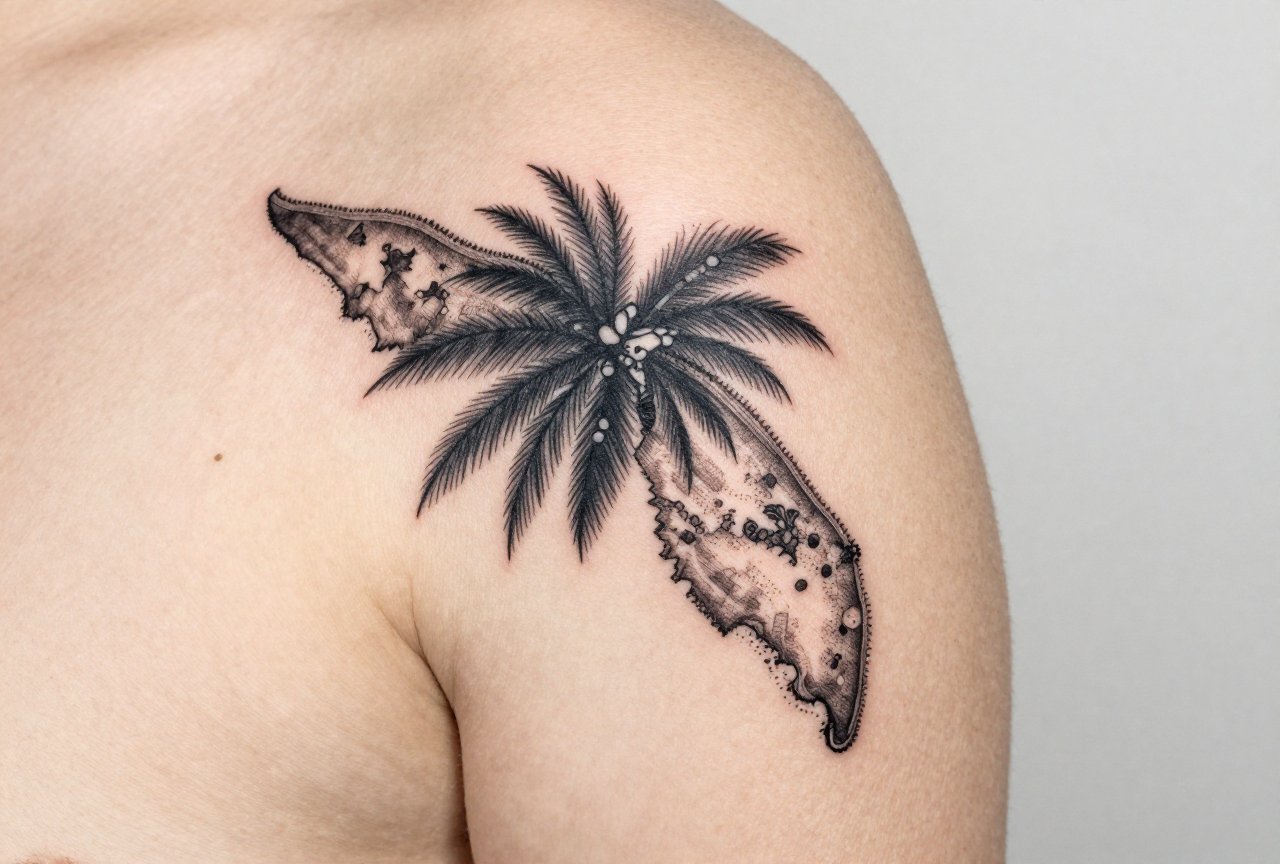
- Ribs and upper arm: Suit the state’s elongated shape as standalone geography
- Hands and feet: Small, bold icons only; detail will blur rapidly
Symbolism & Core Meaning
Florida imagery carries accumulated symbolic weight that transcends simple location marking. Understanding these layers helps in selecting appropriate elements and avoiding unintended messages.
The peninsula shape itself functions as shorthand for multiple concepts: escape, reinvention, boundary-dwelling, the liminal space between land and sea. Unlike more geometric state outlines, Florida’s recognizable silhouette requires no label for identification, making it unusually versatile as symbolic geography.
Specific natural elements carry established associations:
- Alligators: Primal resilience, ancient lineage, hidden danger beneath calm surfaces
- Manatees: Gentleness, vulnerability, the overlooked and underestimated
- Orange blossoms: Fertility and prosperity, though also the agricultural exploitation underlying Florida’s development
- Sawgrass: Endurance, sharp edges protecting fragile ecosystems
- Space shuttle imagery: Human ambition, technological aspiration, the specific optimism of mid-century America
Color choices modify these readings significantly. Saturated oranges and teals suggest tourist-brochure nostalgia, while muted earth tones evoke the actual experience of Florida’s interior landscapes, the dust and humidity and subdued palettes of undeveloped areas.
Personal & Modern Meanings
Contemporary Florida tattoos increasingly reflect individual relationships with the state’s complicated present rather than generic sunshine mythology. This shift parallels broader tattoo culture’s movement toward personal narrative over received symbolism.
Climate anxiety appears with growing frequency. Rising sea levels, hurricane tracking maps, and bleached coral motifs express specific environmental concern rather than celebration. These designs often incorporate data visualization elements, tide gauge readings, or satellite imagery of coastline erosion. The aesthetic can feel stark, deliberately uncomfortable, challenging the viewer to recognize loss beneath familiar forms.
Conversely, some choose Florida imagery to mark survival, hurricane tattoos documenting specific storm experiences with coordinates, dates, or wind speed records. These function as memorials and triumph markers simultaneously, the trauma and the endurance intertwined in the same image.
Identity and Belonging
For transplants and natives alike, Florida tattoos increasingly negotiate questions of authenticity and belonging. The “Florida Man” phenomenon, initially mockery, has been reclaimed by some as regional identity pride, deliberately absurd compositions celebrating the state’s reputation for bizarre news. Others reject this entirely, seeking imagery that counters stereotype with underrepresented aspects: the state’s scientific research stations, its literary history, its complex immigrant communities.
Second-generation Floridians particularly grapple with these tensions, their tattoos often hybrid compositions connecting family origin elsewhere with present location, Cuban flags merging with palmetto fronds, Haitian veve symbols incorporating mangrove ecology.
Mythology & Folklore
Florida’s supernatural landscape offers rich, underutilized tattoo material distinct from better-known national folklore. These images carry regional specificity that resonates with those who grew up immersed in these stories.
The Skunk Ape, Florida’s sasquatch analogue, inhabits swamp and scrubland rather than forest. Descriptions emphasize swamp gas, sulfur smell, red eye-shine. As tattoo subject, it offers more ambiguity than the Northwestern bigfoot, its environment more threatening, its existence more debated even among enthusiasts. Designs range from comic cartoonish to genuinely unsettling, the figure half-submerged in black water.
St. Augustine’s ghost lore, the oldest city’s accumulated haunting stories, occasionally translates into tattoo form. The Castillo de San Marcos, the lighthouse, specific inn facades, these appear as architectural tattoos with subtle spectral suggestion: a figure in a window, an unexplained light source, a slight distortion in perspective suggesting unreliability of memory and perception.
- The Fountain of Youth: Often rendered ironically, Ponce de León’s quest as commentary on modern anti-aging obsession
- Calusa shell mound imagery: Sacred geometry, the accumulated weight of indigenous presence, often linked to mound-building cultures across the Southeast
- Shipwreck and treasure motifs: The literal and metaphorical, lost wealth and lost history beneath Florida’s waters
Modern folklore also proliferates: the “Florida room” as psychological space, the particular quality of light before afternoon thunderstorms, the specific social dynamics of gated communities. These resist literal depiction but inspire abstracted or symbolic approaches.
Cost Factors
Florida-themed tattoo pricing follows standard variables with several regional particularities worth anticipating.
Artist location within Florida significantly affects rates. Miami and South Beach command premium pricing, established artists often charging $200-$400 hourly with substantial minimums. Orlando and Tampa offer somewhat reduced rates with comparable quality. Smaller Gulf Coast and Panhandle towns may provide excellent value, though artist selection narrows considerably outside metropolitan areas.
Tourist destination shops, particularly in Key West and beach towns, sometimes apply “vacation premium” pricing. Research local artists before travel, or wait until return home for better value. Conversely, visiting artists from elsewhere occasionally guest-spot in Florida shops, offering access to styles unavailable locally.
Complexity and Time Estimates
- Simple Florida outline, single color, small: $100-$250, 1-2 hours
- Detailed wildlife portrait, color, palm-sized: $400-$800, 3-5 hours
- Full sleeve incorporating multiple Florida elements: $2,000-$5,000, multiple sessions over months
- Photorealistic landscape, back piece: $3,000-$7,000, 15-30 hours
Color saturation demands particular attention for Florida imagery. The bright oranges and greens that read as “Florida” require more ink saturation, more sessions, and consequently higher cost than muted alternatives. These colors also fade faster in sun-exposed skin, a genuine concern given Florida’s climate and the typical placement of such tattoos on visible areas.
Touch-up policies vary; clarify whether future color refreshing is included in initial pricing or billed separately. Many artists offer complimentary touch-ups within six months for line work issues, but charge for color refreshing necessitated by lifestyle and sun exposure.
Before You Decide
Several considerations specific to Florida imagery deserve final reflection.
Seasonal timing matters practically. Fresh tattoos require sun avoidance during healing; planning around Florida’s intense summer UV makes sense. Winter and early spring sessions allow healing before peak exposure. The humidity also affects healing, potentially extending the delicate phase requiring careful after attention.
Consider whether your Florida connection is permanent or transitional. The state’s demographic fluidity, constant influx and outflow of residents, makes location-based tattoos potentially bittersweet for those who leave. Some choose imagery broad enough to transcend pure geography, the natural elements that exist elsewhere but concentrate particularly in Florida experience.
Finally, examine whether your chosen imagery reinforces or challenges existing Florida stereotypes. Neither choice is inherently superior, but intentionality matters. The same alligator tattoo reads differently as ironic commentary, genuine wildlife appreciation, or unexamined regional cliché. Understanding your own positioning clarifies design decisions and ensures the tattoo continues to satisfy as context and self-understanding evolve.
Frequently Asked Questions
How do I choose between realistic and stylized Florida imagery?
Consider your long-term visual preference and the artist’s demonstrated strength. Realism demands exceptional technical skill and ages differently than bold traditional work. Stylized approaches offer more flexibility in combining multiple elements and typically maintain clarity longer. Examine healed examples of your prospective artist’s work in both approaches, not just fresh tattoos.
Are there cultural sensitivity concerns with Florida-themed tattoos?
Yes, particularly regarding Seminole and Miccosukee imagery. Traditional patchwork patterns carry specific clan significance. Avoid reproducing sacred or ceremonial designs without genuine cultural connection. Broader natural imagery, alligators, palmettos, specific landscapes, generally avoids these concerns while still expressing Florida connection.
How does Florida’s climate affect tattoo healing and longevity?
Intense UV exposure and high humidity both impact tattoos. Sun fades pigment rapidly, particularly the bright oranges and teals common in Florida imagery. Plan healing during lower-UV months when possible. Long-term, consistent sunscreen application becomes essential maintenance, not optional care. Humidity can extend the delicate healing phase, requiring extended attention to moisture balance and infection prevention.
What makes Florida tattoo imagery distinct from general tropical or beach themes?
Specific geographic and historical elements: the peninsula shape itself, Space Coast references, Everglades-specific ecology like sawgrass and mangrove root systems, St. Augustine’s colonial architecture, the particular quality of Gulf versus Atlantic coastal light. Generic palm trees and sunsets could locate anywhere; successful Florida imagery incorporates elements impossible to mistake for Hawaii, California, or Caribbean locations.