
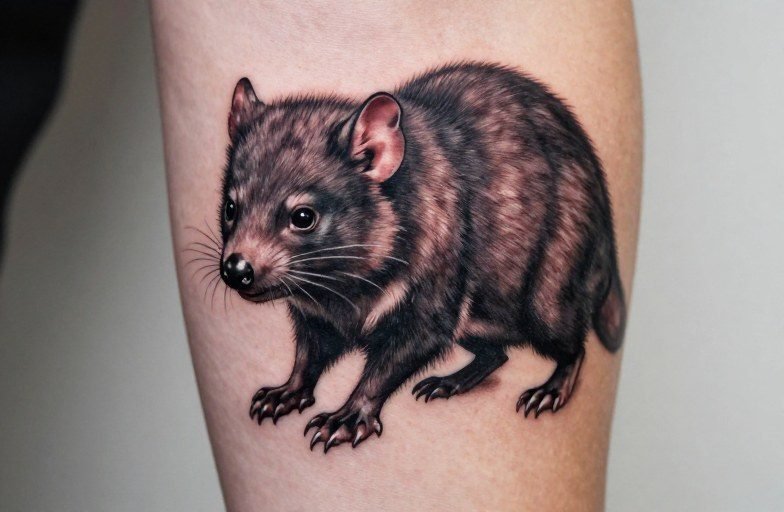
The Tasmanian devil tattoo carries a split personality: the real marsupial represents tenacious survival, ferocity when cornered, and an animal that simply refuses to die out despite disease and habitat loss. The cartoon version, spun from Warner Bros. animation, channels chaotic energy, comic aggression, and pop-culture nostalgia. Most people choose one lane or the other, though some designs merge both. Either way, this is a tattoo about refusing to back down.
Similar & Related Symbols
Animals with comparable symbolic weight tend to cluster around themes of righteous anger, underdog resilience, or trickster chaos. The wolverine matches the Tasmanian devil for reputation, small, stocky, disproportionately vicious when threatened. Badgers occupy similar territory. For cartoon energy, the classic Looney Tunes menagerie offers obvious parallels: Taz shares DNA with the perpetually frustrated Wile E. Coyote and the whirlwind destruction of the Tasmanian Devil’s spin.
Real Animal vs. Animated Counterparts
Biologically accurate devil tattoos sometimes pair with other Australian endemics, thylacine (extinct, hauntingly similar underdog status), quokka (ironic contrast), or echidna. The cartoon path opens to broader pop-culture mashups: sports mascots, vintage animation aesthetics, crossover characters. The two approaches rarely mix well in one piece unless the artist deliberately bridges them, say, a realistic devil mid-transformation into its animated counterpart, or vice versa.
- Wolverine/badger: comparable ferocity-to-size ratio
- Thylacine: extinct Tasmanian sibling, shared conservation narrative
- Classic cartoon spin characters: shared visual grammar of motion lines and dust clouds
- Chaos/trickster archetypes: coyote, Loki figures, punk iconography
Color vs Black and Grey
Color dominates cartoon Taz pieces, Browns, tans, and that specific dusty olive from the animation cels. The palette reads immediately as nostalgic, even when rendered with modern saturation. Realistic devil tattoos in color lean toward nocturnal tones: deep browns, black fur with chestnut highlights, pinkish ears and muzzle. The animal’s actual coloration is fairly uniform, so color in realistic pieces tends to serve lighting and dimension rather than symbolic contrast.
Black and Grey Realism
Realistic black and grey devil tattoos age cleaner and carry more menace. The heavy jaw, the carnivore teeth, the dense fur texture, all translate powerfully through value contrast without hue. This approach suits larger pieces where the animal’s actual musculature and scarring (devils fight constantly, and their faces bear the marks) become narrative details. For smaller tattoos, black and grey prevents the muddiness that color sometimes suffers as it settles.
Cartoon Line Work
Bold traditional-style outlines with limited color fill honor the source material’s vintage animation roots. Think thick black contours, cel-shaded color blocks, minimal blending. This style holds up exceptionally well over decades because it was literally designed for reproduction and visibility at small scale.
Mythology & Folklore
European settlers named the animal for its unearthly vocalizations, screams, growls, and guttural coughs that carried through the Tasmanian bush at night. The name itself created a folkloric identity before science could catch up. Aboriginal Tasmanian cultures had their own relationships with the species, though specific public-domain mythological narratives are limited due to colonial disruption and the sensitivity of cultural knowledge.
The “Devil” Name and Its Afterlife
The diabolical branding stuck. By the mid-20th century, the animal occupied a niche alongside hyenas and wolves as creatures unfairly typecast by human superstition. That very typecasting became available for tattoo subversion: reclaiming the “devil” label as badge of outsider pride, punk affiliation, or simply refusing the polite constraints of domesticated animal symbolism. No lions, no noble stags, just a screeching scavenger that survives.
Common Variations & Styles
Placement shapes the design more than most animal tattoos. The devil’s compact, powerful build suits shoulders, thighs, and upper arms where the rounded muscle groups echo its stocky frame. The spinning cartoon tornado needs vertical space, forearms, calves, ribs, to read as motion rather than static scribble. Chest pieces work for either approach but demand scale; a small devil on a large chest looks lost.
The Classic Taz Spin
The tornado of limbs and dust defines cartoon Taz. Artists render this as everything from minimalist line-trails to fully realized environmental scenes with debris, background characters reacting, or vintage TV static borders. The spin itself becomes a frame for other imagery, sports logos, band names, personal iconography caught in the vortex. This variation demands an artist comfortable with dynamic composition; static spin tattoos look like hairballs.
Portrait and Action Poses
Realistic devils work as snarling head portraits, full-body stalking poses, or defensive postures with raised hackles. The yawn, actually a fear response, not aggression, makes for visually striking open-jaw shots. Some collectors choose the animal at rest, mouth closed, eyes alert: the calm before the confrontation. This subtler approach reads as confidence rather than performative toughness.
- Head portrait: heavy jaw focus, scar detail, intense eye contact
- Full body: compact power, claw emphasis, tail as compositional element
- Cartoon action: spin dynamics, environmental interaction, period-accurate styling
- Hybrid/mashup: realistic animal with cartoon elements, or vice versa
Religious & Spiritual Angles
The “devil” naming invites obvious diabolical association, though most collectors don’t pursue this sincerely. More commonly, the tattoo functions as ironic commentary, wearing the devil label that others might apply. Some Christian collectors explicitly reject this, choosing instead to emphasize the animal’s created nature, its ecological role as cleanup crew and disease survivor. The Tasmanian devil’s actual behavior (monogamous pair bonds, communal feeding, maternal care) contradicts the solitary monster myth, and some designs deliberately highlight this dissonance.
Survival and Conservation Spirituality
Facing extinction from facial tumor disease, wild devils have become conservation icons. Tattoos supporting this narrative sometimes incorporate scientific imagery, microscopic cell patterns, geographic coordinates of Tasmanian wilderness, or the orange nonprofit campaign colorways. This angle shifts meaning from personal ferocity to collective responsibility, from individual survival to species persistence. The spiritual register becomes stewardship rather than dominance.
Design Tips & Pairings
Text pairings with devil tattoos risk cliché. “Taz” in the cartoon font works for dedicated nostalgia pieces. Beyond that, consider what the animal actually does: scavenging, fighting, surviving, raising young. Phrases about endurance, about being underestimated, about noise versus bite, these align better than generic toughness slogans.
Complementary Imagery
Tasmanian wilderness flora (snottygobble, leatherwood, button grass) grounds realistic pieces in actual habitat. For cartoon Taz, period-accurate backgrounds, 1950s television sets, drive-in theaters, vintage cereal boxes, deepen the nostalgia operation. Crossover pairings with other Warner characters require legal caution for commercial tattoo work, but personal collection pieces frequently feature Taz alongside other animated antiheroes.
Technical Considerations
The devil’s black fur challenges ink longevity. Solid black fills can blow out or soften into grey blobs over years. Experienced artists break up large black areas with texture, negative space, or color variation. The pink muzzle and ears in realistic pieces need careful saturation, too light and they disappear into surrounding skin; too heavy and they look inflamed rather than natural. Cartoon Taz’s brown body presents fewer technical problems but still benefits from variation in tone to prevent flatness.
- Line weight: heavier for cartoon, varied for realistic fur texture
- Black saturation: avoid solid pools, use stippling or texture breaks
- Scale minimum: head portraits need palm-sized area minimum for detail
- Spin dynamics: motion lines require confident, continuous linework
Final Thoughts
The Tasmanian devil tattoo offers a rare dual register: genuinely interesting animal with underappreciated ecology, and genuinely iconic cartoon with generational recognition. The choice between them says something about what you want your ferocity to look like, documentary or animated, observed or performed. Either way, this is not a subtle tattoo. The animal screams. The cartoon spins. Both demand space and commitment, and both reward an artist who understands if you’re after biological accuracy or pop-culture velocity. Know which devil you’re carrying before the needle touches skin.
Frequently Asked Questions
Does a Tasmanian devil tattoo always reference the cartoon character?
Not at all. Many collectors choose biologically accurate devils for their conservation story, underdog resilience, or Australian heritage. The cartoon and real animal have diverged into nearly separate tattoo categories.
How well does a detailed Taz tattoo age over ten years?
Bold-line cartoon versions age excellently. Realistic pieces with heavy black depend on placement and sun exposure, areas with frequent friction or UV exposure will soften faster. Expect touch-ups regardless.
Is the Tasmanian devil culturally significant for Aboriginal Tasmanians?
Specific cultural protocols and knowledge around the species remain protected within Tasmanian Aboriginal communities. Most public tattoo references draw from settler naming, European folklore, or modern conservation rather than Indigenous narrative.
What’s the most common placement regret with this design?
Small cartoon Taz tattoos on large body areas often look like stickers rather than integrated pieces. The compact animal needs proportional context, either tight framing or sufficient surrounding detail to justify its scale.
Related Tattoo Meanings
- English Tattoo Meaning: Language, Heritage, and Ink
- Perseverance Tattoo Meaning: Symbols of Endurance
- Meanings List Tattoo Meaning: Cataloging Symbolism in Ink
- Explore more









