
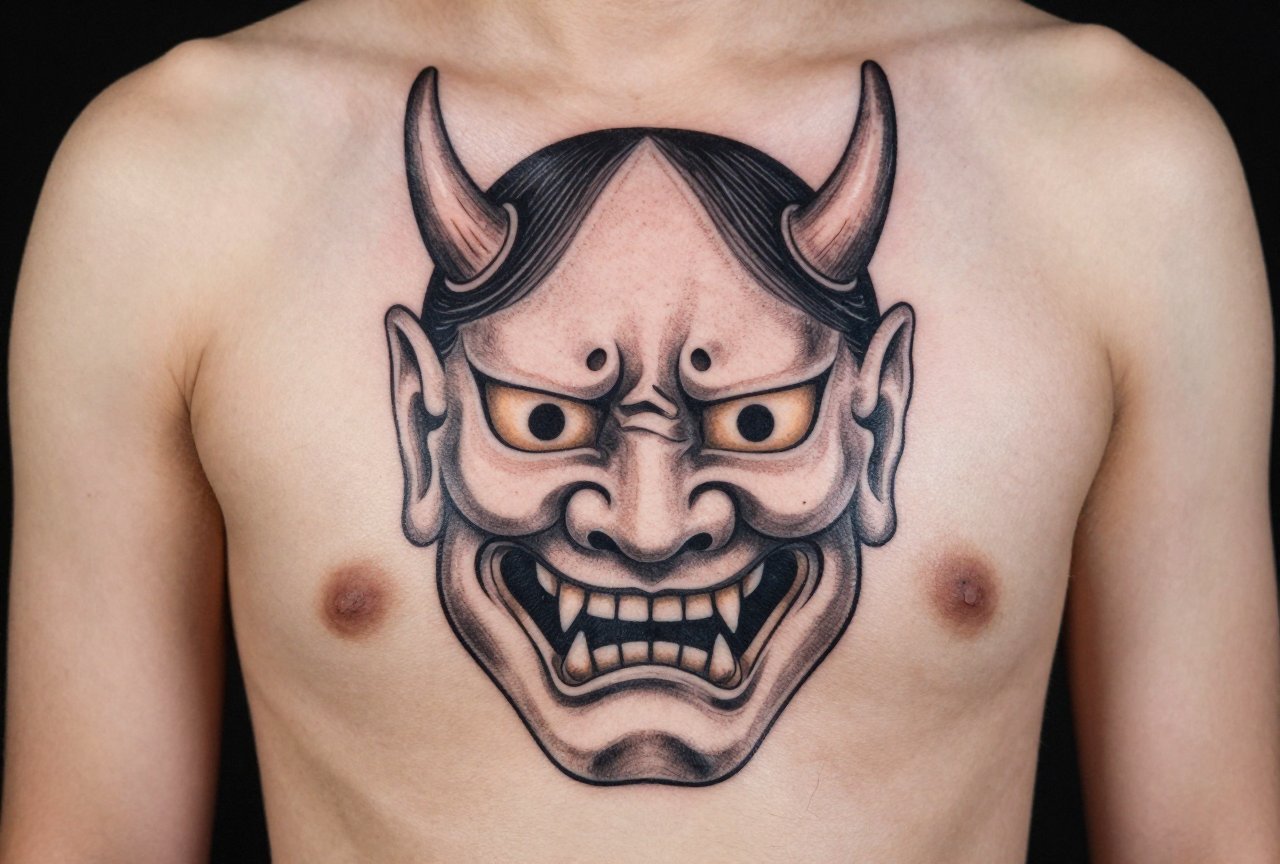
A tengu mask tattoo represents the duality of the tengu spirit, part warrior, part trickster, part protector. In Japanese folklore, tengu are supernatural beings that live in mountains and forests, and their iconic red faces with long noses speak to power, discipline, and transformation. When someone sits in my chair asking for this design, they’re usually drawn to something deeper than aesthetics; they want the weight of that symbolism etched into their skin.
Symbolism & History
I’ve tattooed tengu masks on bikers, software engineers, martial artists, and people who just found the image haunting. The meaning shifts with each person, but the core stays solid. Tengu started as demons in early Japanese Buddhism, creatures to be feared, disruptors of temples and monks. Over centuries, they morphed into something more complex: protectors of mountains, teachers of martial arts, fierce but honorable spirits.
That evolution matters for the tattoo. You’re not just getting a scary face. You’re carrying a symbol of transformation from destructive force to disciplined guardian. I’ve had clients tear up explaining how that mirrors their own recovery, their sobriety, their military service. The mask compresses all that into something visual, immediate, visceral.
The Long Nose & Red Face
The exaggerated nose isn’t random. It connects to the tengu’s origin as a critique of arrogant priests, those who “looked down their noses” at others. In tattoo form, it becomes a reminder to stay humble even as you grow powerful. The red face? That’s theatrical, kumadori makeup from Noh and Kabuki, signaling intensity and supernatural presence. On skin, that red ages beautifully if saturated properly, but it demands a skilled hand. I’ve seen cheap tengu masks fade to pink blobs because the artist didn’t pack the red deep enough.
From Demon to Dharma Protector
By the Edo period, tengu were venerated as skilled warriors who taught Minamoto no Yoshitsune swordsmanship. That martial lineage appeals to fighters, soldiers, anyone who’s had to cultivate violence for protection. The mask becomes a badge: I contain something dangerous, but I direct it. I tell clients who train MMA or work security that this resonates particularly hard. It’s not about aggression; it’s about controlled force.
Common Variations & Styles
Not all tengu masks look identical in tattoo form, and the style you choose changes how the meaning reads.
- Traditional Japanese (Irezumi): Bold lines, heavy saturation, often paired with wind bars, cherry blossoms, or maple leaves. This reads as classic, respectful, connected to the source. The mask might be one element in a larger back piece or sleeve narrative.
- Neo-Japanese / illustrative: Softer lines, more experimental color, teals, purples, golds. I’ve done tengu with cracked porcelain textures, cyberpunk circuitry woven through. These attract younger clients who want the symbolism without the full traditional commitment.
- Black and grey realism: Photographic, dramatic lighting. The mask becomes almost sculptural, like a museum piece on skin. This style emphasizes the object’s physicality over its cultural context. Works beautifully on forearms and calves where the 3D effect pops.
- Minimalist / line work: Just the essential contours, nose, brow, maybe the grimace. Stripped down, it becomes more personal, less theatrical. Good for smaller placements, first tattoos, people who want private meaning rather than public declaration.
The feathered fan (hauchiwa) sometimes appears alongside the mask. Tengu use it to control winds, fan flames, or grant swiftness. Including it adds layers: mastery over chaos, the ability to stir or settle. I once tattooed a tengu mask with a broken fan for a client leaving an abusive relationship. The symbolism wrote itself.
Best Placements
Where you put this tattoo changes its impact and how it ages.
High Visibility: Chest, Thigh, Outer Arm
The chest gives the mask room to breathe, literally, the sternum and pectorals provide a natural canvas for the face’s symmetry. I’ve seen tengu masks placed dead center, staring out, unflinching. That’s power. The thigh offers similar real estate with less bone proximity, so the session hurts less, and the skin stays more stable over time. Outer arm (bicep to forearm) is classic for Japanese work; it flows into sleeves, integrates with other elements.
Intimate or Concealed: Ribs, Back of Neck, Calf
Ribs hurt. Everyone knows this. But the tengu mask on ribs, partially hidden, feels like a secret strength. I’ve tattooed this placement on people who’ve survived assault, who want the protection near their core but not on display. The calf rounds nicely, lets the nose project forward in 3D space. Back of neck is bold, almost confrontational, can’t hide it, can’t soften it.
Line work versus shading matters for longevity. Fine lines on fingers or wrists blur within years; tengu masks need detail to read. I steer clients away from palm-sized tengu faces unless they’re willing to accept touch-ups. The nose especially, if those lines blow out, you’ve got a blob, not a guardian.
Who Chooses This Tattoo / Personal Meanings
In my chair, the tengu mask attracts specific personalities. Not exclusively, but noticeably.
- Martial artists: They know the tengu as the secret teachers of swordsmanship. The mask honors their training lineage, their dojo, their personal discipline.
- People in recovery: The transformation from demon to protector maps onto their own story. I’ve heard this dozens of times. The mask becomes proof of change.
- Japanese heritage clients: Reconnecting with roots, sometimes rebelliously, tengu are outsiders, not mainstream symbols like koi or dragons. There’s pride in choosing the less obvious.
- Those who’ve faced violence: Survivors of combat, assault, abusive systems. The tengu’s ferocity resonates. They want to carry that warning, that boundary.
One client, a firefighter, got the tengu because tengu control flames. Another, a programmer, loved the trickster aspect, the bug-hunter, the one who finds what others miss. The meaning bends without breaking. That’s the mark of a symbol worth wearing.
Similar Symbols
Clients often consider other Japanese masks before settling on tengu. Understanding the difference helps.
- Oni masks: Horned demons, more purely destructive. Less nuance, more raw aggression. Good for people who want to emphasize the battle, not the transformation.
- Hannya masks: Jealous female spirits, tormented love. The tengu’s emotional register is different, pride, discipline, wildness, not romantic anguish.
- Okame / Hyottoko: Comic folk masks, playful, auspicious. Tengu carries weight these lack. You wouldn’t confuse the energy.
- Foo dogs: Guardians, but stationary, protective of places. Tengu roams, teaches, tests. More active, less static.
I’ve had clients combine tengu with hannya in sleeves, representing internal conflict, the disciplined warrior versus the tormented lover. The mask dialogue creates narrative depth that single images can’t achieve.
Final Thoughts
The tengu mask isn’t a gentle tattoo. It stares, it challenges, it carries centuries of complicated spirit. Whether you wear it for protection, transformation, martial connection, or simply because the image grabbed you and wouldn’t let go, it demands respect in execution. Find an artist who understands Japanese iconography, who won’t just copy a Pinterest reference but will build the mask with proper line weight, proper saturation, proper soul.
In my years of tattooing, I’ve learned that the best tengu masks come from conversations, not catalogs. Sit with the image. Let it tell you why it chose you. Then wear it like the mountain guardian it is, fierce, transformed, watchful.
Frequently Asked Questions
Does a tengu mask tattoo need to be red, or can I choose other colors?
Red is traditional and carries the strongest cultural punch, but I’ve done tengu in black and grey, deep purples, even ghostly pale blues. The meaning shifts slightly, red reads as active and fierce, while muted tones feel more ancestral or melancholic. Choose what resonates with your story, not just tradition.
Will a tengu mask tattoo work as part of a larger Japanese sleeve?
Absolutely, and it often does. Tengu masks pair beautifully with maple leaves, wind bars, or mountain scenery. The key is finding an artist who understands Japanese composition flow, how the mask’s gaze directs the eye, where the negative space needs to breathe. A forced tengu in a crowded sleeve looks awkward; a well-placed one anchors the whole piece.
Is it disrespectful to get a tengu mask if I’m not Japanese?
This comes up constantly in my shop. Most Japanese artists and cultural practitioners appreciate sincere engagement with their iconography, what stings is shallow appropriation, getting the imagery wrong, or treating it as pure decoration. Do your research, choose an artist who respects the source, and wear it with understanding rather than novelty.
How painful is getting a tengu mask tattoo on the chest or ribs?
Chest varies, over the sternum bone hurts significantly, on the meat of the pectoral less so. Ribs are consistently rough, especially for detailed work where the needle hits the same area repeatedly. I always tell clients to plan shorter sessions for rib placement, bring headphones, and avoid scheduling around their menstrual cycle if applicable, since pain sensitivity spikes then.
Related Tattoo Meanings
- Tren Aragua Tattoo Meaning: Symbols, Origins Shop Reality
- Triple Cross Tattoo Meaning: Faith, Family Heritage
- Penguin Tattoo Meaning: Loyalty, Resilience Playful Spirit
- Explore more









