
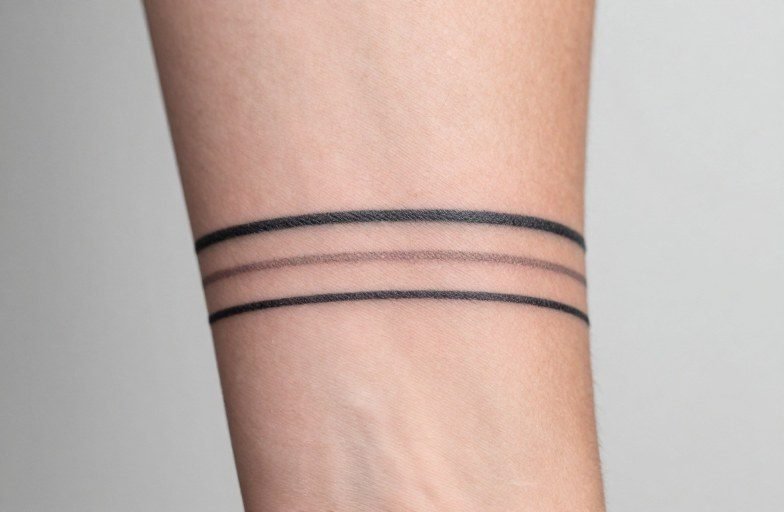
Three parallel lines most commonly represent balance, forward movement, and the passage of time or life stages. The simplicity is intentional, this tattoo strips symbolism to its bones, letting the wearer assign specific meaning without heavy iconography getting in the way. That minimalism is exactly why it has stayed popular across decades and subcultures.
History & Cultural Roots
Parallel line tattoos lack the ancient pedigree of Celtic knots or Japanese irezumi, but their visual DNA runs through several traditions. Understanding where the form comes from helps explain why it carries weight despite its simplicity.
Geometric Traditions
Basic parallel lines appear in Indigenous art from the Pacific Northwest, often carved into totems and masks to represent rivers, migration paths, or familial bonds. In some African textile patterns, triple stripes signify stages of life, birth, adulthood, elderhood. The tattoo form borrows this visual grammar without directly copying any single tradition, which is part of its flexibility and, for some, its controversy.
Modern Minimalism
The three-line tattoo surged alongside the broader minimalist tattoo movement of the 2010s, though it existed in punk and straight-edge scenes earlier. Straight-edge culture sometimes used three lines to mark the “X” philosophy, clean living, often with one line for each principle: no alcohol, no drugs, no tobacco. That association has faded as the symbol spread beyond its subculture origins, but it still lingers in certain communities.
- Prison tattooing in some regions used parallel lines to mark time served or rank
- Military personnel have adopted three lines for deployment counts or unit identifiers
- Street art and graffiti culture contributed to its spread as a “clean” graphic element
Color vs Black and Grey
Ink choice fundamentally changes how this tattoo reads and how it ages.
Black Ink Longevity
Three solid black lines hold up better than almost any other tattoo design. There’s no fine detail to blur, no shading to muddy, no color to fade unevenly. Over ten to fifteen years, black lines soften slightly and spread minimally, but the design remains readable. This makes it a pragmatic choice for people who want something that looks intentional rather than neglected as skin ages.
Color Variations
Some choose three different colors, perhaps birthstone hues, pride flag shades, or simply aesthetic preferences. Color lines require more maintenance; reds and yellows fade fastest, blues and greens hold longer. A three-color line tattoo often reads as more personal or decorative, less stark than black. White ink over black lines creates a subtle raised effect but tends to yellow or disappear entirely on most skin tones within a few years.
Similar & Related Symbols
The three-line motif sits near several related designs that get confused or deliberately substituted.
The triple goddess symbol (three vertical crescent moons) shares the three-part structure but carries specific Wiccan and neopagan associations. The trident or psi symbol (Ψ) offers more aggressive or psychological framing. Three horizontal lines (the “hamburger menu” icon) have become a deliberate joke for tech workers, though this reads as dated already.
Three diagonal lines suggest motion, speed, or air, common in aviation and racing tattoos. Three wavy lines evoke water, often linked to surfing or naval service. The parallel version’s straightness matters: it implies steadiness, not flux.
Symbolism & Core Meaning
Despite its minimalism, the three-line tattoo accumulates meaning through placement, spacing, and context.
Common Interpretations
- Past, present, future: The most frequent reading, with each line representing a time state
- Mind, body, spirit: A holistic framework popular in wellness and recovery communities
- Three significant people: Siblings, children, lost loved ones, often with small initials hidden nearby
- Personal achievements: Sobriety years, degrees, career milestones
- “Still going”: A quiet resilience marker, especially after trauma or depression
Placement as Meaning
On the forearm, three lines face outward, communication, declaration. On the ribs or torso, they’re private, revealed selectively. Behind the ear or on the finger, they become almost secret, discovered rather than announced. The back of the neck offers a middle ground: visible with certain haircuts or clothing choices, hidden otherwise. Spacing matters too, tight lines feel unified, separated lines suggest distinct elements in relationship.
Common Variations & Styles
Tattooers have developed numerous approaches to this deceptively simple form.
Line Weight and Technique
Three identical lines read as most austere. Varying thickness, thick, thin, thick, or gradually increasing, adds rhythm and can imply progression. Some artists use whip shading to soften edges, creating a graphite-like quality rather than hard edges. Dotwork along the lines adds texture without adding new shapes. Single-needle work produces extremely fine lines that look almost drawn-on, but these blur faster and require touch-ups.
Integrated Elements
Lines get broken to incorporate small symbols, tiny birds, semicolons, numbers, or coordinates. The break itself becomes meaningful: an interruption, a loss, a pivot point. Some wrap the three lines around the arm as a band, making them a permanent bracelet with the ends not quite meeting, suggesting incompleteness or ongoing story.
Mythology & Folklore
Direct mythological parallels to three parallel lines are sparse, which has allowed modern wearers to build their own associations.
The three Fates of Greek mythology, Clotho, Lachesis, Atropos, spin, measure, and cut the thread of life. Some trace the three-line motif to this indirectly, though the connection is modern rather than ancient. Norse rune magic includes triple lines in certain bind runes, but these are typically angular and interwoven rather than simply parallel.
In Japanese culture, three horizontal lines form part of the mitsudomoe and other family crests, though these are usually curved or interlocked. Clean parallel lines appear more in seigaiha (wave) patterns, where they suggest calm water expanding outward, peace, good fortune, the endless sea.
Contemporary wearers sometimes reference three wishes folklore, three trials in hero narratives, or the rule of three in storytelling and comedy. These are personal overlays rather than traditional tattoo symbolism, which is entirely valid, the form supports projection.
How Skin Tone Affects the Design
Parallel lines are one of the few tattoo designs where the visual result changes significantly depending on where your skin sits on the spectrum, and that difference matters both for the initial appearance and how the design holds up over time.
On lighter skin tones, fine lines in the 1-2mm range create a clean, precise look with strong contrast. The gap between lines reads clearly, negative space does its job, and subtle variations in line weight are visible from a normal viewing distance. Single-needle work and very delicate spacing work reliably on pale to medium skin because the contrast is high enough to carry it.
On medium to deeper skin tones, fine lines often disappear faster and show less initial contrast. Artists who work extensively with darker skin consistently recommend going thicker: lines in the 2-4mm range give the design enough visual weight to read clearly and hold up as the skin’s natural healing process softens the edges over time. What looks like a bold choice on the day of the tattoo is often exactly what the design needs to look intentional rather than faded a year out.
Before committing to specific line weights, ask your artist for healed photos of parallel line tattoos they’ve done on skin similar to yours. Fresh photos from the same day are not reliable indicators of how the design will look healed. The ink settles, the edges soften slightly, and the surface skin closes over the work. An artist who can show you healed results on your skin tone is giving you real information; one who only has fresh work photos cannot.
Choosing the Right Artist
A parallel lines tattoo is technically demanding in ways that are not immediately obvious. There are no complex elements, no shading gradients, no intricate details to distract from mistakes. Every imperfection is visible. A slightly wobbling line, uneven spacing between the three stripes, or inconsistent line weight from start to finish reads clearly in a design this spare.
What to Look for in Their Portfolio
The specific skill you need is freehand straight-line control under pressure. Look for examples of geometric tattoos, minimalist work, or any design that depends on clean linework rather than texture or shading to carry it. Does the artist’s straight lines actually stay straight across several inches of skin? Do their parallel elements maintain consistent spacing, or does the gap drift slightly wider or narrower? Fine line and single-needle portfolios show this skill clearly, as does any lettering work where baseline consistency matters.
Ask About Their Technical Approach
Some artists use stencils and rulers to establish reference points before freehand execution. Others work freehand from start to finish. Neither approach is wrong, but knowing which one your artist uses helps you evaluate their process. If an artist is dismissive about technique questions or suggests that three lines are simple enough that approach doesn’t matter, that’s a signal worth paying attention to. Artists who take geometric and minimalist work seriously tend to have strong opinions about how they achieve precision, and they’ll share them readily.
Final Thoughts
The three parallel lines tattoo works because it refuses to do too much. It doesn’t explain itself, doesn’t perform symbolism for an audience. That restraint is increasingly rare in tattoo culture, where maximalism and immediate readability often dominate social media.
If you’re considering this design, the real decisions are placement, spacing, and line quality, not meaning. Meaning you can supply yourself; technical execution you cannot. Find an artist whose straight lines are actually straight, whose hand doesn’t waver, who understands that with so little to hide behind, every micron matters. The best three-line tattoos look effortless but weren’t. That’s the point.
Frequently Asked Questions
Do three parallel lines always have the same meaning?
No. The design is intentionally open, though past-present-future and mind-body-spirit are the most common interpretations. Most people assign personal significance that wouldn’t be obvious to strangers.
Where does a three-line tattoo hurt the least?
The outer forearm and calf have more muscle and fat padding, making them generally more comfortable than ribs, feet, or fingers. Pain varies significantly by individual nerve density and tolerance.
How much should a simple three-line tattoo cost?
In most US shops, expect $80-150 minimum for clean, professional work. Extremely low prices often indicate rushed execution or inexperienced artists, risky when precision is everything.
Will three thin lines blur together over time?
If placed too close or tattooed too shallow, yes. A skilled artist spaces them appropriately for your skin type and uses proper depth. Black ink on lighter skin holds separation longest.
Related Tattoo Meanings
- Aeroplane Tattoo Meaning: Travel, Freedom Adventure
- Amor Fati Tattoo Meaning: Embracing What Comes
- Andreas Gustafsson Back Tattoo Meaning: Symbolism Style Guide
- Explore more









