
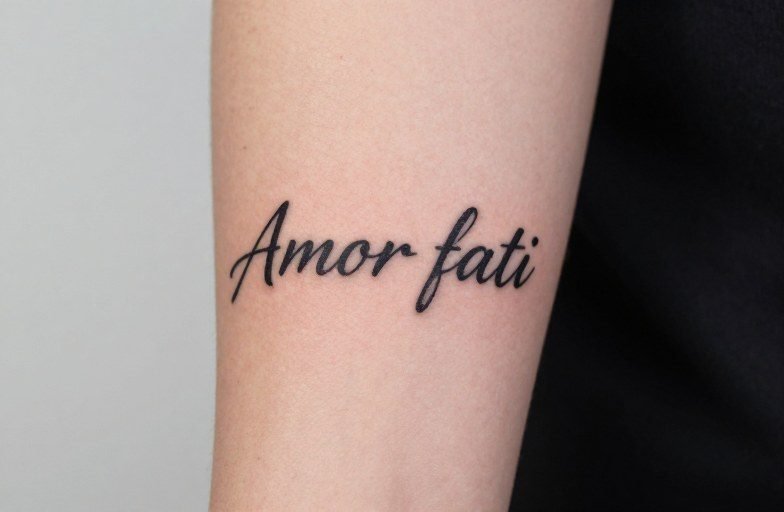
Amor fati translates from Latin as “love of fate” or “love of one’s fate.” The tattoo carries a specific philosophical weight: it signals a commitment to embracing everything that happens to you, not merely enduring hardship but actively affirming it as necessary and good. This isn’t blind optimism. It’s the Stoic idea that resisting reality creates suffering, while accepting it, truly accepting it, frees you.
Symbolism & Core Meaning
The Stoic Roots
The phrase is most commonly associated with Friedrich Nietzsche, who made it central to his philosophy of eternal recurrence, the thought experiment of wanting your life to repeat exactly, forever. But the sentiment runs through Stoic thinkers like Marcus Aurelius and Epictetus: don’t wish for things to happen as you want, but want them to happen as they do. The tattoo marks this stance as a lived practice, not just an intellectual position. Someone wearing it has usually gone through something that tested this philosophy for real.
What It Actually Signals
People choose amor fati after significant loss, major health crises, career collapses, or periods of addiction and recovery. The ink functions as a private marker of a turning point where fighting reality became more painful than accepting it. Unlike carpe diem (seize the day), which can read as aspirational or even consumerist, amor fati has a harder edge. It acknowledges darkness without romanticizing it. The person wearing it isn’t saying life is good; they’re saying they’re prepared to find good in whatever life delivers.
How It Ages on Skin
Text Placement Realities
Amor fati works as text because it’s short, two words, nine letters, clean rhythm. But text tattoos age differently than imagery. Fine lines in small fonts (under 10pt equivalent) blur within five to seven years as ink spreads under the skin. The inner bicep, a popular spot for this phrase, stays relatively protected from sun but stretches with muscle gain and softens with age. The ribcage holds detail well but blurs faster than the upper arm because of thinner skin and constant movement from breathing. Forearms get sun; without consistent SPF, black text fades to charcoal gray and loses contrast against tanned skin.
Long-Term Readability
Serif fonts (Times-style) maintain structure longer because the thin-thick variation gives the eye anchors even as edges soften. Script and cursive degrade faster, loops fill in, thin connecting strokes disappear. All-caps sans-serif, especially geometric versions, can look dated within a decade as tattoo trends shift. For longevity, most artists recommend medium-weight serif or semi-bold lettering, minimum 2-3 inches wide for the full phrase, with adequate spacing between letters (tracking) to accommodate natural ink migration.
Common Variations & Styles
Language and Script Choices
Most stay with Latin for the historical weight, but Greek (agape heimarmene) appears occasionally. Some split the phrase, amor on one wrist, fati on the other. Others incorporate it into larger Stoic pieces: Marcus Aurelius quotes, the Stoic circle symbol, or paired with memento mori. The text itself ranges from minimalist single-needle fine lines to heavy blackletter gothic, which changes the feel from philosophical meditation to almost religious vow.
Visual Embellishments
- Broken columns or ruins: Nietzschean imagery, suggesting strength through destruction
- Hourglasses: time and acceptance intertwined, though this borders on memento mori territory
- Ouroboros: the eternal recurrence connection, snake consuming its tail
- Plain text, no imagery: increasingly common; the phrase carries enough weight alone
Some frame the words in a banner scroll or ribbon, which gives traditional tattoo structure but can look dated. Others let the text float on skin with no border, which ages cleaner but requires confident placement.
Religious & Spiritual Angles
Christian Adaptations
Though fundamentally a Stoic/Nietzschean concept, amor fati resonates with certain Christian frameworks, specifically the idea of surrendering to God’s will rather than demanding your own. Some wearers pair it with crosses or ichthys symbols, creating a synthesis that would have made Nietzsche wince but functions genuinely for the individual. The theological tension is real: Stoic fate is impersonal necessity, while Christian providence is personal divine intention. The tattoo’s meaning shifts based on which framework the wearer inhabits.
Buddhist Parallels
Non-attachment and radical acceptance have clear echoes in Buddhist practice. Some practitioners of Zen or Vipassana meditation choose amor fati as a Western philosophical anchor for Eastern concepts they already live. The tattoo becomes a bridge between traditions, a way to mark practice on the body without appropriating Sanskrit or Pali they don’t read fluently. This isn’t universal, some find the Nietzschean individualism incompatible with Buddhist anatta (no-self), but the overlap exists for many.
Similar & Related Symbols
Several tattoos occupy adjacent philosophical territory. Understanding the distinctions helps clarify what amor fati specifically offers.
- Memento mori: remember you will die. More about mortality awareness than acceptance of ongoing life events. Often more somber, skull-oriented.
- Carpe diem: seize the day. Active, opportunistic, sometimes hedonistic. Less about accepting what comes and more about grabbing what you can.
- This too shall pass: Persian/Hebrew origin, about impermanence of both joy and suffering. More consolatory than affirmative.
- The Stoic circle: concentric circles representing control (self, then influence, then everything else). More abstract, less emotionally direct.
- Nietzsche’s eternal recurrence: rarely tattooed as text (too long), but sometimes represented through circular imagery or the ouroboros.
Amor fati sits uniquely between these: it affirms rather than warns, accepts rather than seizes, embraces rather than merely endures.
Design Tips & Pairings
Complementary Imagery
If you want visual elements, consider what actually reinforces the concept without diluting it. A phoenix rising works only if you understand it as loving even the burning, not just surviving but affirming the fire. Waves or ocean imagery can suggest going with rather than against. Mountain ranges suggest scale and perspective: your fate is part of something larger. Avoid butterflies (overused transformation metaphor) or birds flying free (too much “escape,” not enough “acceptance”).
Placement Strategy
The chest over the heart makes the commitment visceral and private, you see it when you look down, others only if you choose. The back of the neck or between shoulder blades keeps it personal but present. Wrists and forearms make it visible to others, which shifts the function toward communication and declaration. The ribcage protects it from casual view but makes it vulnerable to body changes. Consider whether you want this as a daily reminder to yourself or a signal to others; placement follows that decision.
Artist Selection
Lettering specialists produce better text tattoos than generalists who prefer imagery. Look for portfolios with consistent spacing, clean edges, and healed results (not just fresh photos). Script and fine-line work require different expertise than bold traditional lettering. Ask to see healed examples specifically, fresh tattoos always look sharper than they settle.
The Bottom Line
Amor fati as a tattoo commits you to a demanding philosophy in permanent form. The meaning is specific: not just acceptance but love of whatever happens, a stance that requires practice and often comes from having been tested. The design decisions, Latin or translation, text alone or with imagery, placement, font weight, should serve that specificity rather than drift into generic inspirational tattoo territory. Work with an artist who understands how text ages, choose placement based on whether this is primarily for you or for others, and let the phrase carry its own weight without over-explaining through added symbols. The best amor fati tattoos look like someone made a decision and stands by it.
Frequently Asked Questions
Does amor fati mean you can’t try to change bad situations?
No. Stoic acceptance concerns what you can’t control, not resignation about what you can. The tattoo marks peace with outcomes, not passivity toward action. You still work, still strive, still choose, then accept results without torture.
Is amor fati only for people who’ve suffered trauma?
Not exclusively, but the philosophy typically resonates after difficulty. Someone who hasn’t been tested may find the concept abstract rather than lived. The tattoo carries more weight when it marks a genuine shift in how someone relates to experience.
How much should I expect to pay for a quality amor fati lettering tattoo?
Simple two-word text in a clean font runs $150-400 depending on city, artist tier, and size. Custom lettering, large scale, or added imagery pushes higher. Text specialists often charge premium rates because bad lettering is permanently obvious.
Will people mistake amor fati for a romantic phrase?
Sometimes. “Amor” reads as love, “fati” isn’t common vocabulary. Be prepared to explain, or choose placement that’s more private. The Latin form signals philosophical intent to those who recognize it, but clarity isn’t guaranteed with casual viewers.
Related Tattoo Meanings
- Anvil Tattoo Meaning: Strength, Craft, and Endurance
- Avocado Tattoo Meaning: Growth, Health Modern Wit
- Ballerina Tattoo Meaning: Grace, Discipline, and Hidden Strength
- Explore more









