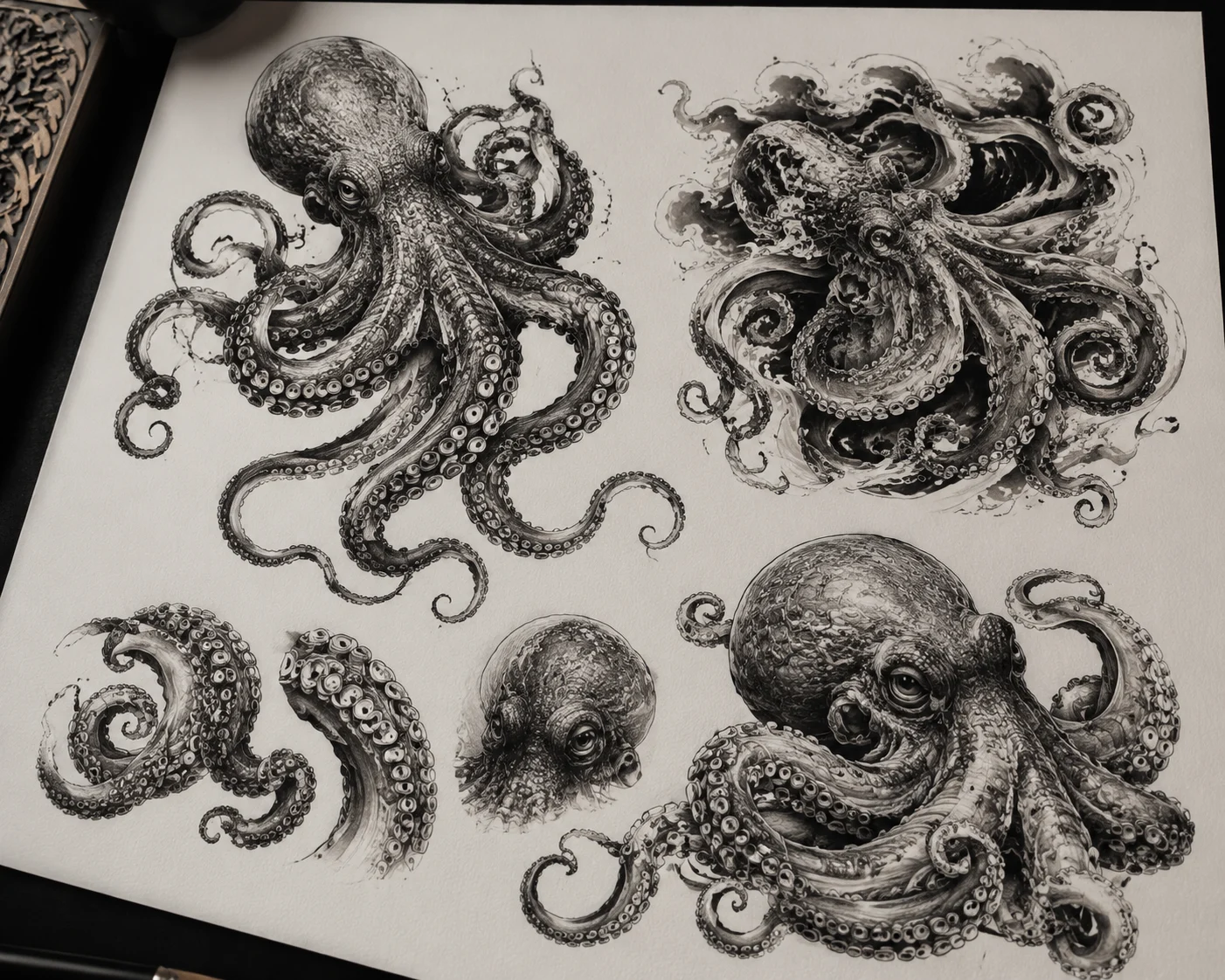
What the Octopus Actually Means
An octopus tattoo carries weight before you add your own story. The animal is a problem-solver: it opens jars, navigates mazes, escapes tanks. That reputation for intelligence is the first thing people read, and it lands whether you planned it or not. From there, the meaning spreads in several directions.
Adaptability is the most common thread. An octopus changes color and texture in seconds, squeezes through gaps no larger than its eye, and survives by bending rather than fighting. If you have rebuilt yourself around obstacles rather than crashing through them, the symbol fits honestly.
Regeneration matters too. An octopus can regrow a lost arm, and that biological fact has made it a quiet emblem for people recovering from injury, loss, or burnout. It is not a loud metaphor of triumph; it is a private one about continuing.
The deep-water habitat adds another layer. The octopus lives in darkness, in places humans visit rarely and understand poorly. That association with mystery and the unconscious is why the design appeals to people who keep parts of themselves hidden, not as deception but as depth.
The tentacles themselves carry ambiguity. Eight arms reaching in different directions can mean juggling roles, managing contradictions, or holding many things at once. The same arms can suggest an embrace or a grip, protection or pressure. This is why placement and flow matter so much with octopus designs: the posture of the animal changes the emotional tone completely.
How Style Changes the Reading
Japanese Tako
In Japanese tattooing, the octopus is called tako, and it occupies the same visual world as dragons, koi, and waves. Folklore often links it to shape-shifting spirits and protective sea deities, so a tako piece can read as both guardian and trickster. The mood is rarely gentle; the traditional palette and bold outlines demand drama.
Tako style needs space. Long tentacles, wind bars, and wave backgrounds carry the eye around the body, which is why you usually see these pieces on sleeves, thighs, or full backs. The tentacles should flow with the muscle structure, not fight it. If you are considering this style, plan for multiple sessions and a cooperative relationship with your artist about how the wrap will actually sit on your specific body.
Blackwork and Dotwork
Blackwork strips the octopus down to shadow and silhouette. The meaning shifts toward the psychological: interior life, hidden weight, the parts of yourself you do not display. This style ages well because it depends on shape and negative space rather than fine shading that blurs over time.
The risk here is overbuilding. A small blackwork octopus with maximum tentacle detail often heals into a smudged blob. You need enough skin real estate to let the negative space breathe, or the suction cups and arm texture disappear into solid black.
Traditional and Neo-Traditional
American traditional octopus tattoos lean nautical and bold: thick outlines, limited color, a sense of the sea as both workplace and adversary. Neo-traditional keeps the bold structure but adds more color variation and smoother gradients, which lets the design feel more alive and less poster-flat.
Both styles work best when the tentacles suggest motion. A static octopus with arms splayed symmetrically looks like a diagram. A coiled octopus with arms wrapping around the limb or torso looks like something happening.
Fine-Line Realism
Fine-line approaches treat the octopus as a specimen to study: accurate anatomy, delicate suckers, careful gradation. The meaning here is often curiosity and respect for the animal itself rather than borrowed symbolism. These pieces demand large scale to hold detail, and they age faster than bolder styles because thin lines spread and soften. If you choose this direction, expect touch-ups and protect the piece from sun.
Placement and Tentacle Flow
Thigh and Calf
The thigh offers the most forgiving canvas for a large octopus. Muscle is relatively stable, skin is thick, and the natural curve lets tentacles wrap organically. A calf wrap can work beautifully if the tentacles spiral down toward the ankle rather than cutting straight across like a band.
Shoulder and Upper Arm
The shoulder cap lets the octopus body sit at the peak while arms cascade toward the chest and back. This placement suits Japanese and traditional styles especially well. The danger is making the design too small; an octopus compressed to a few inches loses all the arm movement that makes it interesting.
Ribcage and Sternum
These areas hurt more and heal slower, but they allow the tentacles to follow the rib lines in ways that feel integrated rather than applied. The sternum specifically suits a central body with arms spreading toward the collarbones. Plan for a longer session and more careful aftercare.
Forearm and Hand
The forearm is visible, which suits a design you want to see and show. The hand is harder: skin there sheds and regenerates faster, lines blur, and the octopus becomes a long-term commitment to maintenance. If you are drawn to hand placement, talk to your artist about how their specific hand tattoos have aged on other clients.
Back and Full Sleeve
A full back or sleeve gives you room to build a scene: waves, rocks, other sea creatures, the octopus as one element in a larger story. This is where Japanese tako tradition shines. The trade-off is time and cost, and the need for a coherent plan before the first needle touches skin.
Working With Your Artist
The best octopus tattoos come from collaboration, not from handing over a Pinterest image and waiting. Ask your artist to sketch tentacle flow directly on your body with marker before committing to stencil. An octopus that looks balanced on flat paper often needs significant adjustment to follow your specific muscle curves and joint movement.
Bring reference photos of real octopus posture, not just other tattoos. Look for how the arms curl and weight distributes when the animal is resting versus reaching. The difference between a convincing octopus and a decorative one is often in the physics of those arms: which ones are loaded, which ones are relaxed, where the tension lives.
Be honest about pain tolerance and session length. Large octopus pieces with detailed suckers require patience, and rushing the last hour because you are exhausted shows in the line quality. Better to split into multiple sessions than to push through sloppy work.
What to Remember
An octopus tattoo means intelligence first, but the specific reading depends on style, posture, and where you place it. Japanese tako draws on myth and transformation; blackwork leans into shadow and interior life; traditional and neo-traditional keep the nautical boldness alive; fine-line realism asks for scale and maintenance. The tentacles are the whole point, so give them room to move and flow with your body rather than against it.
Choose an artist who has built octopus pieces before and can show you healed photos, not just fresh ones. The difference between a good octopus tattoo and a great one is usually in the planning: how the arms wrap, where the negative space sits, whether the animal looks like it is occupying your skin or merely sitting on it.
Take your time with the decision. This is a design that rewards patience, and the people who live with it longest are the ones who thought past the first image to how it will feel five years from now.
Frequently Asked Questions
Does an octopus tattoo always mean intelligence?
It is the most common association, but the meaning shifts with style and context. A blackwork octopus might read as mystery or shadow work; a traditional piece might read as nautical survival. The intelligence meaning is usually present, but not always dominant.
How painful is an octopus tattoo?
It depends on placement. Ribs, sternum, hands, and feet are generally the most intense. Thighs and outer arms are more manageable. The session length matters too: large octopus pieces with detailed suckers often require multiple hours, and fatigue amplifies discomfort.
Do octopus tattoos age well?
Bold styles with strong outlines and adequate negative space age better than fine-line realism with tiny detail. Blackwork and Japanese traditional tend to hold up; delicate sucker detail in small pieces often blurs over time. Sun protection and occasional touch-ups help any style last.
Can an octopus tattoo be small?
Technically yes, but practically difficult. The tentacles need room to show movement and distinction between arms. Below a certain size, the octopus becomes a blob with lines. Most experienced artists will recommend a minimum size for the design to read clearly.
What should I ask my artist before starting?
Request healed photos of their octopus work, not just fresh shots. Ask them to sketch tentacle flow on your body before finalizing the stencil. Discuss how the design will adapt to your specific muscle structure and movement, and be clear about how many sessions you are willing to commit to.