
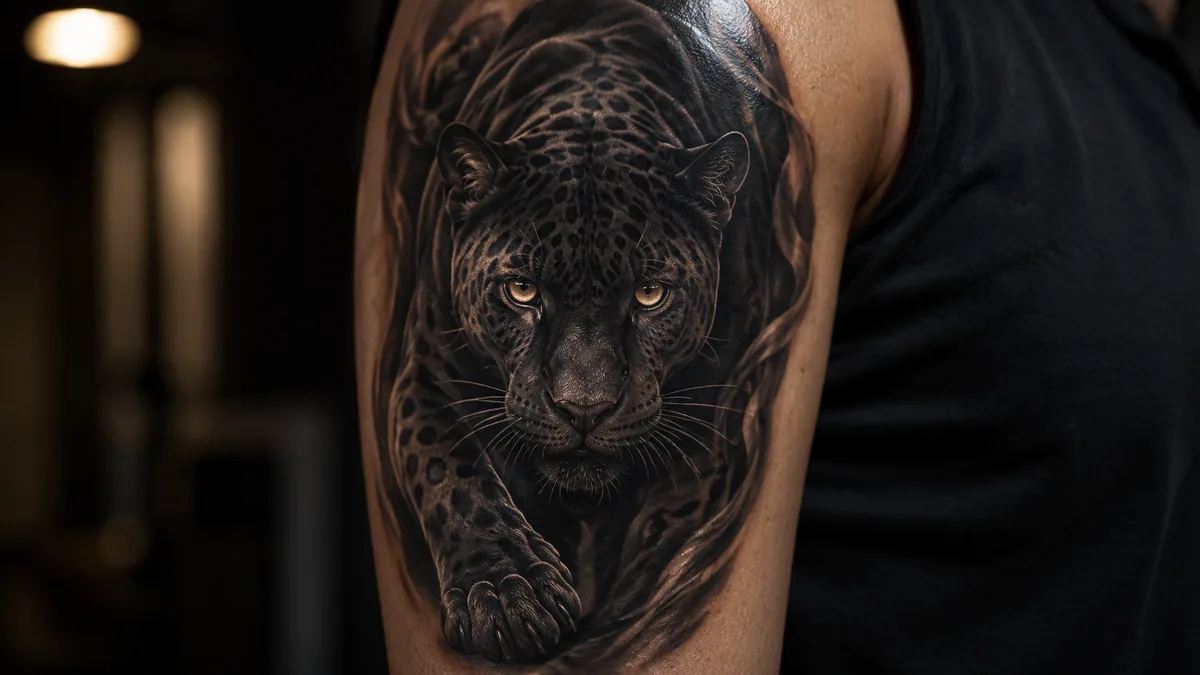
The black jaguar tattoo is one of those pieces that hits different. It reads as raw power before you even know the meaning behind it. A fully black jaguar, whether rendered in bold traditional, deep black and grey realism, or clean fine line, carries weight that most animal tattoos just don’t.
People get this tattoo for a reason. The black jaguar isn’t just a cool cat. It’s a symbol with deep roots in indigenous Mesoamerican and South American cultures, and it carries a meaning that still lands hard in a modern context. Let’s get into what this piece actually means and how to wear it right.
Core Symbolism: What the Black Jaguar Actually Represents
The jaguar is the apex predator of the Americas. It doesn’t chase, it ambushes. That’s the first layer of meaning: calculated power, patience, and precision. People who get this tattoo are often drawn to the idea of being a force that moves quietly and strikes when it matters. Not loud, not flashy. Effective.
The black coloring adds another dimension. Black jaguars aren’t a separate species. They’re melanistic jaguars, spotted cats with extra pigment. That hidden duality, powerful patterns concealed beneath a dark surface, maps onto themes of hidden depth, inner strength, and the idea that what looks uniform on the outside holds complexity within.
Cultural and Historical Background
The jaguar does not roar to prove it is powerful, it simply moves.
In pre-Columbian Mesoamerican cultures, the jaguar was sacred. The Olmec, Maya, and Aztec civilizations treated the jaguar as a symbol of rulership, warfare, and the underworld. Jaguar Warriors were among the most elite fighters in Aztec society. The animal wasn’t just respected. It was feared and revered as a conduit between the human world and the spirit world.
In Amazonian and Andean shamanic traditions, the black jaguar specifically represents transformation, night vision, and access to other states of consciousness. Shamans who worked with the jaguar spirit were believed to literally become the animal during ritual. That concept of shapeshifting and crossing thresholds gives the black jaguar tattoo a layer of meaning around personal transformation that many wearers connect with directly.
Popular Design Styles and Variations
Realism is the heavy hitter for this subject. A detailed black and grey jaguar face with deep shadow work, textured fur, and piercing eyes will read from across the room and age respectably if the artist knows how to pack black without muddying the mid-tones. Solid blacks need to be truly saturated, no thin spots, or you’ll see patchy fading in two years.
Neo-traditional gives you bold outlines with graphic shading, great for smaller placements where hyper-realism gets too tight to hold detail. Blackwork and dotwork interpretations lean into the symbolic side, sometimes incorporating geometric patterning or Mesoamerican-inspired design elements around the figure. Fine line jaguar portraits are popular but risky on high-movement skin. Fine line needs a skilled hand and a low-wear zone to stay crispy long-term.
Black and Grey vs. Solid Black Approaches
Most black jaguar tattoos stay in a black and grey palette, and that’s where the design really shines. The gradient from deep, saturated black into soft grey whip shading captures the way light moves across fur. A good black and grey jaguar piece with clean transitions will hold its drama for years. The key is that the darks stay dark. Under-packed blacks go grey fast, especially on lighter skin.
Some clients want a fully solid blackwork jaguar, flat and graphic, more of a silhouette approach. That style carries its own power. It reads as bold, intentional, almost totemic. Blowout risk goes up when you’re packing large fields of black in thin-skinned or high-flex zones, so placement conversation matters a lot here. Your artist should talk you through needle configuration and pass count before committing.
Best Placements and How It Ages
The thigh is the gold standard for a large jaguar piece. Low wear, relatively flat surface, good canvas for a full portrait or a wrap-around composition. The back and ribcage work well for sprawling, dynamic poses. Upper arm and shoulder are solid mid-size placements, good balance of visibility and longevity. The chest is spicy on pain but holds ink beautifully and gives you room for a statement piece.
Placements to think hard about: inner bicep, behind the knee, and the hand. These are high-wear zones where ink migrates and fades faster, and fine detail becomes mush within a few years. If you want a small fine-line jaguar on your wrist, go in knowing it’ll need a touch-up. Bold will hold in the long run. A simpler, bolder design in a low-wear zone will look better at year ten than a hyper-detailed piece on a high-movement zone.
Who Gets This Tattoo and Why
The black jaguar tattoo attracts people who identify with controlled strength. Not aggression for its own sake, but the kind of quiet confidence that doesn’t need to announce itself. A lot of athletes, martial artists, and people who’ve worked through serious personal transformation end up sitting for this piece. The shamanic angle pulls people on a spiritual path who feel connected to the idea of navigating between worlds or accessing their own deeper instincts.
It’s also a significant tattoo for people with Latin American heritage, particularly those with indigenous ancestry from Mexico, Central America, or the Amazon basin. For those clients, it’s a reclamation, a way to carry cultural identity on the skin with pride. Whatever your reason, the piece works best when it’s personal. Talk to your artist about incorporating elements that tie it to your story, whether that’s a specific pose, a background element, or an accompanying glyph.
Making It Personal: Customizing the Design
A jaguar face centered on the chest hits different than a full-body jaguar mid-stalk wrapping the thigh. The pose carries its own meaning. A frontal face is confrontational, dominant, a declaration. A crouching or leaping full-body reads as readiness, motion, energy contained before release. Talk through pose options with your artist before locking anything in, because composition shapes meaning as much as the symbol itself does.
You can deepen the design by incorporating cultural reference points, Aztec calendar elements, Mayan geometric borders, jungle foliage, or moon imagery, all of which have real symbolic ties to the jaguar across multiple traditions. Keep it cohesive. Too many elements competing for attention breaks the read. The jaguar is already doing heavy lifting. Let it breathe, keep the composition clean, and the piece will say exactly what you need it to say.









