Fu dogs aren’t actually dogs. They’re guardian lions, sometimes called lion dogs, rooted in Chinese imperial art. The Western nickname stuck because the creatures don’t look much like either animal, so the name kind of split the difference. As a tattoo, the fu dog is one of the oldest symbols of protection you can put on your body.
People get fu dog tattoos because they want something that hits hard visually and carries real weight symbolically. These aren’t decorative pieces you pick off a flash sheet without thinking. They mean something specific, and the imagery backs it up every single time.
Core Symbolism: What a Fu Dog Tattoo Actually Means
The fu dog represents protection above everything else. In Chinese tradition, paired guardian lions were stationed at the entrances of temples, palaces, and important buildings specifically to block negative energy and evil spirits from entering. That meaning translates directly to skin. People who get fu dog tattoos are making a statement about guarding themselves, their family, or something sacred to them. The piece is essentially a permanent sentinel.
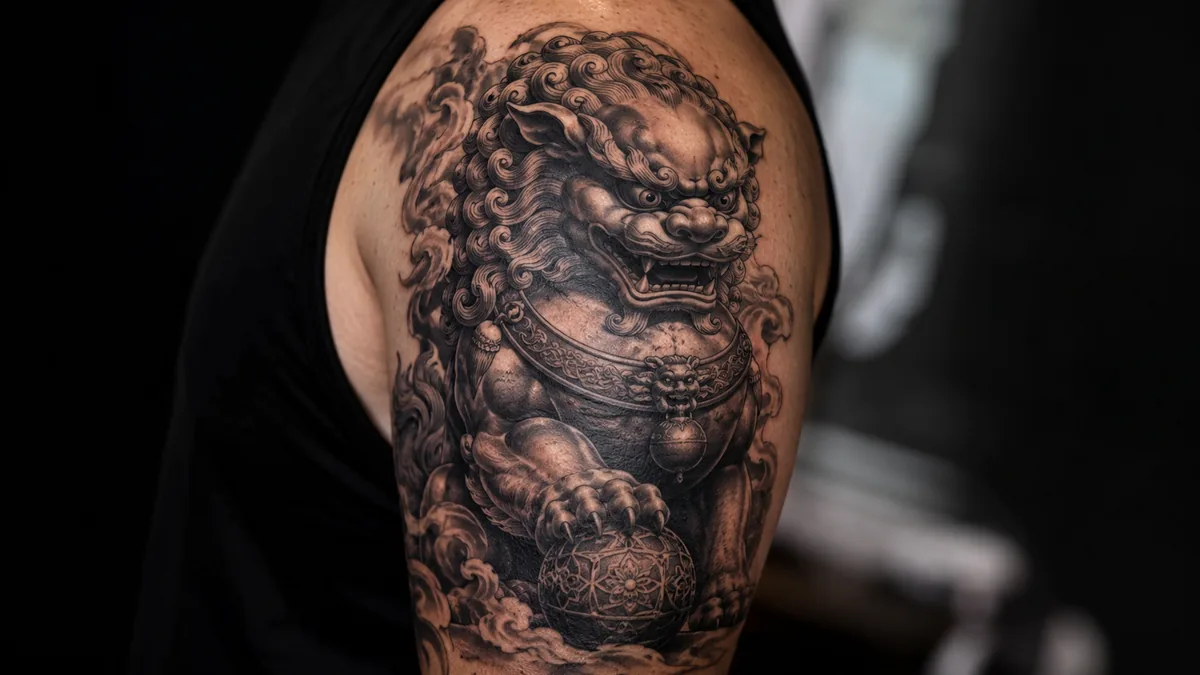
Beyond protection, fu dogs represent strength, authority, and luck. The male figure traditionally rests a paw on a globe, symbolizing dominion over the world. The female rests a paw on a cub, symbolizing nurturing and protection of family. These aren’t minor details. Which figure you choose changes what your tattoo is saying, so it’s worth deciding before you sit down.
The Real History Behind the Imagery
A Fu Dog tattoo without its pair is a door with one hinge.
Guardian lion statues originated in China during the Han Dynasty, around 200 BCE, heavily influenced by Indian Buddhist art. Lions weren’t native to China, so Chinese sculptors worked from secondhand descriptions and imagination. The result was a stylized, mythological creature, part lion, part dragon, with bulging eyes, a wide mane, and a powerful stance. These statues spread across East Asia, showing up in Japanese, Korean, Thai, and other Buddhist and Taoist traditions under various local names.
In Japan they’re called komainu, often found at Shinto shrines. In Okinawa they’re shisa, placed on rooftops and gates. Each culture adapted the imagery slightly, so the exact look varies. Japanese versions tend to have more angular, fierce faces. Chinese versions are often rounder, more ornate. This history is real and documented. It matters when you’re building out a fu dog tattoo concept, because authentic reference beats generic clip art every time.
Design Variations: Traditional, Neo-Trad, and Japanese
Traditional American style gives you bold outlines, limited palette, and a flat graphic quality. Fu dogs in this style look punchy and read strong from ten feet away, which is exactly what you want from a protective symbol. Neo-traditional opens up more detail, richer colors, and dimensional shading while keeping that bold structure. Both age well because the linework is solid and the composition doesn’t rely on hairline detail to carry the piece.
Japanese-style fu dogs fit naturally into sleeves and back pieces. They pair well with chrysanthemums, waves, clouds, and fire. The flowing composition of Japanese tattooing suits the fu dog’s dynamic pose. Black and grey realism is another strong option for people who want sculptural weight, like the tattoo is carved stone rather than painted. Each approach gives you a different energy, but all of them need a tattoer who can handle complex linework without losing clarity.
Color vs Black and Grey
Color fu dogs go saturated or they go wrong. Washed-out pastel tones undercut the authority the subject demands. Classic color choices lean into reds, golds, and deep greens, colors that read as imperial and intentional. A fully saturated red fu dog with black outlining and gold accents is one of the most visually commanding pieces you can get. The colors reference traditional lacquer and ceramic art, so they carry cultural context and look good at the same time.
Black and grey fu dogs hit differently. The shading creates a stone-like, almost sculptural feel that references the actual guardian statues directly. Whip shading in the mane and fur can create real texture without muddying the piece. Black and grey also ages more predictably than color on most skin tones. If you’re worried about longevity, black and grey done right with crisp lines will still read clean years down the road. Color will need touch-ups sooner, especially in high-wear zones.
Placement and How It Ages
Fu dogs need space. This is not a dainty piece. Thigh, upper arm, forearm, chest panel, back, and calf are all solid placements. The thigh gives you a large flat canvas and ages nicely since it stays covered and doesn’t flex constantly. Upper arm and forearm work well for people who want to showcase the piece. Rib placement is possible but spicy, and the skin there moves more than you’d like for a detailed piece with this much linework.
Avoid cramming a fu dog into a spot that’s too small. A fu dog that’s too tiny loses the detail in the face and mane that makes it recognizable. The symbol is meant to be imposing. Size serves the meaning. Hands and the inner wrist are high-wear zones where fine detail blows out fast. If you’re set on a visible placement, forearm or outer bicep will hold better and stay crisper over time than anything near a joint or on the hands.
Pairing and Personalizing Your Fu Dog
A lot of people get fu dogs in pairs, one on each side of the chest, mirrored on the forearms, or flanking a back piece centerpiece. Paired fu dogs reference the original guardian-at-the-gate concept most directly. Solo fu dogs work fine too, especially when the piece is large enough to anchor a sleeve or fill a back panel. You can tilt the symbolism by adding elements around it: peonies for prosperity, lotus flowers for spiritual protection, flames for power, clouds for divinity.
Personalizing a fu dog tattoo is about intention. Some people get them after a loss, as a tribute piece protecting someone’s memory. Others get them as family crests, using the male and female pair to represent themselves and a partner or parent and child. The symbolism is flexible enough to hold those personal meanings without being forced. Talk to your artist about what you want the piece to carry. A good tattoer will build the composition around the meaning, not just the aesthetic.
Who Gets Fu Dog Tattoos and Why
Fu dog tattoos cut across cultures and collector types. You see them on people with deep ties to East Asian heritage who want to wear that lineage visibly and respectfully. You also see them on collectors who have no direct cultural connection but are drawn to the symbolism of protection and strength. Both are valid. The imagery is historical and widespread enough that it doesn’t function as an exclusively closed cultural symbol, though anyone getting one should understand what it actually means before committing.
Collectors building large-scale Japanese or traditional Asian-influenced sleeves and back pieces gravitate toward fu dogs as anchor elements. They also show up on people who have been through something hard and want a piece that declares they came out the other side protected. The fu dog says you made it and something’s watching over you. That resonates across a lot of different lives. As long as you’re approaching it with real knowledge of the symbol, the piece will carry that intention.