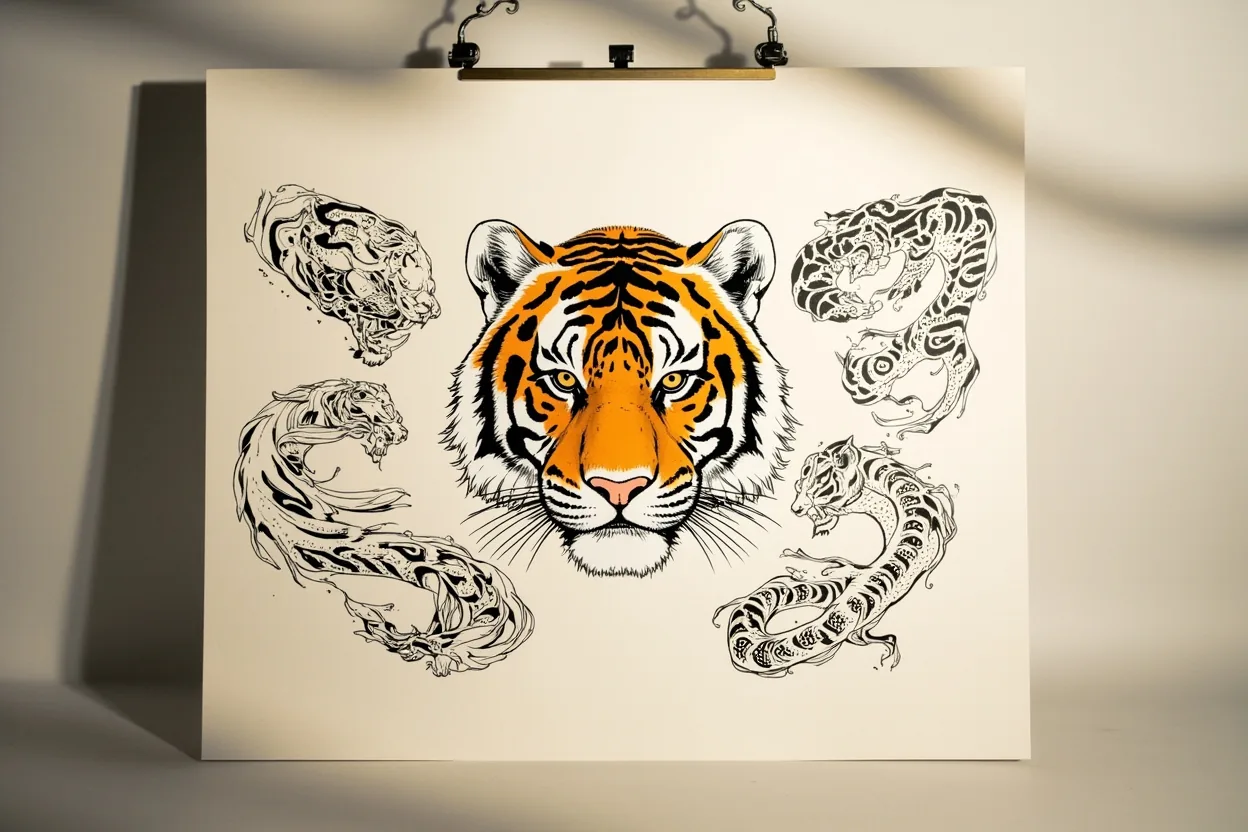
A tiger tattoo is not subtle by default. It usually means strength, focus, courage, protection, independence, danger, hunger, controlled aggression or the refusal to move through life like prey.
Quick answer: A tiger tattoo usually means strength, courage, protection, focus and wild power. The design changes the tone: roaring tigers feel aggressive, calm tiger heads feel controlled, and Japanese-inspired tigers need strong flow and scale.
What Different Tiger Designs Communicate
A tiger can look protective, violent, royal or spiritual depending on the face and body posture. The same animal carries completely different weight when roaring versus stalking, in full color versus black and grey, paired with flowers or standing alone.
Roaring versus calm tiger heads
A roaring tiger reads aggression and raw dominance. It is a warning made visible, the moment before violence. This works for people who want their tattoo to broadcast power outwardly, who do not mind strangers reading confrontation on their skin.
A closed-mouth tiger, stalking low or watching from stillness, hits differently. It signals patience, controlled power, the predator who does not need to announce itself. This reads as confidence rather than threat. In most studios, the calm tiger head gets requested more often because it ages better in social contexts: the meaning stays personal rather than performative.
Color choices and their shifts
An orange and black tiger pulls from nature and feels primal, immediate, rooted in the actual animal. A white tiger shifts the meaning toward rarity and spiritual protection in some East Asian traditions, though this association is more modern and commercial than ancient. Full black and grey tigers, especially with heavy contrast, tend to read as more introspective, almost meditative. The absence of color strips away some of the wild energy and leaves something more solemn behind.
Pick the version that matches what you actually want to carry on your skin, not what looked dramatic on a Pinterest board.
Japanese-inspired tigers
Japanese-style tigers carry specific cultural weight often linked to perseverance through hardship, particularly when paired with bamboo or wind bars. These designs need scale to work. A small Japanese tiger on a wrist looks cramped and loses the flowing background elements that give the piece its movement. The stripes must follow the body’s natural lines, and the composition needs enough room for the wind, water, or foliage to breathe around the animal.
If you want this style, find an artist who has actually studied Japanese tattooing conventions, not someone who has simply copied a few reference images. The difference shows in the direction of the stripes and the negative space around the face.
Why People Choose the Tiger
The tiger does not announce itself. Neither should the person wearing it.
A tiger does not need a crown. The animal already reads as force. The question is whether you want that force to feel calm, protective or dangerous.
A roaring tiger is a warning. A calm tiger is confidence. A tiger moving through leaves or waves feels more like controlled momentum. If you want a strength tattoo that carries less group-identity weight than a lion, the tiger fits better. It is solitary, alert and harder to soften accidentally into something cute or friendly.
Tigers do not scatter energy. They lock in. That quality draws people who are rebuilding after difficulty, establishing discipline, or marking a period of intense personal focus. The tattoo becomes a daily reminder of intent, of choosing to show up with purpose. That kind of meaning tends to age well on the skin, outlasting the initial excitement of the image itself.
What Makes or Breaks the Execution
Tiger tattoos fail when the face is almost right. One crooked eye or weak muzzle and the whole piece loses authority. That is why realism and neo-traditional tiger tattoos need a strong artist. Ask for healed big cat work, not just animal sketches or fresh photos where the contrast is artificially high.
The eyes specifically
If the eyes are muddy, the piece loses its center. Tiger eyes need crisp highlights, a clean pupil shape, and enough contrast between the iris and the surrounding area that they pop from a normal viewing distance. In black and grey, this means your artist must nail the whip shading around the eye socket without overworking it into grey soup. In color, amber and gold tones need to be saturated cleanly, without patchiness or muddied transitions.
Fine line tiger faces rarely age well around the eyes. The detail blurs, the highlights close up, and in a few years you have a fuzzy suggestion rather than a portrait. Bold, slightly stylized eyes built with solid linework and strong contrast hold through the years. If your artist’s portfolio shows tiger eyes that still read clean on healed and settled pieces, that is who you want.
Stripes and body flow
Stripes are not decoration. They follow muscle structure, and on a tattoo they should follow yours. A tiger whose stripes ignore the curve of your arm or the plane of your thigh looks like a sticker applied after the fact, not something living on your body. Good artists map the stripe flow during the stencil phase, adjusting the reference to your specific anatomy.
Small tigers present a real problem here. Stripes and eyes blur when the design is too tiny. The minimum size for a readable tiger face is roughly the palm of your hand, and even that is pushing it for complex realism. A strong tiger silhouette or simplified graphic treatment works better at small scale than a miniature portrait.
Placement and Scale
Upper arm, shoulder, chest, back, thigh and calf are the strongest tiger placements. The face needs space, and a full-body tiger needs even more. The chest and back offer the largest continuous panels, which suits Japanese-inspired compositions especially well. The upper arm and thigh give enough room for a strong portrait without committing to a full torso piece.
Ribs and sternum
These spots hurt more and heal slower due to movement and friction from clothing, but they offer a particular intensity. A tiger over the heart or along the ribs reads as private, something felt more than displayed. The pain is real, though, and the stretching of the skin during breathing can affect how the tattoo settles. Artists often recommend slightly simpler designs for these areas, with less tiny detail that might shift during healing.
Hands, wrists, and neck
These are difficult for tiger work. The skin is thin, the detail must be tiny, and the visibility is constant. A small tiger symbol or abstracted claw mark can work, but a recognizable face at this scale is genuinely hard to execute well. Most experienced artists will steer you toward a different placement if you want a tiger that actually looks like a tiger.
Historical and Cultural Notes
The tiger appears in tattoo traditions across East Asia, South Asia, and Southeast Asia, though specific meanings vary significantly by region and period. In Korean tradition, the tiger is often linked to protection and courage, sometimes appearing in folk painting before moving into tattoo culture. In parts of India, the tiger carries associations with divine power through connections to deities like Durga, though this is rarely rendered directly in tattoo form.
Japanese tattooing, particularly the irezumi tradition, uses the tiger as one of several powerful animal motifs, often linked to the idea of a solitary warrior spirit. The specific pairing with bamboo and wind is a compositional convention developed over decades of tattoo practice, not necessarily an ancient symbolic code. Western adoption of these motifs has sometimes flattened these distinctions, so if cultural specificity matters to you, it is worth researching beyond the design itself.
Western military and sailor tattoo traditions also included big cats, though lions appeared more frequently. The tiger gained ground in European and American tattooing during the twentieth century as global travel increased and reference material became more available. Claims of specific ancient meanings should be treated cautiously; the tiger’s symbolic power is real and widespread, but precise attributions to particular centuries or rituals are often overstated by studios trying to add gravitas.
Before You Decide
Know which quality of the tiger you want on your body. Strength is general. Focus is specific. Protection implies vigilance. Danger implies willingness. The same animal cannot carry all these equally unless the design is large and complex enough to contain contradictions.
Find an artist whose healed big cat work you have examined in person or in detailed, dated photographs. Fresh tattoos lie. The contrast is higher, the lines sharper, the colors more saturated. Healed work shows you what you will actually live with.
Give the face enough room. Compromise on size and you compromise on impact. A tiger that reads as decorative rather than powerful has usually been shrunk to fit a spot that deserved a different design entirely.
Consider the long-term context of your life. The tiger does not soften with age. It stays predatory, alert, potentially aggressive in its visual effect. Make sure that is something you want to carry in professional settings, family environments, and quiet moments decades from now. The best tiger tattoos are chosen by people who understand that stillness and violence are not opposites but phases of the same animal.
Frequently Asked Questions
What does a tiger tattoo mean?
It usually means strength, courage, protection, focus, and controlled wild power. The specific meaning shifts based on whether the tiger is roaring, calm, in color or black and grey, and what cultural style it draws from.
Do tiger tattoos have to be large?
No, but they strongly benefit from adequate scale. A tiger face needs roughly palm-sized minimum to preserve eye detail and stripe clarity. Smaller designs usually work better as silhouettes or simplified graphics rather than realistic portraits.
Are Japanese tiger tattoos culturally appropriative?
It depends on execution and context. Japanese tattooing is a living tradition with specific conventions. If you respectfully engage an artist trained in those conventions and understand the imagery’s history, the work generally reads as participation rather than appropriation. Random copying without understanding crosses a different line.
How do I pick between a roaring and calm tiger?
A roaring tiger broadcasts aggression and warning outward. A calm tiger reads as internal confidence and patience. Consider whether you want strangers to feel confronted by your tattoo or whether you prefer the meaning to stay personal.