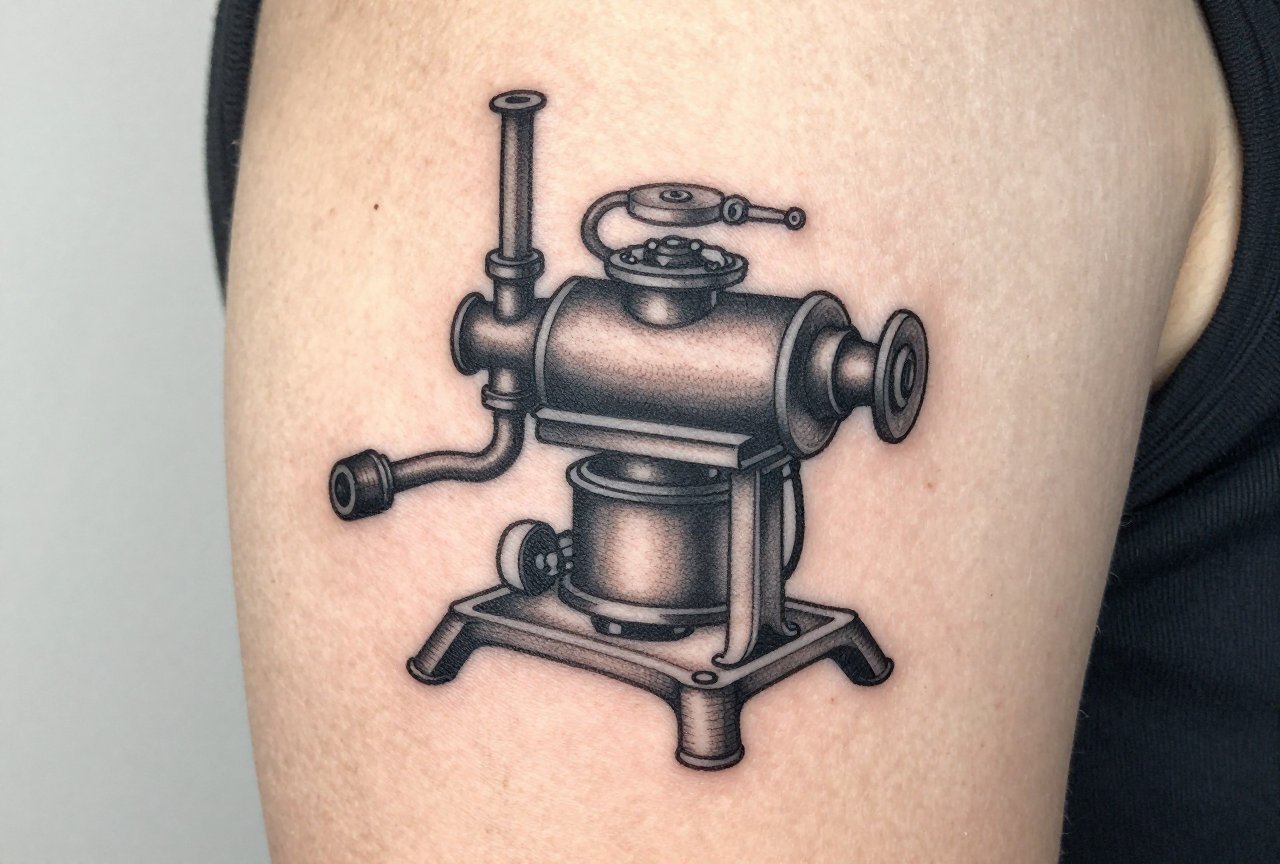
A machine tattoo can mean a lot of different things depending on who is wearing it and what kind of machine they chose. At the core, the image usually signals something about power, precision, or the relationship between people and the systems they build and maintain. It is one of the few tattoo concepts that genuinely cuts across subcultures, from biker shops to tech workers to people who grew up watching their fathers rebuild engines in the driveway.
Symbolism and History
Machine imagery in tattoos picked up momentum with industrial-era working class culture. Factory workers, mechanics, and engineers wore the tools and machines of their trade as identity markers. Motorcycle culture in the mid-20th century pushed engine imagery further, particularly through outlaw bike clubs where the machine was as much a philosophy as a vehicle.
The biomechanical style changed things significantly. H.R. Giger’s work in the 1970s gave artists a template for machines that erupted from beneath skin rather than sitting on top of it. Tattooers like Aaron Cain and Guy Aitchison spent the next two decades figuring out how to render that concept properly on a body that breathes and moves. The idea of flesh merged with machinery opened up questions about identity and technology that are arguably more relevant now than when Giger was painting them.
What the symbol means today tends to fall into a few categories:
- Craft and skill: The machine as evidence of work done well over time, often worn by people who fix, build, or operate things with their hands
- Endurance: A machine that keeps running despite wear, often chosen after illness, injury, or a long hard period
- Rebellion: Motorcycle engines, custom car parts, the counterculture associations that built up around grease and speed
- Technology and identity: The biomechanical version, questioning where the person ends and the system begins
Common Variations and Styles
Realistic engines and motors
Harley V-twins, jet turbines, V8 blocks. These pieces demand a technically skilled artist who can render oil stains, chrome reflections, and the dimensional geometry of metal parts. The level of detail modern tattooing can achieve with realism makes these genuinely impressive when done well. They tend to be large pieces, upper arm, chest, or thigh, because the detail requires space to breathe.
Biomechanical and bio-organic
Machinery appears to emerge from beneath the skin. Pistons replace bones, cables run alongside tendons, metal plates overlay muscle tissue. These work particularly well on areas where the body bends, elbows, knees, ribs, because the illusion deepens when the machinery seems to activate with movement. Artists who specialize in this style understand anatomy well enough to make the integration look logical rather than random.
Steampunk aesthetics
Victorian-era design combined with imagined mechanical function. Brass gears, clockwork mechanisms, pressure gauges. The appeal here is nostalgia for a version of technology that was visible, tactile, and repairable, before everything moved into chips and software. These often pair well with clocks, compasses, or airship imagery.
Minimalist and geometric
Single gears, schematic line drawings, abstract mechanical patterns. Works for people who want the association without a large commitment. A single gear rendered in fine line can sit behind the ear or on the inner wrist and still read clearly.
Traditional and neo-traditional
Bold outlines, limited color palette, iconic objects. Spark plugs, wrenches, eight-ball shift knobs. These pull from both biker culture and sailor flash, and they age well because the line weights were designed for skin rather than paper.
Best Placements
The design should match the scale of what you are trying to convey. Large engine pieces need large canvases. The chest, back, and outer thigh give enough room for mechanical complexity to read properly. Trying to compress a detailed V8 onto a forearm usually ends in something that blurs into gray mush within a decade.
Biomechanical work follows the body’s own structure. The forearm and calf follow natural lines of bone and tendon. The elbow and knee joints look genuinely mechanical when rendered with this style because the movement is already there. These placements reward the viewer who pays attention.
Smaller pieces, individual gears, tool designs, schematic drawings, work anywhere that single-needle or fine line holds up: inner arm, collarbone, behind the ear. Plan for touch-ups on high-wear areas like hands and fingers.
Who Chooses This Tattoo
Mechanics and engineers often choose machine imagery that connects to their actual work. A tattooed Harley engine on a builder who has pulled that engine apart a dozen times means something specific. The same image on someone who has never owned a bike means something different. Both are legitimate, but the personal connection changes how it reads.
There is a significant group that comes in after surviving something physically difficult. A mechanical heart, a prosthetic-inspired design, machinery where something organic used to be. The machine as metaphor for what continues functioning despite damage. I have done a few of these and they are usually the quietest conversations in the shop.
Tech workers and programmers sometimes lean toward biomechanical or schematic work, processing their relationship to digital systems through physical imagery. There is something interesting about people who spend their days working on invisible machines choosing to put visible ones on their skin.
Related Designs
Machine tattoos share territory with several related concepts:
- Clock and timepiece tattoos: Gear imagery overlaps heavily, but the emphasis is on mortality and time passing rather than power and function
- Robot and android designs: The human-technology boundary question, but pushed toward anthropomorphic forms
- Tool tattoos: Celebrate craftsmanship without the mechanical complexity, often more trade-specific
- Sacred geometry: Shares the appreciation for mathematical precision that underlies good mechanical design
Final Thoughts
Machine tattoos earn their staying power by being honest about what they are. A tattooed engine is not asking to be beautiful in a conventional sense. It is asking to be taken seriously. The imagery comes from people who build things and fix things and sometimes become part of the systems they work on, literally or not.
The best examples I have seen are the ones where the machine is specific. Not a generic gear but a particular engine. Not a vague mechanical aesthetic but a design that tells you exactly what kind of work this person does or what they have been through. Specificity is what keeps machine tattoos from feeling like they belong on a t-shirt.
Frequently Asked Questions
How large does a machine tattoo need to be to hold detail?
Realistic engine work generally needs at least half a sleeve to read properly. Detail that looks sharp in a reference photo often blurs into gray within a few years when compressed onto a small area. Biomechanical work can go smaller because the visual interest comes from the integration rather than mechanical specificity.
Which style ages best for machine tattoos?
Traditional and neo-traditional styles age most predictably because the bold outlines hold the image even as other details soften. Biomechanical work done with strong contrast also holds well. Ultra-fine line schematic work looks clean fresh but can lose definition faster, particularly on areas with movement or sun exposure.
Do I need to be a mechanic to wear a machine tattoo?
No, but having a specific reason for the image makes it more interesting. The strongest pieces connect to something real, a particular machine you worked on, a period in your life you are marking, a question about technology you are sitting with. Generic gear imagery exists, and there is nothing wrong with it, but it rarely has the same presence as something chosen with a clear purpose.
What is biomechanical tattooing and who does it well?
Biomechanical tattooing renders machinery as if it exists beneath the skin, integrated with the body’s own structure. It requires an artist who understands both mechanical design and human anatomy. Look for healed work specifically, not just fresh photos, because this style depends on how the shading holds over time.