Heron Tattoo Meaning: Grace, Patience, Quiet Strength
Standing motionless at the water’s edge, the heron embodies a particular kind of power. Not the obvious force of predators that announce themselves, but something more deliberate: stillness as strategy, waiting as skill. For those drawn to this bird as tattoo subject matter, the appeal often lies in precisely this refusal of spectacle. The heron offers symbolism that rewards slow attention rather than immediate recognition.
Origins and Cross-Cultural Resonance
Across continents and centuries, human observers have found the heron worth watching. The consistency of this attention suggests something about the bird itself: its behavior reads as meaningful even without cultural prompting.
Native American and Indigenous Symbolism
Among numerous tribal traditions, the heron occupies significant symbolic territory. Coastal and wetland peoples particularly developed sophisticated associations with this bird. In several Pacific Northwest traditions, herons function as liminal figures: creatures comfortable in multiple elements (air, water, land) and thus suited to mediating between worlds. The bird’s solitary hunting style also made it a natural emblem for self-reliance.
Specific tribal meanings vary considerably:
- Patience and calculated action rather than reactive pursuit
- Self-sufficiency and comfort with solitude
- Transition states, particularly between emotional and rational modes
- Prosperity through timing rather than force
These associations emerge from sustained observation of actual heron behavior: the bird’s capacity to remain utterly still for extended periods, then strike with explosive precision. Indigenous symbolism here is grounded in ecological knowledge rather than imposed abstraction.
Asian Traditions
Japanese culture offers particularly developed heron iconography. The bird appears frequently in Edo-period painting and later tattooing traditions, often linked to longevity, purity, and good fortune. In Chinese symbolic systems, herons are often linked to strength of character and the dignity of aging gracefully. The white heron specifically carries associations with moral integrity.
These Asian traditions influenced Western tattooing substantially through the global circulation of Japanese irezumi. Contemporary heron tattoos sometimes reference these lineages directly, sometimes unconsciously absorb them through shared visual vocabulary.
Core Symbolic Dimensions
What does the heron actually represent for contemporary tattoo collectors? The answer depends partly on which aspect of the bird’s behavior or appearance resonates most strongly.
Stillness as Active Virtue
The heron’s most distinctive behavior is its refusal to move unnecessarily. This is not laziness or passivity; the bird’s metabolism demands regular feeding. Rather, the stillness represents energy conservation deployed strategically. For tattoo symbolism, this translates into several related concepts:
- Disciplined patience: the capacity to wait without anxiety
- Timing: recognition that action has optimal moments
- Efficiency: minimum expenditure for maximum result
- Presence: full attention to the present circumstance
People who choose heron imagery often identify with situations requiring extended waiting: medical recovery, career development, relationship repair, creative incubation. The tattoo functions as a visual reminder that stillness itself constitutes a form of work.
Adaptability and Resourcefulness
Herons thrive across remarkably diverse environments: salt marshes, freshwater wetlands, agricultural fields, urban waterways. This ecological flexibility supports symbolic readings of resilience and adaptability. The bird’s varied diet, fish, amphibians, small mammals, insects, reinforces an image of pragmatic opportunism rather than rigid specialization.
For tattoo purposes, this adaptability often appeals to people navigating significant life transitions or operating in multiple social contexts. The heron suggests that identity need not be fixed to be coherent.
Design Approaches and Visual Language
The heron’s distinctive silhouette offers tattoo artists substantial formal possibilities. Understanding these options helps collectors make informed choices about how their symbolic intentions translate into visual form.
Postural Variations
How the heron is depicted dramatically affects the tattoo’s emotional register:
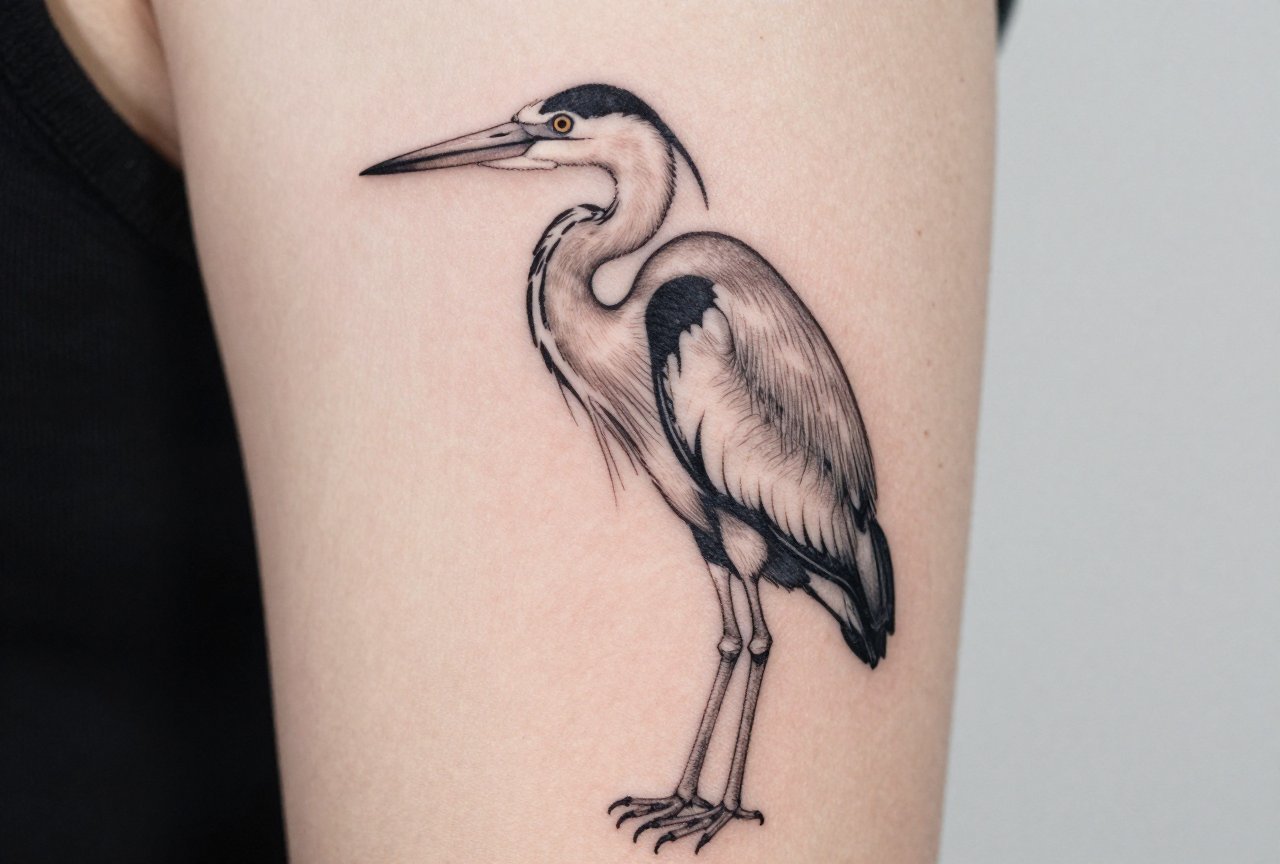
- Standing/wading: The classic pose, emphasizing patience and watchfulness. Works well as vertical compositions along arms, legs, or torso sides.
- In flight: Suggests transition, aspiration, or the release of accumulated tension. The heron’s flight is slow and deliberate, distinct from more frantic bird movements.
- Striking: Captures the moment of action, the sudden transformation from stillness to motion. High drama, suitable for those emphasizing decisive capability.
- Resting/nesting: Less common, but available for emphasizing domesticity, care, or vulnerability.
Stylistic Considerations
Japanese traditional approaches emphasize flowing lines, bold color, and integration with water or plant motifs. The heron’s long neck becomes a vehicle for elegant curve composition. Black-and-grey realism focuses on feather texture, the bird’s almost architectural bone structure, and reflective water surfaces. Illustrative or neo-traditional approaches permit more stylized color palettes and decorative patterning.
Scale matters significantly with heron imagery. The bird’s proportions, long legs, extended neck, substantial body, require adequate space to read clearly. Small tattoos often reduce to silhouette or simplified profile, which can work effectively but sacrifices detail. Medium to large pieces allow the full formal vocabulary: feather layering, eye expression, water interaction.
Placement and Composition
The heron’s vertical emphasis naturally suits certain body locations. Forearms, calves, and ribcage sides accommodate the standing posture without awkward compression. Back pieces permit full scenes with environmental context: reeds, water, sky, companion species.
Compositional pairing offers additional symbolic layering. Herons with lotus flowers draw on shared associations with purity and emergence from murky conditions. Pairing with koi connects to perseverance narratives, though this risks visual cliché without careful handling. Solitary herons maintain the strongest emphasis on self-contained presence.
Color choices carry weight beyond mere preference. Blue herons reference actual species and suggest cooler, more contemplative moods. White herons evoke the Asian integrity associations and offer striking contrast against darker skin. Black-and-grey treatment emphasizes form and shadow, the bird’s sculptural quality.
Personal Resonance and Selection
Choosing a heron tattoo ultimately requires honest self-assessment. The symbolism functions best when it connects to lived experience rather than aspirational self-image. Consider whether you actually practice the patience the heron represents, or if you are cultivating it. The tattoo’s meaning strengthens through this grounding in genuine struggle or confirmed capacity.
Some collectors report that heron imagery helped them through specific periods: recovery from injury, completion of lengthy education, survival of relationship dissolution. The tattoo then serves as permanent marker of that passage, not merely decorative choice. This autobiographical specificity prevents the symbolism from becoming generic.
Consultation with experienced tattoo artists proves valuable here. Artists who regularly work with natural imagery can suggest compositional solutions that align symbolic intention with visual impact. The best heron tattoos result from collaborative dialogue rather than template selection.
Final Thoughts
The heron endures as tattoo subject because it offers symbolism resistant to quick consumption. Unlike more immediately dramatic imagery, the heron rewards sustained attention and repeated viewing. Its meanings unfold gradually, matching the bird’s own temporal rhythm.
For those considering this imagery, the essential question is whether you want a tattoo that announces itself or one that accumulates significance over years. The heron distinctly favors the latter approach. Its quiet strength is not a deficit of spectacle but a positive quality: the power of withheld force, the dignity of appropriate timing, the grace of unhurried movement.
In an era of constant acceleration, the heron tattoo offers a small, permanent dissent. It marks the body with an emblem of patience in impatient times. Whether this registers as political statement, personal reminder, or simply aesthetic preference depends on the individual collector. The bird itself remains indifferent to human interpretation, continuing its ancient hunting patterns regardless of our symbolic investments. Perhaps this very indifference is part of the appeal: the heron exists fully without requiring our meaning-making. We borrow its image, gratefully, temporarily, and try to live up to what it demonstrates.
Frequently Asked Questions
What does a heron tattoo symbolize?
Heron tattoos most commonly symbolize patience, quiet strength, self-reliance, and strategic timing. The bird’s actual behavior, remaining motionless for extended periods before striking with precision, supports these associations across multiple cultural traditions. Additional meanings include adaptability, comfort with solitude, and the dignity of aging gracefully.
Is a heron tattoo better in color or black and grey?
Neither is objectively superior; the choice depends on your symbolic priorities and aesthetic preferences. Black and grey emphasizes the heron’s architectural form, feather texture, and sculptural quality. Color allows species-specific accuracy (blue heron, white egret) and can connect to particular cultural traditions, especially Japanese or Chinese symbolic systems. Discuss both options with your artist during consultation.
Where is the best placement for a heron tattoo?
The heron’s vertical proportions suit elongated body areas: forearms, calves, ribcage sides, and thighs. Standing postures work naturally in these locations. Full scenes with environmental elements require larger areas like the back or chest. Small heron tattoos are possible but typically reduce to simplified silhouette, which sacrifices the detailed feather and eye work that distinguishes quality heron imagery.
What styles work best for heron tattoos?
Japanese traditional, black-and-grey realism, and illustrative/neo-traditional approaches all accommodate heron subject matter effectively. Japanese traditional emphasizes flowing lines and bold color integration with water or plant motifs. Realism focuses on accurate feather texture and reflective surfaces. Illustrative approaches permit more personal color choices and decorative patterning. The best style matches your existing tattoo collection and personal aesthetic rather than forcing a mismatch.