
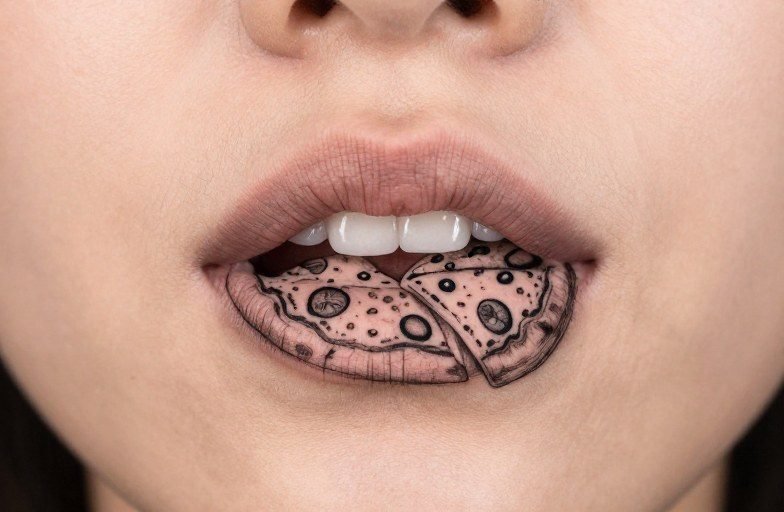
A pizza tattoo inside the lip typically signals irreverence, comfort, and a refusal to take yourself too seriously. It’s a wink at pop culture, a private joke you share only when you choose to flip your lip down. Most people who get this placement aren’t chasing deep symbolism, they’re marking belonging to a certain loose, food-loving, internet-fluent sensibility that treats pizza as shorthand for “the good stuff in life.”
Symbolism & History
Food as Personal Emblem
Food tattoos have moved far beyond chef culture. Pizza specifically carries layered associations: late nights, shared meals, survival on a budget, pure pleasure without pretense. Inside the lip, these meanings compress into something almost secret. The wearer knows it’s there; most of the world doesn’t. That selective visibility mirrors how comfort itself works, present when you need it, invisible when you don’t.
The Lip Placement Tradition
Inner lip tattoos emerged from punk and hardcore scenes in the 1990s and early 2000s, often linked to band logos, slogans, or crude humor. The placement guaranteed near-total concealment, which appealed to people in straight jobs or conservative families. By the 2010s, the style had broadened into mainstream weirdness, food items, emoji, single words. Pizza fit naturally: universally recognized, instantly funny, slightly absurd. Some trace the specific pizza motif to meme culture and the rise of “foodie” identity, where loving pizza became a personality trait rather than merely a preference.
Common Variations & Styles
Not all pizza lip tattoos look alike. The design choices shape how the piece reads and how well it holds up.
- Simple slice outline: Clean black line, minimal detail. Ages best in the lip’s wet environment. Reads as graphic, almost icon-like.
- Whole pie with pepperoni: More detail means more risk. Small dots and color blocks tend to blur faster in inner lip tissue.
- “Pizza” wordmark: Typography-only designs. Script or bold block letters. Easier to execute than imagery, but font choice matters, overly thin lines disappear.
- Combination pieces: Pizza paired with a slice phrase (“in crust we trust,” etc.). These crowd the small canvas and often require touch-ups.
Line work generally outperforms shading in this placement. The inner lip’s mucosal skin sheds and regenerates rapidly; saturated black lines settle more reliably than graywash or color packing. Most artists will advise keeping it under an inch, positioned on the lower lip’s inner center where the tissue is relatively flat and stable.
Best Placements
“Inside lip” isn’t one uniform surface. The lower inner lip offers the most predictable results, thinner, less mobile than the upper lip, easier to stretch and tattoo. The upper inner lip, by the gum line, sees more friction from speech and saliva flow. Pieces here fade faster and can feel more uncomfortable during healing.
Center versus off-center matters too. Dead center on the lower lip sits directly under the frenulum attachment; some artists avoid this zone to minimize irritation. Slightly left or right of center often heals cleaner. The far corners of the mouth are rarely used, they’re harder to access, more painful, and the tissue moves excessively.
Healing reality: expect 3-7 days of noticeable swelling, a thick white film (normal mucosal response, not infection), and potential blowout where ink spreads beyond the intended line. Eating carefully, avoiding alcohol and acidic foods, and using alcohol-free mouth rinse help. Many inner lip tattoos need a touch-up within 6-12 months regardless of aftercare diligence.
Who Chooses This Tattoo / Personal Meanings
The Humor-First Crowd
Plenty of people get this tattoo because the concept itself makes them laugh. It’s anti-grandiosity, a deliberate choice to mark your body with something trivial, temporary-feeling, and joyfully stupid. That stance carries its own philosophy: life is short, pizza is good, not everything needs to be profound. The hidden placement amplifies the joke. You become the only one in on it, until you choose otherwise.
The Comfort & Nostalgia Thread
For others, pizza connects to specific memories, childhood Friday nights, a particular city’s slice culture, a relationship built around shared meals. The tattoo becomes a private anchor, visible only in moments of intentional disclosure. Unlike a forearm piece that prompts constant questions, the inner lip version keeps those associations protected.
Subculture Signaling
In certain circles, especially online-native communities, the pizza lip tattoo operates as low-key credentialing. It says you understand internet humor, you probably have other tattoos, you don’t fear judgment about your choices. It’s rarely someone’s first tattoo, though exceptions exist. More often it joins a collection of similarly playful, poorly behaved pieces.
Similar Symbols
People drawn to pizza lip tattoos often consider related options. Understanding the alternatives clarifies why pizza wins for some and loses for others.
- Other foods: Tacos, donuts, ramen, similar humor and comfort associations, but pizza holds broader cultural recognition. A taco might read more regionally specific; a donut carries different connotations (police jokes, sweetness, “basic” culture).
- Emoji: The slice of pizza emoji itself, rendered exactly. More directly references digital communication, slightly less personal than a stylized drawing.
- Word tattoos: “Snack,” “hungry,” food-related phrases. Lose the visual recognition but gain ambiguity. “Snack” can shift meaning depending on context.
- Traditional flash motifs: Dagger, rose, spider, same placement, entirely different tone. Choosing pizza over these establishes your priorities immediately.
Some people pair the pizza piece with a matching tattoo on a partner or friend, creating a hidden connection. Others get it as a counterweight to more serious work elsewhere on their body, the permanent equivalent of a whoopee cushion in a formal room.
Final Thoughts
A pizza tattoo inside the lip won’t change your life. It might not last more than a few years without refreshing. The meaning, such as it is, lives in the choice itself: to mark your body with something frivolous, to hide it where only you control its visibility, to align yourself with pleasure and humor over solemnity. That’s enough for the people who seek this piece out. If you’re considering it, find an artist with specific inner lip experience, this isn’t a placement for someone’s first attempt. Ask to see healed photos, not just fresh work. Be realistic about fading, and choose a design that’ll still read as pizza even when the lines soften. The best pizza lip tattoos look like exactly what they are: a small, dumb, perfect thing that made someone happy.
Frequently Asked Questions
How long does an inner lip pizza tattoo usually last?
Most inner lip tattoos fade significantly within 1-3 years due to rapid cell turnover in mucosal tissue. Many people need touch-ups annually to maintain crisp lines, and some find the design becomes unreadable regardless of care.
Does getting a tattoo inside your lip hurt more than other spots?
Pain varies by individual, but the inner lip ranks fairly high for most people due to dense nerve endings and the difficulty of stretching such sensitive tissue. Sessions are typically short, often under 20 minutes, which helps limit the discomfort.
Can you get color in a lip tattoo, or should it be black only?
Black and dark red are the most reliable choices for inner lip work. Lighter colors and complex shading tend to blur or disappear entirely as the tissue heals. Some artists will attempt limited color, but they usually warn clients about unpredictable results.
Will a pizza lip tattoo affect my speech or eating while healing?
Swelling during the first few days can cause temporary lisping and discomfort while eating. Most people adapt quickly by choosing soft, non-acidic foods and avoiding alcohol. Long-term speech changes are extremely rare once healing completes.
Related Tattoo Meanings
- Please Lip Tattoo Meaning: Symbolism, Styles Placement
- Poisonous Tree Tattoo Meaning: Danger, Growth Protection
- Post Malone Face Tattoo Meaning: Broken Sword Barbed Wire
- Explore more









