Phoenix Tattoo Meaning: Rebirth, Resilience & Rising Strong
The phoenix occupies rare territory in tattoo culture. A creature that never existed in flesh yet persists across millennia of human imagination. Its appeal lies not in zoological accuracy but in the architecture of its myth: total destruction followed by absolute renewal. For anyone considering this design, understanding the layers beneath the feathers helps ensure the final piece resonates beyond surface aesthetics.
Origins and Cross-Cultural Roots
The phoenix narrative threads through civilizations with remarkable consistency. Ancient Egyptian sources describe the bennu bird, often linked to solar cycles and the god Ra, though scholars debate how directly this influenced later Greek conceptions. Greek writers from Herodotus onward shaped the phoenix into the fire-born creature most recognize today: a being that lives for centuries, builds a pyre, and emerges renewed from the ashes.
Chinese mythology offers the fenghuang, a paired bird of prosperity and virtue rather than solitary rebirth. Japanese tradition adapts similar motifs through the hō-ō, associated with imperial virtue and the arrival of enlightened rulers. Persian and later Byzantine iterations each added regional color to the core narrative.
The Persistence of the Fire-Born Motif
What explains this cross-cultural endurance? The phoenix compresses a universal human experience into singular visual drama. Mortality confronts every culture; the fantasy of transcending it through transformation rather than mere continuation satisfies something deeper than simple wish-fulfillment. The bird does not evade death. It metabolizes death into life. This distinction matters for tattoo selection. The design declares not escape from hardship but passage through it.
Core Symbolism for Tattoo Wearers
Contemporary phoenix tattoos cluster around several interconnected meanings, though individual interpretation always shapes the final significance.
- Rebirth and new beginnings: Recovery from addiction, the end of a destructive relationship, career pivots, spiritual conversions. The phoenix marks threshold moments when a previous self has been left behind.
- Resilience through ongoing struggle: Not all rebirths resolve cleanly. Some wearers choose the phoenix during active hardship, the fire not yet extinguished. The design becomes aspirational rather than commemorative.
- Survival of trauma: Medical recovery, abuse survival, combat experience. The imagery offers symbolic language for experiences that resist straightforward narrative.
- Transformational identity: Gender transition, name changes, cultural reclamation. The phoenix frames change as organic rather than artificial.
Personal Meaning Versus Cultural Weight
These categories overlap considerably. Someone surviving chemotherapy might equally emphasize rebirth, resilience, and transformation. The tattoo’s power emerges from the specific intersection of universal symbol and private circumstance. A skilled artist helps navigate this translation from interior experience to exterior image.
Design Variations and Their Implications
Phoenix tattoos accommodate extraordinary stylistic range. Each approach carries distinct connotations and technical considerations.
Traditional Japanese (irezumi): Typically rendered in bold outlines with limited color palette, often paired with paulownia or maple leaves. The Japanese phoenix carries associations of justice, fidelity, and cosmic order. Full back or body suit placement maintains historical precedent. These pieces demand artists with specific training in classical conventions.
Neo-traditional and illustrative: Expanded color vocabulary, exaggerated proportions, decorative patterning. Permits more individual expression while retaining readable iconography. Suits medium to large scales; forearms, thighs, torsos.
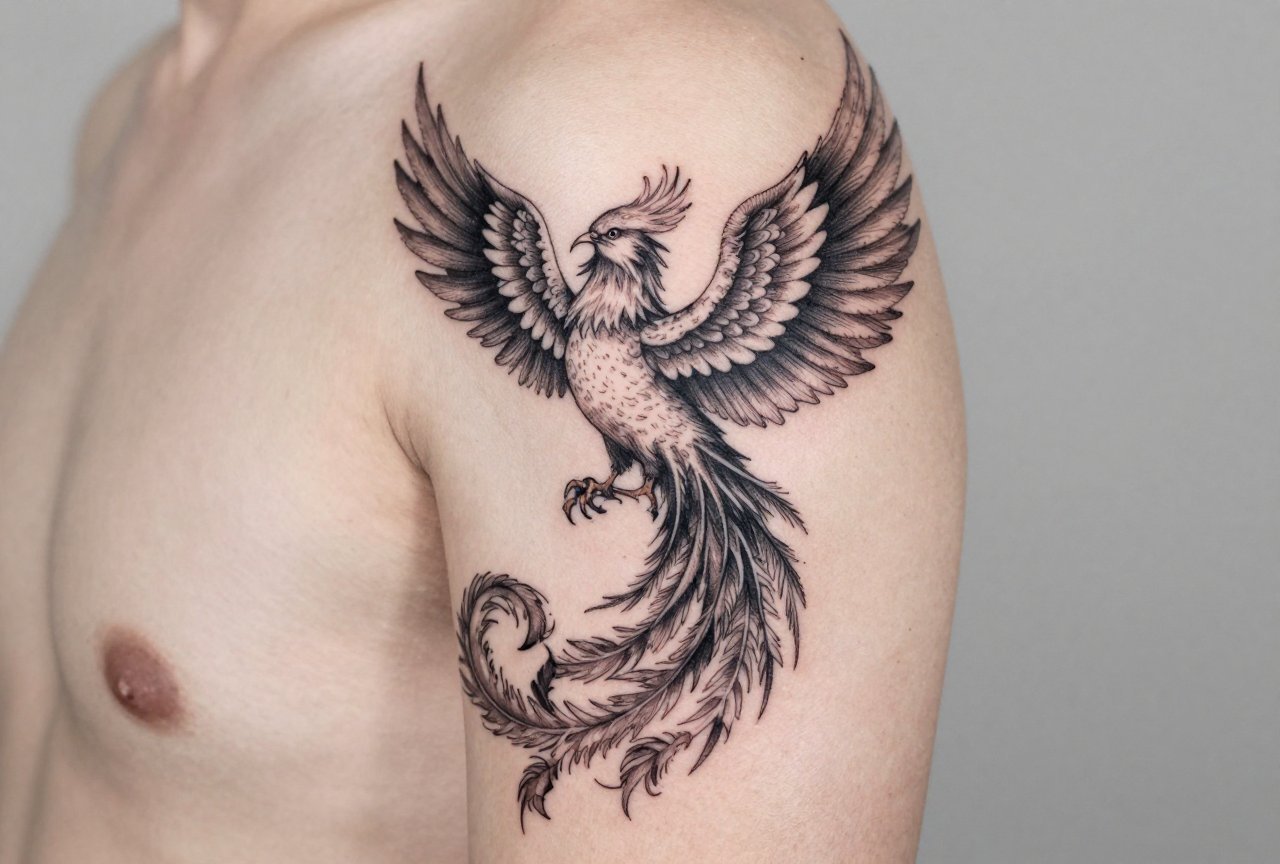
Black and grey realism: Smoke and ash become textural opportunities. The absence of color can emphasize somber aspects of the narrative. Requires exceptional technical skill to prevent muddiness in the feather details.
Minimalist and geometric: Reduced to essential silhouette or constructed from angular planes. Effective for smaller placements, though the phoenix’s inherent complexity resists extreme simplification. Best executed with precise line work and negative space planning.
Placement and Scale Considerations
The phoenix’s wing structure and trailing tail feathers naturally favor vertical or diagonal compositions. The spine, ribcage, and outer thigh provide anatomical curves that complement the bird’s posture. Small phoenix tattoos on wrists or ankles often sacrifice recognizability for placement convenience; consider whether a partial image or stylized feather might serve better at reduced scale.
Color Symbolism and Technical Execution
Color choices in phoenix tattoos carry both traditional associations and practical implications for longevity.
- Orange and red: The conventional flame palette. Connects directly to the fire-rebirth narrative. These pigments, particularly reds, historically showed faster fading but modern formulations have improved considerably.
- Blue and purple: Often linked to spirituality, mystery, or cooler emotional registers. Creates visual distance from the literal fire interpretation.
- Gold and yellow: Solar associations, triumph, regal transformation. Effective for highlighting but can appear muddy if overapplied.
- Black and grey: Mortality emphasis, the ash rather than the flame. Suits narratives where destruction precedes and perhaps outweighs renewal.
Color saturation affects aging substantially. The phoenix’s feather structure, with fine individual barbs, challenges long-term clarity. Discuss with your artist how specific hues in their preferred palette behave at five, ten, fifteen years. Some bold contemporary pigments shift unpredictably; conservative color planning often serves permanence better than immediate visual impact.
Choosing Your Artist and Refining Your Concept
Not every talented tattooist specializes in avian or mythological subjects. Portfolio review should examine specifically: feather rendering quality, fire or smoke depiction, dynamic posing in flying creatures, and color saturation in healed work. The phoenix demands all four.
Consultation preparation improves outcomes significantly. Collect reference images not merely of other phoenix tattoos but of actual birds in flight, flame photographs, and art historical sources that resonate. Distinguish between aesthetic preferences and symbolic priorities. An artist can adapt style more readily than core meaning.
Questions Worth Asking During Consultation
How would you approach the transition from burning body to emerging form? What scale do you consider minimum for the detail level I want? How do you handle color aging in pieces with extensive warm tones? Can you show me healed examples of similar complexity? The responses reveal both technical competence and collaborative disposition.
Living With the Phoenix
A phoenix tattoo commits to visibility. Unlike designs that retreat easily beneath clothing, the bird’s scale and drama typically claim substantial skin real estate. Consider professional contexts, family dynamics, and personal comfort with ongoing explanation. The symbol’s near-universal recognition means questions will arise.
This visibility can become part of the practice. The tattoo serves as external accountability to internal transformation. Having marked the skin with rebirth, the wearer navigates ongoing life with that declaration present. Some find this pressure generative; others prefer more private symbolism. Neither choice indicates superior authenticity.
Final Thoughts
The phoenix endures in tattoo culture because it addresses something genuinely difficult: how to represent change that originates in destruction without romanticizing the destruction itself. The fire hurts. The burning is real. The renewal that follows does not erase what preceded it.
Selecting this design means entering a visual conversation spanning Egyptian temple walls, medieval bestiaries, Japanese woodblock prints, and contemporary skin. The conversation continues with your specific iteration. What burned. What rose. What remains ash.
Work with artists who respect the weight of that conversation. Invest in technical execution that honors temporal scale. And allow the meaning to settle gradually, as skin heals and narrative clarifies, into something that genuinely belongs to your particular experience of rising again.
Frequently Asked Questions
Does a phoenix tattoo always have to include fire or flames?
No. While flames are the most common visual shorthand for the rebirth narrative, many effective designs emphasize the bird itself, rising smoke, or ash remnants. Some minimalist interpretations use only the silhouette or a single feather to suggest the full myth. The absence of literal fire can shift emphasis toward the renewal rather than the destruction phase.
How large should a phoenix tattoo be to work effectively?
Most successful phoenix tattoos require at least palm-sized dimensions to preserve feather detail and wing structure. Smaller designs often sacrifice recognizability or force excessive simplification. For full narrative impact, including burning and rebirth elements, consider forearm, thigh, back, or torso placement that permits vertical composition.
Can a phoenix tattoo work in all-black ink?
Absolutely. Black and grey phoenix tattoos emphasize texture, mortality, and solemnity over triumphal color. The approach demands exceptional skill in smoke and feather rendering to prevent visual muddiness. Discuss with your artist how they plan to create depth without color temperature variation.
Is the phoenix exclusively a feminine tattoo design?
The phoenix carries no inherent gender association. Historical depictions span masculine and feminine contexts across cultures. Contemporary tattooing sees the design chosen across all gender identities. Personal narrative and aesthetic preference determine suitability far more than any demographic convention.