I’ve had a lot of clients sit in my chair wanting something venom-themed. Sometimes it’s the Marvel antihero, sometimes it’s actual snake venom, sometimes it’s just that thick black drip aesthetic that looks like it’s eating through skin. The word means different things to different people, and that’s actually the cool part. What unites them all is wanting something that looks dangerous, alive, and a little unsettling. Here’s what I’ve learned from tattooing these designs and watching them heal over the years.
Popular Styles
Not every style handles the venom concept equally well. Some look incredible fresh but fall apart in five years. Others age like armor.
Blackwork and Dark Realism
This is what most people picture. Thick black ink, high contrast, that wet-looking drip effect. I’ve done pieces where the venom looks like it’s pooling in the hollow of someone’s collarbone, catching light like actual liquid. The trick is building up saturation gradually. Go too heavy too fast and you blow out the edges. The best blackwork venom tattoos use negative space strategically, little skin breaks that read as highlights on the surface tension of the “liquid.”
Dark realism takes this further. I’ve tattooed snakes mid-strike where the venom sac is actually visible, the muscle tension rendered in graywash. These pieces need room to breathe. You can’t cram that detail into something palm-sized and expect it to hold.
Neo-Traditional and Graphic Styles
Bolder outlines, limited color palette, more symbolic than literal. Think old flash sheets but with venom dripping from the dagger, the snake’s fangs exaggerated to cartoon proportions. These age better than almost anything because the line weight carries the design even as color softens. I’ve got a client from six years ago whose neo-traditional rattler still reads clean from across the room. The venom drops were just simple teardrop shapes with a highlight dot. Simple works.
- Blackwork: demands perfect saturation, risks blowout if rushed
- Dark realism: needs scale, minimum 4-5 inches for detail
- Neo-traditional: forgiving, ages excellently, travels well
- Graphic/illustrative: can mix text, abstract shapes, more experimental
Design Ideas
Here’s where I get into actual concepts I’ve tattooed or drawn up for consultations.
The Character Route
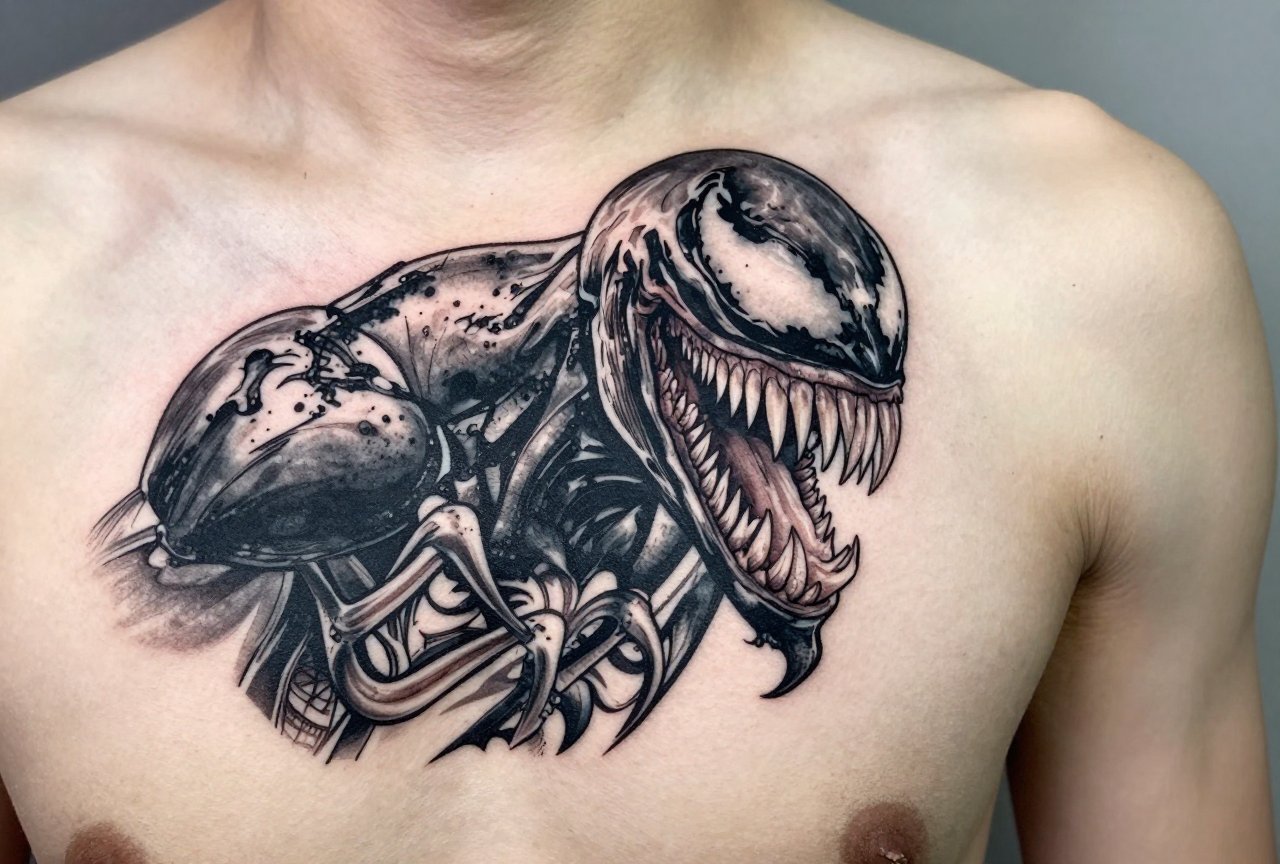
Marvel’s Venom is its own whole category. The symbiote’s face, the tongue, the white spider emblem on black, it’s instantly readable. I’ve done full sleeves of Eddie Brock’s transformation sequence, the face splitting open. I’ve also done single-needle versions of just the eyes that look like they’re watching you from the skin. The character works at any scale, which is rare. Small behind-the-ear Venom eyes? Hit hard. Full back piece with the jaw unhinging? Obviously hits harder.
The key with character work is reference quality. I keep a folder of comic panels and stills from the films, but I always redraw. Direct copies look flat. You want an artist who understands the anatomy underneath the monster.
Organic and Biological
Actual venom delivery systems in nature are gorgeous. Fangs with venom grooves visible. The way a gaboon viper’s fangs fold like switchblades. I’ve tattooed cross-sections of snake heads showing the venom gland connected to the hollow fang. One client wanted a spitting cobra with the venom stream rendered as negative space through a black background, so the spray was literally their skin tone.
Spider venom hits different aesthetically. The drip from a black widow’s fangs, the amber color of recluse venom. Less dramatic than snakes but more precise, more clinical. Appeals to a different kind of collector.
- Symbiote portrait with liquid edges melting into skin
- Snake skull with venom gland exposed
- Spider fangs dripping, framed in web
- Vial of venom, apothecary style, with handwritten label
- Abstract: black drip with chemical structure of actual venom compound
Best Placements
Where you put this matters more than most subjects. Venom is about flow, about gravity, about direction.
I’ve tattooed the drip effect trailing down from the elbow toward the wrist, and the reverse feels wrong every time. Venom falls. It pools. It follows anatomy. The forearm’s inner curve is perfect for a collecting pool. The throat’s hollow, same thing. I’ve done collarbone pieces where the black appears to be running down toward the heart. One guy wanted it on his calf and I had to talk him through why the vertical orientation there reads as rain, not venom.
Hands and fingers are popular but I always warn: these spots shed ink fast. The black drip on a finger looks incredible for six months, then it’s a gray smudge. If you’re committed to hand work, plan for touch-ups. Accept it as maintenance.
Thighs and ribs give you the real estate for something that unfolds. I’ve done a full thigh piece of a snake’s open mouth, the venom stream wrapping around to the hip. The curvature of the body became part of the composition. That’s the placement working with the design, not just hosting it.
- Forearm: classic, visible, follows natural drip direction
- Throat/collarbone: intimate, dramatic, hurts more
- Thigh: scale, privacy, curves complement flow
- Hand: high commitment, high maintenance, instant impact
- Ribcage: large canvas, painful session, worth it for the right piece
Color Choices
Most venom tattoos live in black and gray. That’s the expectation. But I’ve pushed color in ways that really land.
Staying in Black and Gray
Graywash lets you build that translucent quality. Actual venom isn’t opaque. It’s fluid, it catches light. I use three-needle configurations for the finest gray tones, switch to mag shaders for the deep pools. The transition between light and dark is where the magic lives. Bad graywork looks like a gray blob. Good graywork looks like you could dip your finger in it.
Adding Color Strategically
When I do use color, it’s usually one accent. Amber for actual snake venom. Sickly green for the symbiote’s tongue. I’ve done a piece where the only color was a tiny injection of purple around the puncture wound of a bite, just that bruise beginning. One color, used like a knife.
Red is tricky. Blood and venom are different things, and mixing them muddies the concept. I’ve had clients ask for both and I usually push them toward one or the other. Commit to the venom. Let it be its own thing.
- Black and gray: timeless, heals most predictably
- Single accent color: green, amber, or purple for specific references
- Full color: rare, usually for character work only
- White ink highlights: fade fast, use sparingly, plan for refresh
Tips for Choosing
I’ve watched too many people rush into venom pieces because they look cool on Instagram. Here’s what I tell clients in consultation.
First, know which venom you mean. The symbiote? Actual biological venom? The abstract aesthetic? These aren’t interchangeable. An artist who crushes Marvel character work might struggle with biological accuracy. I’ve referred clients to colleagues when the reference material was outside my wheelhouse. Good artists do this. Be suspicious of anyone who says they can do everything.
Second, consider your lifestyle. Venom tattoos read aggressive. They’re black, they’re dripping, they suggest danger. I’ve had teachers and nurses reconsider placement because of workplace visibility. That’s not cowardice, that’s planning. We can hide things. Inner bicep exists for a reason.
Third, budget for the long game. Heavy black saturation needs touch-ups. The drip effect that looks so wet and fresh will settle. In five years, those perfect highlights might need refresh. I build relationships with clients, not one-off transactions. Find an artist who thinks the same way.
Finally, bring reference but stay open. The best piece I did last year came from a client who wanted a cobra strike, but let me redesign the angle based on his shoulder movement. The tattoo looks alive when he flexes. That collaboration is everything.
- Define your specific venom concept before booking
- Match artist to subject matter, not just style
- Plan for visibility in your actual life
- Budget for touch-ups, especially saturated blackwork
- Stay flexible in consultation, your body isn’t flat paper
Final Thoughts
Venom tattoos have staying power because the concept is primal. Danger, transformation, the thing that lives inside and might escape. I’ve tattooed enough of them to know the best ones come from clients who understand why they’re drawn to it, not just what they want to look like.
The symbiote speaks to duality. The snake speaks to patience and sudden violence. The abstract black drip speaks to something more internal, harder to name. Whatever your version is, find an artist who gets it. Sit in their chair. Let them draw. The tattoo will outlast the trend, and if it’s done right, it’ll look more true as your skin changes, not less.
I’ve got a venom piece myself, biological, not character, a copperhead’s fang on my left forearm. Six years old now. The graywash settled into something softer, more like memory. That’s what good ink does. It lives with you.
Frequently Asked Questions
How long does a heavy black venom tattoo take to heal?
Expect 2-3 weeks for the surface to close, but the real settling happens over 2-3 months. Heavy saturation can look patchy during healing, don’t panic. I tell clients to trust the process and book their touch-up for the 3-month mark, not earlier.
Will a venom drip tattoo stretch if I gain muscle?
Any tattoo on muscle-prone areas shifts some, but the drip style is actually forgiving. The organic flow disguises minor stretching better than rigid geometric designs. I avoid placing the focal drip point exactly on the peak of a bicep or other high-flex area.
Can you cover up an old tattoo with a venom design?
Blackwork venom is excellent for cover-ups, the heavy saturation and organic edges eat old ink well. I’ve covered tribal pieces and faded script with symbiote tendrils. The key is letting the artist design around what needs hiding, not forcing a stock image.
What’s the most painful spot for a venom tattoo?
The throat hollow and sternum make grown men grit their teeth. The skin is thin, the bone is close, and the vibration hits different. I’ve had tough clients tap out on throat pieces. If you want that placement, come fed, hydrated, and mentally prepared for a shorter session.
More Tattoo Ideas
- Spiderman Tattoo Ideas That Actually Work
- Snake Tattoo Meaning: Rebirth, Protection and Danger
- 21+ Fish Tattoos That Work With Your Skin Not Against It
- Explore more