Soccer Tattoo Ideas That Actually Work on Skin
Translating the beautiful game into permanent ink requires more than enthusiasm for your club. The pitch offers motion, geometry, and raw emotion, yet skin imposes its own constraints. What looks powerful on a jersey or banner often needs fundamental rethinking to hold up over decades. These ideas have proven themselves across years of healed work, not just fresh photos.
Best Placements
The body becomes your canvas, but certain areas naturally complement soccer imagery better than others. Movement and visibility should guide your decision, not just pain tolerance or hiding potential.
High-Impact Zones
Calves and thighs carry the sport’s energy with particular authenticity. The leg’s musculature echoes the athletic subject, and a well-placed ball or cleat follows the natural curve of the muscle beneath. Forearms work exceptionally for tactical diagrams or jersey numbers, offering constant visibility without requiring a mirror to appreciate. The ribcage and side accommodate sweeping compositions: a goalkeeper’s diving save, a stadium silhouette, the arc of a corner kick frozen mid-flight.
Shoulders and upper arms provide stable, relatively flat surfaces ideal for detailed ball textures or portrait work. Here, the skin ages more predictably than on hands or feet, preserving fine lines longer.
Subtle and Strategic Locations
- Behind the ear: tiny studs or minimalist goalposts, visible only when hair is tied
- Inner bicep: personal mantras, coordinates of meaningful pitches, or match dates in your own numbering system
- Ankle: continuous line work suggesting motion, wrapping like a shin guard strap
- Finger sides: micro balls or whistle silhouettes, though these blur faster than larger work
Feet present a particular challenge. The skin there sheds rapidly and holds ink poorly. A ball on the foot often becomes an unrecognizable blob within five years. If foot placement feels essential, consider the top rather than the sole, and expect touch-ups.
Design Tips & Pairings
Successful soccer tattoos solve visual problems rather than merely reproducing familiar imagery. The most enduring designs abstract the sport’s essence rather than illustrating it literally.
Compositional Strategies
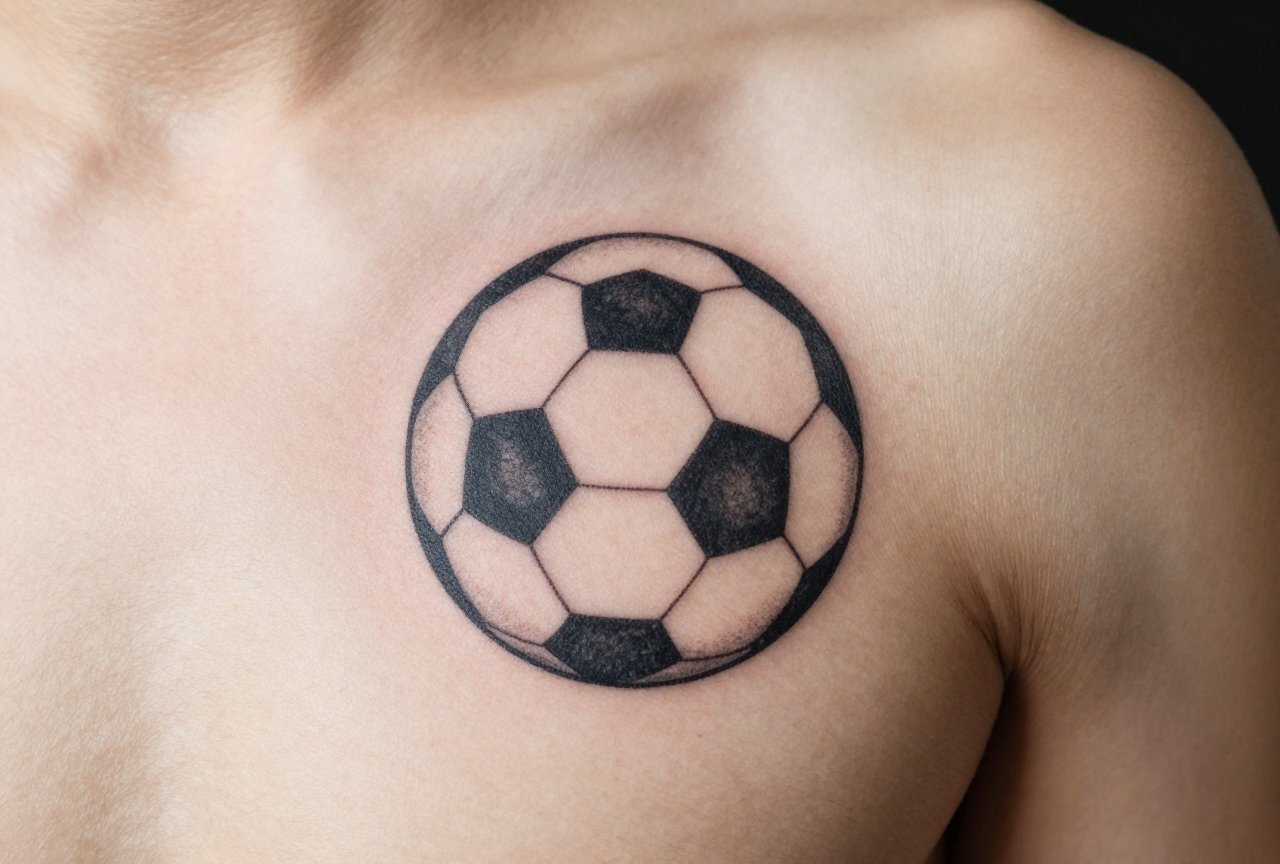
Negative space proves invaluable. A goal net rendered through skin-toned gaps within black ink creates texture without overwhelming density. Silhouettes of players mid-action, stripped of facial detail, avoid the uncanny valley that dooms many portrait attempts. Geometric deconstruction of a ball’s hexagonal pattern scales elegantly from small wrist pieces to full back panels.
Consider integrating established tattoo vocabularies: traditional bold lines for vintage club crests, fine single-needle for contemporary minimalist interpretations, or ornamental framing for trophy and achievement pieces. The sport itself need not dominate; a rose whose stem curves into a corner flag, or a clock stopped at match time, often resonates more deeply than overt imagery.
Meaningful Combinations
- Coordinates + pitch outline: specific grounds where transformation occurred
- Player silhouette + native flora: grounding athletic identity in place
- Tactical formation + constellation pattern: the geometry of teamwork and individual fate
- Jersey number + parental handwriting: lineage and inherited passion
- Scuffed ball texture + wood grain: the passage of time on beloved equipment
Avoid cramming multiple elements into small spaces. A crest, number, quote, and ball fighting for space on a forearm will age into indistinguishable gray soup. One strong concept, given room to breathe, outlasts any collage.
Color vs Black and Grey
The choice between palettes shapes not just aesthetics but longevity and cost over your lifetime.
Black and grey excels for stadium architecture, historical photography references, and any design emphasizing form over affiliation. It heals more predictably, fades more gracefully, and generally requires less maintenance. For supporters of clubs with iconic monochrome identities, this restriction becomes a strength rather than compromise.
Color demands more from both artist and collector. Saturated reds, greens, and blues in club crests can look electric when fresh, but yellows and lighter tones often shift toward muddy olive or peach within a decade. Strategic color placement, limited to key identifying elements against a black and grey foundation, frequently outperforms fully saturated approaches. The human eye reads a red poppy or blue stripe instantly even when surrounded by monochrome detail.
Skin tone fundamentally alters how color reads. Deep, saturated pigments generally show more vibrancy on lighter skin, though excellent artists achieve striking results across all tones through adjusted saturation and contrast strategies. Discuss specific ink brands and their documented behavior on skin similar to yours.
Choosing the Right Artist
Technical proficiency in tattooing does not automatically translate to compelling soccer imagery. The right collaborator possesses specific, demonstrable experience with your chosen approach.
Examine healed work, not just fresh photography. A portfolio heavy in sports imagery suggests genuine interest rather than opportunism. For photorealistic player portraits, verify the artist’s comfort with human features at scale; many excellent tattooists avoid faces entirely. For geometric or abstract work, look for precision in line weight consistency and pattern repetition across multiple healed pieces.
Geographic proximity matters less than alignment. Many collectors travel for artists who specialize in their specific vision. Budget accordingly: quality work from established practitioners typically commands rates reflecting their demand and skill level. The cost of removal or cover-up far exceeds the premium for getting it right initially.
During consultation, observe whether the artist questions your concept constructively. Someone who simply agrees to any request without suggesting compositional improvements or flagging potential aging problems may prioritize the booking over your long-term satisfaction.
Personal & Modern Meanings
Soccer tattoos carry significance that often diverges from obvious fandom. Understanding this range helps you articulate what you actually want, not what you think a soccer tattoo should represent.
Beyond Club Loyalty
The sport frequently encodes broader life experiences. Immigration narratives surface through club crests from left-behind homelands, or through pitch coordinates spanning continents. Recovery from injury, physical or psychological, finds expression in imagery of return: the substitution board, the rehabilitation timeline, the standing ovation after absence. For some, the ball represents childhood itself, the last unscripted period before adult structure.
Contemporary approaches increasingly reject literal representation altogether. Sound wave tattoos of crowd chants, though technically challenging, capture atmosphere without visual cliché. The offside line, rendered as a minimal horizon, speaks to marginal existence and contested belonging. Even the penalty kick’s psychological weight, the solitary figure against the goalkeeper, translates into compositions about individual pressure and public judgment.
Collective and Communal Dimensions
Matching or complementary pieces between teammates, siblings, or parent and child create bonds that outlast any single season. The design’s success depends on functioning independently while gaining resonance from its pair. Simple shared elements, a consistent geometric motif or coordinated placement, prove more sustainable than elaborate connecting compositions that require both participants present for full effect.
Who Chooses This Tattoo
No single demographic dominates soccer tattoo collectors, though patterns emerge across my years observing this particular niche.
Professional players often choose understated pieces: small coordinates, family numbers, or symbolic references recognizable only to insiders. The visibility of their bodies for commercial purposes, combined with league regulations, generally discourages prominent work. Retired players frequently commission more substantial pieces as second careers begin, the tattoo marking transition rather than current status.
Amateur players and dedicated supporters form the largest group. Age ranges widely, from late teens committing to first clubs through middle-aged collectors memorializing decades of attendance. Gender distribution has shifted notably; women now represent a growing proportion of soccer tattoo inquiries, particularly around women’s club and international achievements.
Coaches and referees occasionally choose imagery reflecting their specific relationship to the game: the tactical board, the whistle, the fourth official’s numbered panels. These often carry more abstracted, less celebratory tones than player or supporter pieces.
The unifying thread is not skill level or role but sustained emotional investment. Casual viewers rarely commit permanently. The tattoo marks a relationship that has already proven durable, not one wished into existence.
Before You Decide
Live with your concept mentally before committing physically. Sketch variations, or have an artist produce multiple approaches. Consider how the design interacts with professional contexts you cannot yet foresee, and how it might read at sixty as clearly as at twenty-five.
Research the specific imagery’s broader associations. A number you wore might coincide with infamous figures. A club crest adopted during ownership controversies may carry complications you would not choose to embody. The sport’s global reach means symbols accumulate layered, sometimes contradictory meanings across cultures.
Finally, budget for quality and for maintenance. Even excellent tattoos benefit from periodic refreshment as skin changes. The initial investment is only the beginning of a lifelong relationship with both the artwork and what it represents.
Your skin deserves the same care you would bring to any pitch: preparation, respect for the surface, and attention to what will endure beyond the immediate moment.
Frequently Asked Questions
How do soccer tattoos age compared to other sports-themed tattoos?
Soccer imagery presents specific aging challenges. Ball textures with fine hexagonal patterns often blur faster than simpler geometric designs. Action poses with extended limbs can distort as skin shifts. Black and grey tactical diagrams and minimal silhouettes generally age most gracefully, while detailed color crests require more frequent refreshment. The constant motion inherent to soccer poses, when frozen in tattoo form, demands particularly thoughtful placement on body areas with stable skin.
Can I get a tattoo of my favorite player’s likeness?
Photorealistic portraiture is among tattooing’s most technically demanding specialties. Many excellent tattooists avoid faces entirely. If you proceed, verify the artist’s healed portrait work specifically, not just fresh photography. Consider whether you want the player as they appeared at a specific moment, which dates the piece, or a more timeless stylized approach. Also understand that public figures’ likenesses exist in complex legal territory, though personal tattoos rarely trigger enforcement.
What if my club changes its crest or I switch allegiance?
This concern shapes many experienced collectors’ approaches. Abstracted elements, a single color stripe, or a founding date often outlast specific visual identities. Some choose stadium architecture or local symbols over crests. If club loyalty feels central, consider placement that accommodates modification or coverage. The most enduring soccer tattoos typically encode why the club mattered, not just which club, allowing meaning to persist even if affiliations evolve.
Is it appropriate to get a tattoo commemorating a tragic stadium event?
Memorial tattoos require particular sensitivity. Research whether survivor organizations or affected families have articulated preferences about how such events are represented. Avoid replicating graphic imagery from media coverage. Consider whether the design serves private remembrance or public statement, and whether those purposes align. Some choose to support related causes financially rather than or alongside permanent marking. The intention behind such tattoos matters enormously, but intention alone does not guarantee respectful execution.