
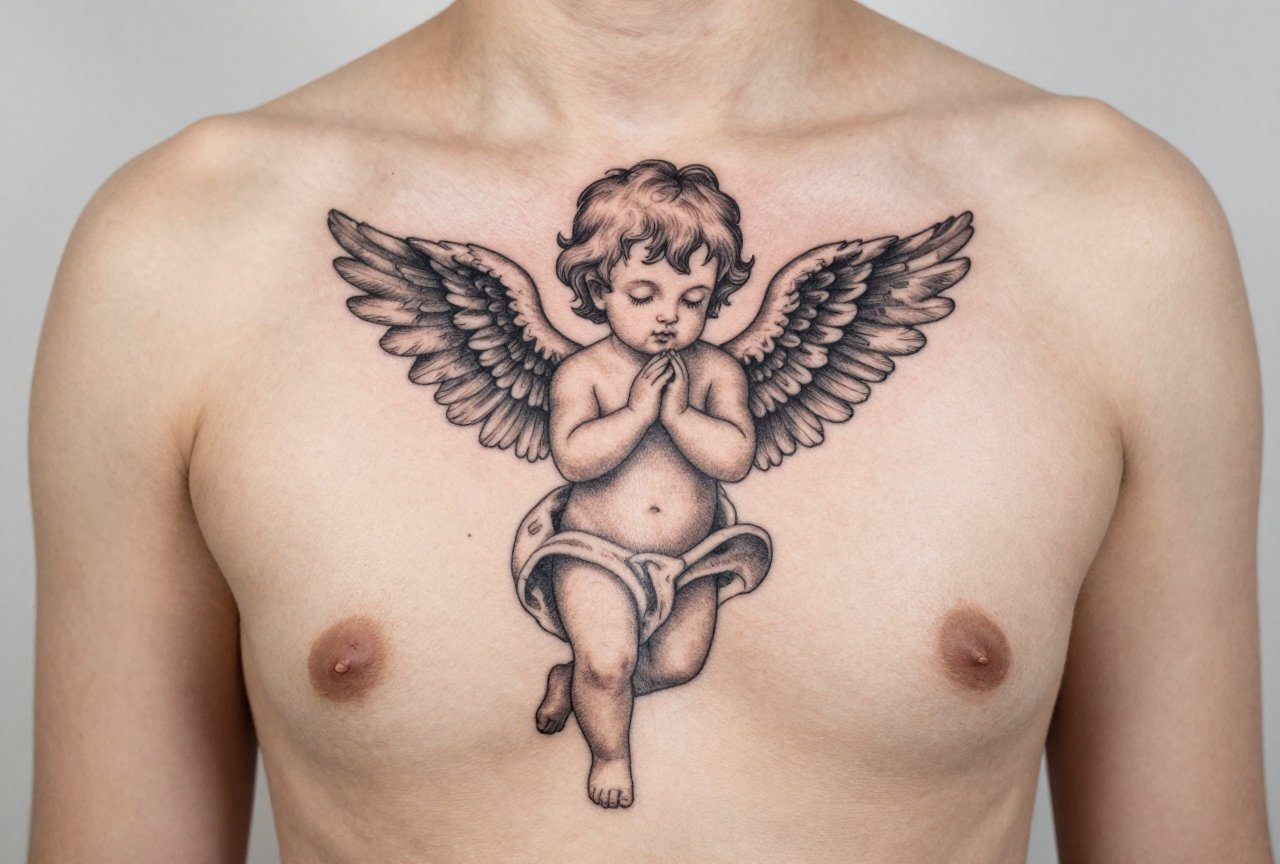
Cherubim tattoos most commonly represent innocence, spiritual love, and connection to something beyond the everyday. In my chair, I’ve seen them serve as memorials for lost children, celebrations of new parenthood, and quiet declarations of faith. The meaning shifts dramatically based on how you render them, soft and classical versus bold and modern changes everything.
Symbolism & History
The cherubim most people picture, that chubby baby with wings, comes from Renaissance art, not biblical text. Actual cherubim in religious tradition are fierce, multi-faced guardians. But tattoo culture has embraced the Renaissance version for centuries. Sailors got them. Soldiers got them. The imagery traveled through flash sheets in the 1940s and never really left.
What draws people in is the emotional accessibility. A cherub isn’t threatening. It carries weight without demanding explanation. I’ve tattooed them on bikers and on grandmothers, and the symbolism bends to fit whoever wears it.
Religious vs. Secular Meanings
For believers, the cherub represents divine presence, God’s love made visible and gentle. For non-religious clients, it often symbolizes lost innocence, childhood memory, or the protective instinct they feel toward their own kids. The same image holds both readings simultaneously. That’s part of its power.
The Guardian Aspect
Many clients specifically request a cherub “watching over” something, a name, a date, another symbol. This guardian framing is huge in memorial work. I’ve done cherubs with empty cradles, with folded letters, with tiny footprints. The angel becomes a stand-in for the person who can’t be there physically.
Common Variations & Styles
Not all cherubs look alike. The style you choose completely changes the tattoo’s feel and how it ages.
- Classical/Renaissance: Soft shading, round forms, often with draped fabric or clouds. These age beautifully if your artist understands skin tone and contrast. Too light, and they blur into mush in five years.
- Traditional/Americana: Bold black outlines, limited color palette, stylized wings. Holds up incredibly well. We see this a lot in shops because the strong lines fight time.
- Black and grey realism: Photographic detail, dramatic lighting. Stunning when fresh, but requires a skilled hand and good aftercare. Fine details in faces can soften faster than you’d want.
- Neo-traditional: Bold lines with expanded color, decorative elements, sometimes darker emotional tones. Great for clients who want the sweetness with an edge.
- Minimalist/line work: Single needle, delicate, often just the silhouette or a few flowing lines. Trendy right now, but I always warn clients, thin lines spread. Plan for touch-ups.
Common Companion Elements
Cherubs rarely fly solo in tattoo design. Hearts, obviously. Names and dates. Roses for love and loss. Hourglasses for time passing. I’ve done cherubs breaking chains, cherubs with boxing gloves, cherubs smoking cigarettes (don’t ask). The base image is flexible enough to carry almost any personal narrative.
Best Placements
Where you put a cherub matters as much as how you draw it. These aren’t tiny detail pieces for the most part, they need room to breathe.
- Chest/pec: Classic placement. The cherub sits over the heart, literally protecting what matters. Traditional designs thrive here. Plenty of flat skin for clean lines.
- Upper arm/shoulder: The wing curve follows the shoulder cap naturally. I’ve done dozens where the wing extends onto the deltoid while the body faces forward on the arm. Flows with the muscle.
- Back piece: For larger compositions, multiple cherubs, clouds, full scenes. The back gives you a canvas to build atmosphere.
- Ribs: Painful, but the vertical space suits a descending cherub or one in profile. Soft shading here can look incredible as the body moves.
- Thigh: Increasingly popular, especially for women who want something visible on their own terms. Good real estate for detail without the rib pain.
One thing I tell clients: cherubs have faces. Faces need to be sized large enough to hold detail. A dime-sized cherub head becomes a smudge in a decade. Plan for at least a few inches minimum if you want it to read as a face in ten years.
Who Chooses This Tattoo / Personal Meanings
After fifteen years in shops, I can tell you there’s no single “cherub person.” I’ve tattooed them on:
- Fathers memorializing miscarriages or stillbirths
- Mothers celebrating surviving children
- People marking their own survival, recovery from illness, addiction, abuse
- Religious converts claiming their faith visibly
- Artists who simply love classical imagery
- Partners getting matching pieces for anniversaries
The common thread isn’t demographic. It’s a need for softness in a hard world. The cherub is gentle. That’s increasingly rare in tattoo culture, where aggressive imagery often dominates. Choosing sweetness is itself a statement.
The Memorial Connection
I want to be real about this: a huge percentage of cherub requests involve loss. Not all. But many. Clients sometimes cry in the chair. Sometimes they tell me the whole story. Sometimes they stay quiet. Either way, the tattoo becomes a permanent witness to grief that society often rushes people past. The cherub stays. It doesn’t forget.
Similar Symbols
Clients often come in asking for a cherub but end up with something adjacent. Here’s how they compare:
- Seraphim: Six-winged, fiery, more intense. Less common in tattooing because the visual is busier and harder to read at smaller sizes.
- Putti: Basically the same visual as cherubs, but strictly secular in art history. Renaissance decorative figures. Some purists care about this distinction. Most tattoo artists don’t, but it’s worth knowing.
- Angels (adult): More somber, more powerful, more explicitly religious. The cherub’s child form keeps things approachable.
- Doves: Similar peace/innocence symbolism, but less figurative. Good for clients who want the meaning without the human form.
- Butterflies: Transformation, souls, lightness. Often chosen by the same clients who consider cherubs, especially for memorial work.
I usually ask clients: do you want a figure or a symbol? The cherub gives you both, a recognizable form loaded with abstract meaning. That’s its advantage over pure symbolism.
Final Thoughts
Cherubim tattoos endure because they mean something different to everyone who wears them. They’re not trend pieces. They’ve been on skin for generations, and they’ll keep being relevant because love and loss and faith and memory don’t go out of style.
If you’re considering one, think about what you’re actually trying to carry. The image is just the vessel. The meaning comes from you. Find an artist who gets that, who asks what the cherub is doing, what it’s holding, where it’s looking. Those details turn a generic angel into your angel.
And please, size it appropriately. Give the face room. Let the wings spread. A cramped cherub looks like a blurry blob in five years. Respect the image, and it’ll carry your story for decades.
Frequently Asked Questions
Do cherubim tattoos always have religious meaning?
Not at all. While some people choose them for faith, many clients use cherubs to represent lost loved ones, childhood innocence, or protective love for family. The meaning is personal, not prescribed.
How well do detailed cherub faces age over time?
Fine detail in small faces tends to soften and blur as skin changes. I recommend keeping the head at least two to three inches tall, with strong contrast between light and shadow areas to maintain readability.
What’s the difference between a cherub and a putto in tattoo design?
Visually, almost nothing. Historically, putti are secular decorative figures from Renaissance art, while cherubs carry religious associations. Most tattoo artists and clients use the terms interchangeably.
Are cherubim tattoos only done in traditional or realistic styles?
Definitely not. I’ve seen beautiful cherubs in neo-traditional, blackwork, minimalist line work, and even abstract styles. The image adapts well, though bold-line approaches generally age more gracefully than extremely delicate work.
Related Tattoo Meanings
- Seraphim Tattoo Meaning
- Angel Wings Tattoo Meaning
- Diddy Back Tattoo Meaning: Symbolism Style Guide
- Explore more









