
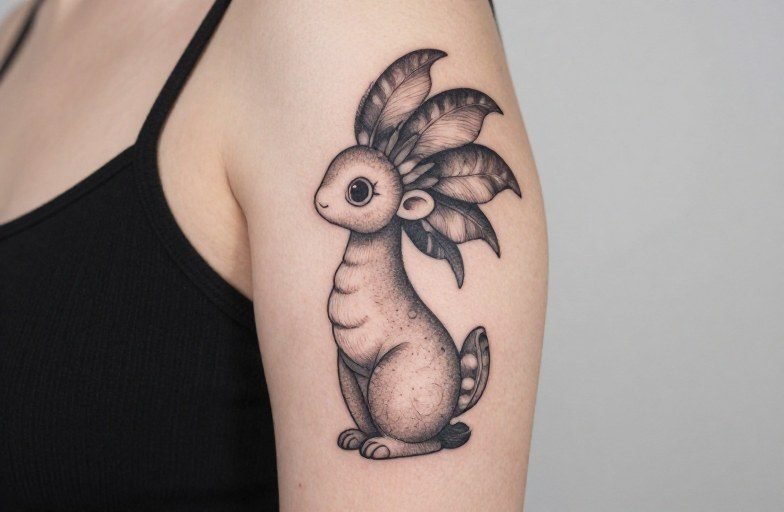
The Kokopelli tattoo depicts the humpbacked flute player found in ancient Pueblo and Hopi rock art, and it most commonly represents fertility, agriculture, music, and the joyful disruption of routine. Beyond that core meaning, the symbol carries regional weight specific to the American Southwest, where it originated, and attracts people drawn to desert landscapes, spiritual playfulness, or personal renewal.
Symbolism & History
The Ancient Roots
Kokopelli imagery appears in petroglyphs and pottery across the Colorado Plateau dating back over a thousand years, often linked to Puebloan cultures and later adopted by Hopi and Zuni traditions. The figure’s distinctive hump, sometimes interpreted as a sack of seeds, unborn children, or trade goods, connects him to abundance and the agricultural cycle. His flute playing was believed to announce the coming of spring, coaxing seeds to sprout and drawing women to fertility. Some trace the name itself to similar figures in Zuni and Hopi kachina traditions, though exact linguistic origins remain debated among scholars.
Layers of Meaning
Modern wearers rarely choose Kokopelli for a single reason. The symbol operates on several registers simultaneously:
- Fertility and creation: The oldest and most direct association, relevant to new parents, those hoping to conceive, or anyone celebrating generative energy in their life
- Agricultural cycles: Planting, harvest, patience, and the reward of sustained effort
- Music and artistic expression: The flute as creative voice, improvisation, and the courage to perform
- Mischief and trickery: Many traditions cast Kokopelli as a prankster who disrupts social order, making him appealing to those who value irreverence
- Travel and trade: The hump as a pack of goods carried between settlements, symbolizing journey and exchange
The trickster aspect gets overlooked in sanitized tourist versions, but it’s central to the figure’s cultural depth. He steals wives, disrupts ceremonies, and still gets welcomed back, his chaos serves renewal.
Common Variations & Styles
Traditional vs. Contemporary Rendering
The classic Kokopelli is a line-drawing silhouette: bent back, feathered head, flute raised, phallus often prominent. Traditional tattoo adaptations keep this graphic simplicity, usually in solid black or muted earth tones. Line work ages cleanly here, the silhouette reads even when slightly softened by time.
Contemporary versions fragment and recombine the figure. Some artists incorporate:
- Geometric deconstruction, breaking the silhouette into Southwest-patterned triangles and stepped designs
- Realistic desert backdrops, red rock formations, agave, saguaro, framing the figure in landscape
- Watercolor washes in sunset corals and turquoise, though these fade faster and require more maintenance
- Combined imagery: Kokopelli with dreamcatchers (a contested pairing, since dreamcatchers belong to Ojibwe tradition, not Southwest Pueblo cultures), or with specific flora like prickly pear or sage
Color vs. Black and Grey
Black silhouette maintains the symbol’s graphic punch and holds up longest. Color introduces regional authenticity, terracotta, ochre, turquoise, sage green, but requires a larger piece to avoid muddiness as pigments settle. Fine color detail in small Kokopelli tattoos often blurs within five to seven years, especially on high-movement areas like wrists or ankles.
Best Placements
The silhouette’s vertical orientation and curved back suit several body locations particularly well:
- Outer forearm: The flute player’s raised arm follows the natural line of the radius; highly visible for those who want the symbol as public statement
- Calf or ankle: The humpbacked curve mirrors muscular contours; ankle placement works for smaller, simpler versions
- Upper arm/shoulder: Room for surrounding landscape or complementary elements; the curve sits naturally over the deltoid
- Ribcage: Vertical space accommodates the full figure with room for detail, though this placement hurts and heals slowly due to movement and friction
- Behind the ear or nape: Micro versions, usually just the head and flute, for subtle placement
Back pieces allow for narrative expansion, Kokopelli leading a procession, or multiple figures in seasonal sequence, but demand commitment to the theme. Hand and finger placements generally fail; the silhouette’s fine details blur quickly on high-use skin.
Who Chooses This Tattoo & Personal Meanings
Regional Connection vs. Spiritual Adoption
Some wearers have lived in the Four Corners region, hiked Canyonlands, or grown up with Southwestern aesthetics as ambient culture. For them, Kokopelli functions as homeland marker, similar to how someone from the Pacific Northwest might choose a Douglas fir or orca.
Others without geographic ties gravitate toward the symbol’s specific emotional register: playful abundance rather than stern wisdom, creative disruption rather than peaceful balance. It appeals to musicians, gardeners, parents, and travelers, people whose lives center on cycles of growth and movement.
The Fertility Question
Women and couples choosing Kokopelli for fertility symbolism often pair it with moon phases, seeds, or sprouting plants. Men sometimes select the figure to mark fatherhood or to acknowledge their role in conception and nurture. The phallic traditional imagery can be minimized or emphasized depending on the wearer’s comfort; modern artists frequently abstract the genital element while keeping the recognizable silhouette intact.
Not everyone choosing this symbol knows its full cultural context. That’s common with widely circulated iconography, but respectful wearers typically learn enough to avoid cringeworthy combinations, Kokopelli with Celtic knots, for instance, or slapped randomly on tribal armbands where the figure’s meaning gets drowned in generic “spiritual” noise.
Similar Symbols & How They Differ
Several figures occupy overlapping symbolic territory:
- Green Man (European): Also vegetative, also seasonal, but more solemn and arboreal; Kokopelli’s musicality and trickster energy have no direct equivalent
- Trickster figures (Coyote, Raven, Loki): Share the disruptive intelligence, but lack Kokopelli’s specific fertility-agriculture-music triad
- Pan/Satyr (Greco-Roman): Flute-playing, sexual, nature-connected, but Pan carries melancholy and danger; Kokopelli’s tone is lighter, more generative
- Modern fertility symbols: Clinical and direct; Kokopelli embeds fertility within broader cultural and ecological context
None substitute cleanly. The specific combination of arid-landscape origin, musical announcement, and benevolent mischief makes Kokopelli distinct.
Final Thoughts
Kokopelli works as tattoo imagery because the silhouette reads instantly while the meaning stays spacious enough for individual interpretation. It carries genuine cultural weight without demanding single-definition loyalty. The symbol rewards those who understand its agricultural and trickster dimensions, not just its surface “Southwestern vibe.”
For lasting results, prioritize clean line work over trendy color techniques, scale it to a size where the hump and flute remain distinguishable, and place it where the body’s natural curves complement the figure’s posture. Like the figure himself, a well-executed Kokopelli tattoo announces something: not just where you’ve been, but what you value, growth, music, the necessary disruption that keeps life fertile.
Frequently Asked Questions
Is it culturally appropriative to get a Kokopelli tattoo if I’m not Native American?
The symbol has circulated widely in Southwestern tourism and art for decades, but respectful wearers should understand its specific Pueblo and Hopi origins rather than treating it as generic ‘Native American’ imagery. Avoid combining it with unrelated tribal elements from other cultures.
How much detail can a small Kokopelli tattoo hold?
At under two inches, the silhouette becomes hard to read and fine details like feather textures or facial features blur within a few years. For palm-sized or smaller placements, stick to bold outline versions without interior detail.
Why do some Kokopelli tattoos look different from the classic humpbacked figure?
Regional variations exist in ancient petroglyphs, some show him with a full backpack, different head ornaments, or insect-like features. Contemporary artists also stylize the figure, sometimes to the point of near-abstraction, which can obscure the original readable silhouette.
Does the direction Kokopelli faces matter in tattoo design?
In traditional imagery, he usually faces left with his flute raised toward the right, suggesting forward movement and the calling of spring. Some wearers reverse this for compositional reasons, but the left-facing orientation remains most immediately recognizable.
Related Tattoo Meanings
- Lamb Tattoo Meaning: Innocence, Faith, and Quiet Strength
- Lips Tattooed on Neck Meaning: Symbolism, Styles Placement
- Lipstick Neck Tattoo Meaning: Symbolism, Styles Placement
- Explore more









