
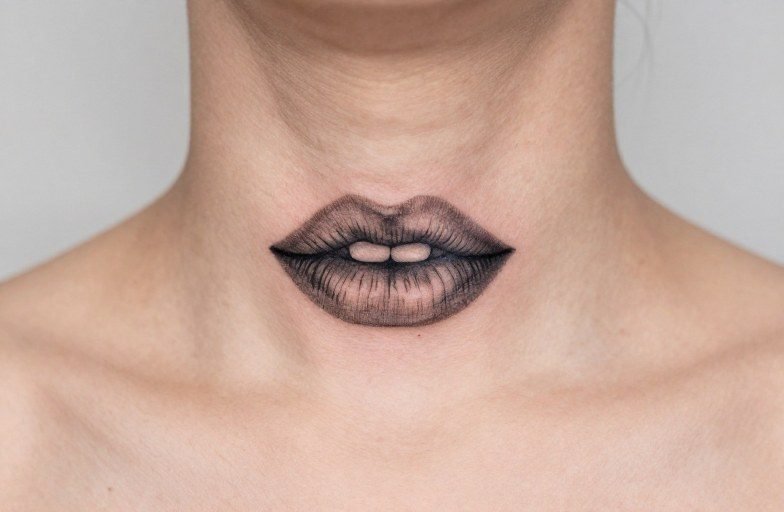
A pair of lips tattooed on the neck most commonly symbolizes sensuality, intimacy, and the power of spoken connection. The neck itself, exposed, vulnerable, and close to the voice, amplifies these meanings, turning a simple image into a statement about how someone communicates desire or guards their personal boundaries. Specific details in the design shift the message dramatically, from playful flirtation to memorial tribute.
Symbolism & History
What the Lips Represent
Lips carry primal significance across virtually every culture: they speak, kiss, taste, and express. In tattooing, isolated lips strip that symbolism down to its essentials. Red or pink lips lean into romantic and sexual energy, often referencing the classic “kiss mark” left on skin. Blackwork or grayscale lips can suggest something more ambiguous, mystery, secrets, or the threshold between internal thought and external expression.
The mouth as a gateway also appears in folk traditions worldwide, sometimes linked to truth-telling, sometimes to temptation. Tattoo imagery borrows freely from these associations without needing to anchor them to any single origin story.
Neck Placement as Amplifier
The neck transforms any tattoo into a declaration. Unlike a chest or thigh piece, this location refuses concealment in most professional and social settings. Someone choosing lips here accepts that visibility, they’re not hedging their bet. The proximity to the actual mouth creates a visual echo: the tattooed lips and the real ones operate in conversation, sometimes ironically, sometimes reinforcement.
Historically, neck tattoos carried countercultural weight, associated with outlaw status in various subcultures from the 1970s onward. That edge persists even as neck tattoos have mainstreamed; the lips design specifically softens that aggression into something more playful or intimate, depending on execution.
Common Variations & Styles
Design Elements That Shift Meaning
- Kiss print style: Mimics lipstick transferred to skin, usually bold red with slight smudge or texture. Reads as spontaneous, playful, overtly sexual or romantic.
- Realistic rendered lips: Detailed shading, skin pores, moisture highlights. Often memorializes a specific person’s mouth, partner, parent, child. The intimacy becomes personal rather than generic.
- Minimal line work: Single needle or fine-line outline, sometimes just the upper lip curve. Abstract, modern, leaves more interpretation open.
- With text or script: Words emerging from or surrounding the lips. “Speak,” “truth,” names, lyrics, adds narrative layer but risks becoming cluttered at small neck scale.
- Multiple lips: Clustered or repeated pattern. Suggests many voices, gossip, or overwhelming sensory input. More avant-garde in execution.
Technical Considerations for Style Choice
Neck skin is thin, mobile, and constantly flexing with head movement. This affects how different styles age. Heavy black saturation holds up better over time than fine red lines, which tend to blur and fade faster on this placement. Watercolor-style color blending, popular elsewhere, often heals poorly on the neck and requires frequent touch-ups.
Line weight matters practically: too fine, and the detail disappears within a few years; too heavy, and the delicate subject matter becomes cartoonish. Experienced artists typically recommend medium-weight outlines with selective shading for longevity on this specific body part.
Best Placements on the Neck
Not all neck real estate carries the same weight. The lateral neck, running from behind the ear toward the collarbone, offers the most continuous flat canvas and heals relatively predictably. Centered front placement, directly under the chin or on the throat, maximizes visibility and vulnerability; it’s confrontational by design.
Nape placement (back of neck, below the hairline) allows concealment with longer hair, making it the choice for those who want optionality. However, hairline irritation during healing complicates aftercare significantly. The area where neck meets shoulder, often called the “clavicle notch,” provides an interesting framing opportunity but experiences substantial movement and sun exposure.
Size constraints are real: below about two inches, lip detail becomes muddy; above four inches, the design dominates the neck’s natural architecture. Most successful pieces fall in that middle range, scaled to the individual’s neck length and width.
Who Chooses This Tattoo & Personal Meanings
Patterns in Clientele
There’s no single demographic, but certain contexts recur. Performers, musicians, drag artists, actors, sometimes use lip neck tattoos as stage identity markers, playing with the mouth as their instrument or tool. People marking significant relationship milestones occasionally choose partner’s lip prints, though tattoo artists generally caution against this for obvious reasons.
Survivors of voice-related trauma, those who’ve reclaimed speech after abuse, surgery, or psychological struggle, sometimes select this imagery to commemorate their return to verbal power. The meaning here is genuinely specific and potent, though rarely discussed in generic tattoo symbolism lists.
Gendered Readings and Reclamation
Historically, prominent lip imagery on bodies has been marketed heavily toward women, framed as decorative and sexually available. Some tattoo collectors deliberately subvert this: men choosing elaborate lip pieces, nonbinary individuals using the design to complicate assumptions about whose desire gets displayed. The neck placement intensifies this gender play, since neck visibility itself carries loaded social expectations across different professional and cultural contexts.
Similar Symbols & Design Alternatives
Collectors drawn to lip neck tattoos often also consider related imagery. A single rose at the neck corner carries comparable romantic signaling with more traditional tattoo lineage. Mouths with teeth showing, or the full face rather than isolated lips, shift from intimacy toward aggression or expressionistic intensity. Script tattoos at the neck, names, words, phrases, occupy similar visibility territory but sacrifice the bodily, sensory connotation.
The “hickey” or bruise tattoo, sometimes rendered in purple and yellow realism, shares the kiss-print’s territory of marking sexual encounter on skin, but reads as more transgressive and less permanently commemorative. Swallows and other traditional neck tattoos offer the same placement boldness with entirely different symbolic language, travel, loyalty, nautical heritage.
Final Thoughts
The lips-on-neck tattoo works because it compresses multiple meanings into an unavoidable location. Whether read as romantic, memorial, provocative, or simply aesthetically striking, it refuses to be background noise. The design succeeds when technical execution matches conceptual clarity, when the wearer understands why the neck specifically, why these particular lips, and what happens when both are visible in a room full of strangers. Like any tattoo with genuine symbolic weight, its power comes from that alignment of personal intention, physical placement, and visual craft.
Frequently Asked Questions
Do lip neck tattoos hurt more than other placements?
The neck ranks among the more painful spots due to thin skin, minimal fat padding, and proximity to bone and nerve clusters. Pain is subjective, but most people describe it as sharp and intense compared to fleshier areas like the thigh or upper arm.
How well do red lip tattoos hold up over time?
Red pigments, especially brighter shades, tend to fade faster than black on neck skin due to sun exposure and constant movement. Expect more frequent touch-ups than you’d need for blackwork, and plan for diligent sun protection to slow degradation.
Can I get a lip tattoo covered up if I change my mind?
Covering lips on the neck is challenging because the design is typically dense and saturated, and neck skin doesn’t take rework as readily as other areas. Laser removal first, or incorporating the lips into a larger dark piece, are usually the viable paths.
Will a lip neck tattoo affect job prospects?
Visible neck tattoos still carry professional stigma in conservative fields, finance, law, medicine, corporate management. Some industries have shifted, but the neck remains a boundary that many employers read as nonconformity. Consider your specific career trajectory before committing.
Related Tattoo Meanings
- Lipstick Neck Tattoo Meaning: Symbolism, Styles Placement
- Please Lip Tattoo Meaning: Symbolism, Styles Placement
- Question Mark Tattoo Meaning: Mystery, Doubt Curiosity
- Explore more









