
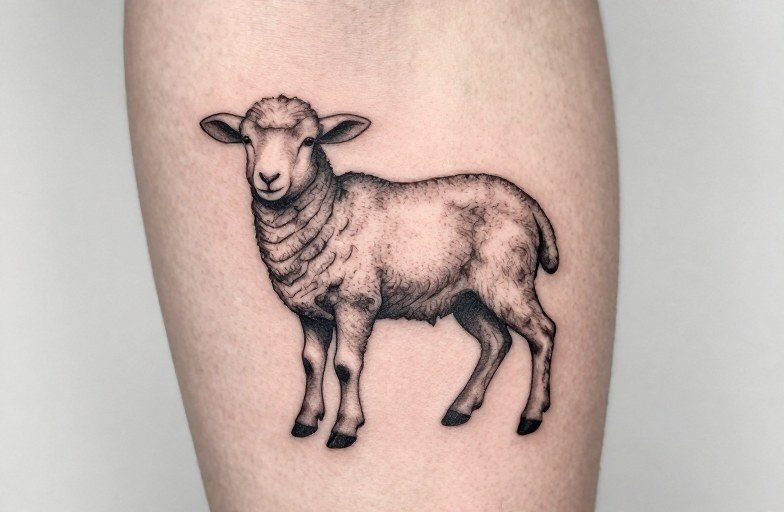
A lamb tattoo most commonly represents innocence, purity, and spiritual devotion, though its meaning stretches to include sacrifice, peace, and the quiet strength found in gentleness. The image carries weight across religious traditions, folklore, and personal symbolism, making it one of the more emotionally layered animal motifs in tattooing.
Symbolism & History
Religious and Spiritual Roots
The lamb’s strongest associations trace back to Abrahamic traditions. In Christianity, the “Lamb of God” (Agnus Dei) symbolizes Jesus Christ’s sacrifice and redemption. This imagery appears in centuries of religious art, stained glass, and illuminated manuscripts. Some trace the tattoo’s popularity in Western shops to clients seeking visible expressions of faith without the direct crucifix imagery that can feel more aggressive or public.
Judaic tradition links the lamb to Passover, where blood on doorposts marked protection and deliverance. Islamic art occasionally features the lamb in contexts of sacrifice and obedience to divine will. These roots mean the tattoo often carries devotional weight even when worn by people who wouldn’t describe themselves as traditionally religious, the symbol’s cultural penetration runs that deep.
Beyond Religion: Gentleness and Vulnerability
Stripped of doctrinal context, the lamb represents what culture reads as “soft” qualities: innocence, meekness, harmlessness. For some wearers, this becomes an intentional choice to claim gentleness as strength rather than weakness. The contrast between the lamb’s perceived vulnerability and its actual hardiness as an animal creates symbolic tension that many find personally meaningful.
In folklore and pastoral traditions, the lamb often linked to spring, renewal, and agricultural cycles. Celtic and Norse art incorporated sheep and lamb motifs in knotwork and metalwork, though direct tattoo lineage from these sources is less documented than from Christian iconography.
Common Variations & Styles
Traditional and Neo-Traditional Approaches
American traditional lamb tattoos typically feature bold black outlines, limited color palettes (black, grey, red accents), and graphic simplicity. The lamb may carry a banner, cross, or halo. Neo-traditional work pushes the color range into softer pastels, cream, pale pink, sage green, while maintaining strong line weight and stylized forms.
Realism and Fine Line
Photorealistic lamb portraits demand technical precision in rendering wool texture. This style works best at medium-to-large scale where individual curls and shadow depth remain readable. Fine line approaches, popular in contemporary single-needle work, reduce the lamb to essential contours, often a profile silhouette with minimal internal detail. These age more gracefully on areas with less skin movement.
- Black and grey realism: emphasizes the lamb’s soft form through careful contrast
- Minimalist line: single continuous line or sparse dotwork
- Illustrative/watercolor: color bleeding outside linework, often paired with floral elements
- Blackwork silhouette: solid black form, sometimes with negative-space details
Combined Imagery
Lamb tattoos frequently incorporate complementary symbols: crosses, Bibles, roses (often linked to the Virgin Mary in Catholic iconography), wolves (playing on the “wolf in sheep’s clothing” inversion), or lions (referencing the “lion and lamb” peace motif). A less common but striking variation shows the lamb with a dagger or wound, directly invoking sacrifice imagery.
Best Placements
Scale and detail level should drive placement decisions. Small, simple lamb designs, under two inches, work on wrists, behind ears, or along the collarbone. These locations suit the symbol’s association with delicacy and visibility control.
Medium-scale pieces with wool texture or surrounding elements fit the outer upper arm, thigh, or calf. These areas provide flat, stable skin that preserves line integrity over time. The ribcage and sternum accommodate larger compositions where the lamb might sit within a religious chest piece or among floral arrangements.
Back pieces or full sleeves incorporating the lamb as one element among many typically place it centrally or near the heart. Hand and finger placements are rare for this specific imagery; the lamb’s soft associations clash with the aggressive connotations of hand tattoos in most Western contexts, though this rule softens as hand tattooing normalizes.
Who Chooses This Tattoo / Personal Meanings
Faith and Devotion
The most straightforward wearer profile: practicing Christians seeking permanent religious expression. These clients often arrive with specific reference imagery, Renaissance paintings, church windows, particular biblical passages. The lamb offers a gentler entry point than crucifixion imagery, especially for women or those wanting something less confrontational.
Recovery and Transformation
Some choose the lamb to mark periods of personal rebuilding, leaving behind “wolf” behavior, embracing vulnerability after trauma, or honoring innocence reclaimed. The symbol’s association with spring and renewal supports this usage without requiring religious framework.
Memorial and Loss
Parents who’ve lost children sometimes select lamb imagery, drawing on the animal’s connection to childhood innocence. This overlaps with the traditional gravestone motif of the lamb marking a child’s burial site, a visual language that persists in tattoo form.
Agricultural and Regional Identity
In farming communities, particularly in the UK, New Zealand, and rural America, lamb tattoos occasionally signal actual livelihood, sheep raising, wool work, rural upbringing. These tend toward realistic or folk-art styling rather than religious treatment.
Similar Symbols
Understanding adjacent imagery helps clarify what distinguishes the lamb specifically. The dove shares its peace and Holy Spirit associations but lacks the sacrificial dimension. The fish (ichthys) carries Christian identity without the innocence component. The unicorn occupies similar symbolic territory, purity, gentleness, but remains fantastical rather than grounded in agricultural reality.
The wolf in sheep’s clothing, as tattoo subject, inverts the lamb’s meaning entirely: deception, hidden danger, the predator’s mask. Some wearers deliberately pair both animals to express internal duality or past survival strategies.
Goat imagery, often visually similar, carries opposite connotations in Western tradition: the scapegoat, the demonic, the rebellious. Tattoo artists working in black metal or occult styles sometimes deliberately blur lamb/goat boundaries, but these read as distinct symbolic statements.
Final Thoughts
The lamb tattoo endures because its symbolism operates on multiple frequencies simultaneously, devotional, personal, aesthetic. It can whisper faith without preaching, mark softness as chosen strength, or simply render an animal whose form translates beautifully to skin. Technical execution demands respect for the wool texture that defines the subject; without it, the image flattens to generic livestock. Whether rendered in bold traditional lines or whisper-fine single needle, the lamb’s power lies in its loaded simplicity, a small creature carrying centuries of meaning.
Frequently Asked Questions
Does a lamb tattoo always have religious meaning?
No. While the lamb carries strong Christian associations, many wearers choose it for personal reasons, gentleness, innocence, agricultural connection, or memorial purposes. The meaning depends entirely on the individual’s intention and surrounding imagery.
How well does a detailed lamb tattoo age over time?
Fine wool texture tends to blur after 5-10 years, especially on high-movement areas like wrists or inner arms. Bold-line traditional styles and blackwork silhouettes age more reliably. For realistic pieces, strategic use of negative space and strong contrast helps preserve readability.
What’s the difference between a lamb and a sheep tattoo symbolically?
The lamb specifically emphasizes youth, innocence, and sacrifice. Sheep imagery more commonly represents flock behavior, pastoral life, or general Christian community. The lamb carries more emotional and sacrificial weight; the sheep reads more neutral or agricultural.
Can a lamb tattoo work in a larger composition with darker imagery?
Absolutely. The lamb creates effective contrast against skulls, daggers, or darker religious symbols. This juxtaposition, innocence amid darkness, sacrifice within violence, has precedent in centuries of religious art and translates powerfully to contemporary tattooing.
Related Tattoo Meanings
- Bible Say About Getting Tattoo Meaning: Faith, Ink, and Scripture
- Alpha Omega Tattoo Meaning: Beginnings, Endings Everything Between
- Punisher Tattoo Meaning: Skull, Symbolism Shop Reality
- Explore more









