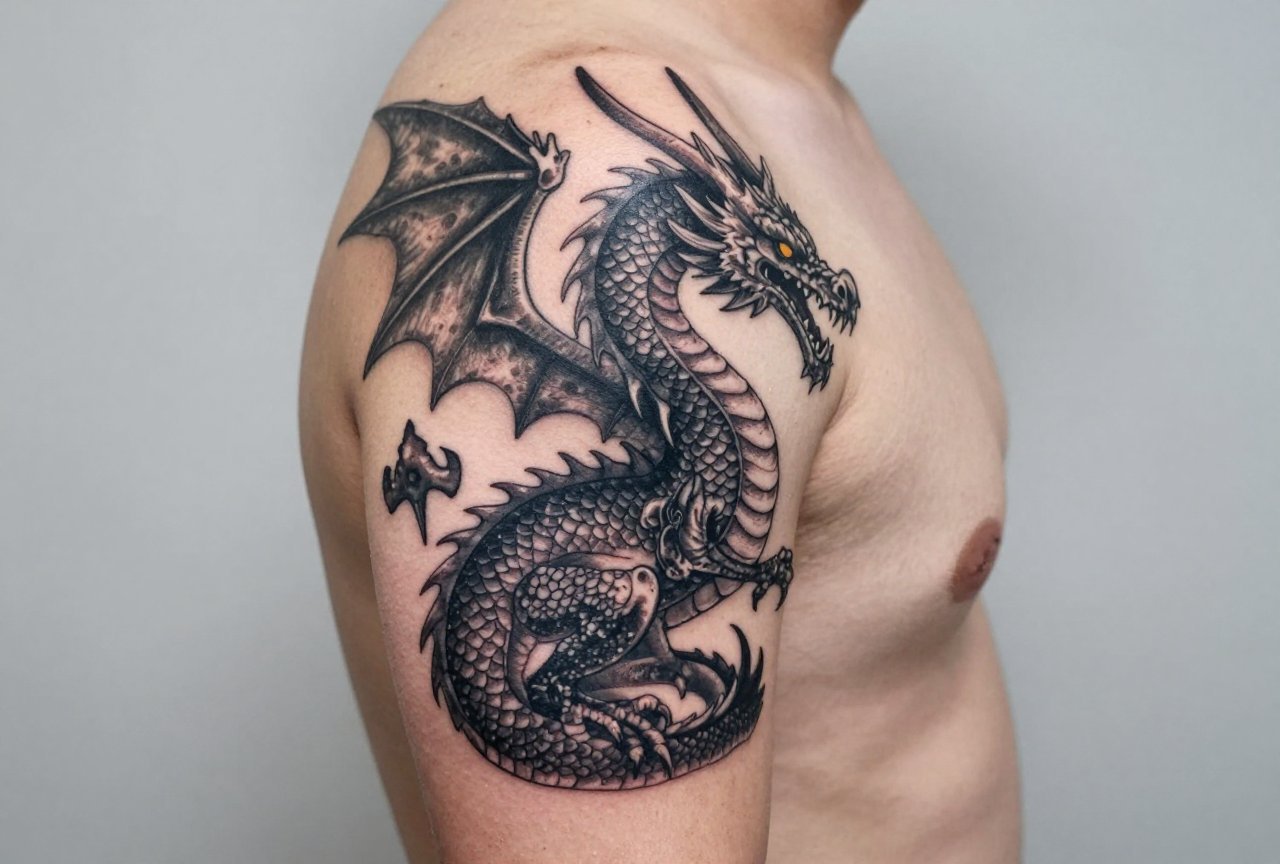
A realistic dragon tattoo isn’t some fantasy book cover slapped onto your arm. It’s a creature that has to look like it could actually exist, breathing on your skin, scales catching light, eyes holding weight. I’ve tattooed dragons that wrap around shoulders and crawl up thighs, and I’ve fixed dragons that looked like inflatable pool toys because someone went to the wrong shop. The gap between a dragon that looks alive and one that looks dead on arrival comes down to understanding what this style actually demands from both artist and client.
Origins & History
From Sailor Jerry to Photo-Real Skin
Traditional dragon tattoos came through Sailor Jerry and the Japanese masters, bold lines, flat color, stylized forms. The realistic approach emerged later, riding the same wave that brought us photorealistic portraits in the 90s and 2000s. Artists started asking: what if this creature looked like you could reach out and feel its hide?
I’ve watched the shift in my own career. Early on, clients brought in Boris Vallejo prints and said “make it look like that.” Now they bring reference photos of Komodo dragons, crocodiles, iguanas, even birds of prey for the wings. The goal shifted from symbolic to biological. We want dragons that obey anatomy, that have muscle tension, that cast shadows correctly.
Eastern vs Western Realism
The two traditions still split the room. Eastern dragons, serpentine, whiskered, often without wings, demand flowing composition and negative space mastery. Western dragons, the four-legged fire-breathers, need structural understanding, weight distribution, how that bulk would actually move. I’ve had clients sit for six hours while I built out a Western dragon’s shoulder girdle because getting the anatomy wrong makes it look like a dog in a Halloween costume. Eastern dragons flow easier in some ways, but the scale patterning gets obsessive, row after row, each one catching light differently.
Key Characteristics & Motifs
What separates a realistic dragon from a stylized one? In my chair, I look for these elements:
- Anatomical plausibility: Joints that bend correctly, muscle groups that attach where they should, wings with bone structure you can almost name
- Scale differentiation: Not stamp-repeated patterns, but scales that vary in size by body region, that overlap with irregularity, that catch highlights at different angles
- Eye depth: The eye is where most dragons live or die, a glassy, dimensional orb with reflected light, not a flat painted symbol
- Texture mixing: Smooth belly plates against keeled back scales, maybe some horn or bone texture on the head, maybe tattered membrane in the wings
- Environmental interaction: Smoke, flame, water, or wind that actually affects the creature, ruffling scales, pushing against wings
I tell clients the most important detail is often the least flashy. The transition from a dragon’s neck into its shoulder, how the scales shrink and the skin wrinkles, that’s what sells the whole piece. Skip it and you’ve got a sticker. Nail it and people stop walking to stare.
Color vs Black and Grey
Color: The Fire and the Risk
Color dragons hit hard when fresh. Emerald scales, gold eyes, crimson wing membranes, the full fantasy. But I’ve watched color dragons fade in five years to a bruised-looking mess because the client didn’t protect them from sun, or because the artist packed color too shallow. Red and yellow, especially, they wander in skin over time. I use them in my color dragons, but I place them strategically, areas that won’t blur as badly, and I always warn clients: this is a high-maintenance relationship.
Color realism also demands more sessions. Building saturation in scales without making them look plastic, that’s slow work. I might do a full sleeve dragon in four sessions of black and grey, but six or seven in color.
Black and Grey: The Sculptural Approach
This is where I think most realistic dragons actually succeed. Black and grey lets you sculpt. You can push a scale forward with a highlight, sink a shadow between two plates, build actual dimension without fighting color theory. The healed result ages cleaner, reads better from distance, and doesn’t depend on the client’s willingness to wear sunscreen like religion.
That said, black and grey dragons can go muddy if the artist doesn’t understand value separation. I’ve seen pieces where the whole dragon reads as one gray blob because every scale was shaded with the same three tones. You need range, from near-white highlights to deep black cores, and you need to place them where light would actually hit a rounded, textured surface.
Best Placements
Dragons need room. They’re long, they’re complex, they have parts that need to connect. In my experience, these placements work:
- Full back: The classic. Eastern dragons especially, they can wind and flow, head at one shoulder, tail disappearing at the opposite hip. I’ve done backs that took 40 hours over a year, and the clients never regretted the canvas size
- Thigh to hip: Western dragons do well here, coiled, clawed, the hip giving natural curve for the body mass, the thigh extending for tail or wing
- Upper arm to chest: The shoulder becomes the dragon’s perch, the chest its hunting ground. Works for medium-sized pieces with the head as focal point
- Forearm: Risky. Small dragons rarely read as realistic, they become cute, which is death for this style. I only take forearm dragons if the client wants a dragon’s head portrait, tight crop, no full body
- Ribcage: Painful, and the skin there moves constantly with breathing. I’ve done it, but I warn clients that fine scale detail can blur over time in that high-motion zone
We see this a lot in shops: someone wants a realistic dragon on their wrist. I say no. The style needs scale, literally. A wrist dragon would have scales the size of pinheads, impossible to detail, impossible to heal clean.
Who It Suits
Not everyone should wear a realistic dragon. The style carries weight, aggression, mythic presence. I’ve tattooed dragons on soft-spoken accountants who wanted to feel something ancient on their skin, and I’ve talked clients out of dragons when their reference folder was all koi and cherry blossoms. The energy doesn’t match.
The commitment level matters too. These pieces are long sessions, multiple sittings, real money. A small realistic dragon head starts around four hours. A full back piece can be a year’s project. You need patience, pain tolerance, and skin that heals reasonably well. I check for keloid history, for skin conditions in the placement area, not because I’m a doctor, but because I’ve seen beautiful work raised and ruined by the body’s own overreaction.
Realistic dragons also suit people who can handle the attention. This isn’t a hidden tattoo. It’s a conversation starter, sometimes a conversation killer, depending on the room. I’ve had clients come back saying their dragon got them jobs in creative fields, and clients saying they cover it for family holidays. Know your life before you commit.
Modern Variations
Biomechanical Dragons
The fusion of organic dragon with mechanical elements, gears showing through torn scales, pistons replacing joints. I’ve done a few, they’re exhausting, the reference gathering alone takes hours. The key is making both languages read equally real, the metal and the meat. When it works, it’s stunning. When it doesn’t, it looks like a dragon had a car accident.
Dark Realism
Muted palettes, almost monochromatic, dragons emerging from shadow or smoke. Popular in the last five years, influenced by artists like Paul Booth’s aesthetic but applied to mythical subjects. I enjoy these, the atmosphere becomes half the subject, the dragon almost secondary to the mood.
Double Exposure & Embedded Scenes
Dragon silhouettes filled with landscapes, or scales that contain smaller images. Technically difficult, conceptually trendy. I’ve done a dragon whose wing membrane showed a star map, another whose eye held a castle reflection. These work best when the secondary image doesn’t fight the primary realism, when it rewards close looking without breaking the illusion.
Choosing an Artist
This is where I get serious with people. A realistic dragon is not a beginner’s piece. Not for the artist, not for the client. When someone sits in my chair asking about this style, I want to see their portfolio first, and I want them to want to see mine.
- Check for animal work: Dragons are imaginary, but they’re built from real animals. An artist who can’t render a convincing snake or lizard won’t build a convincing dragon
- Look at healed photos: Fresh tattoos lie. Everyone’s work looks good at one week. Ask for one-year healed shots of detailed pieces, see how the scales held
- Ask about their reference process: Do they build from photos, from 3D models, from imagination? The best dragon artists I know use multiple references, sometimes sculpting small clay models to understand form
- Discuss their plan for your specific skin: Darker skin tones need adjusted approaches for realism, different value ranges, sometimes different color choices. An artist who gives one answer for all skin is an artist to avoid
- Trust your gut on the consultation: If they sketch quickly and confidently, if they talk about the dragon’s weight and movement, if they seem genuinely excited, that’s your person. If they seem bored or rushed, walk
I’ve referred clients to other artists when the style match wasn’t right. Better to lose a booking than to do a dragon I’m not built for. Any artist worth your money will respect that honesty, or practice it themselves.
Final Thoughts
A realistic dragon tattoo is a collaboration between myth and flesh, between what we imagine and what skin can actually hold. It demands an artist who understands both fantasy and anatomy, who can build a creature that never existed but looks like it should have. It demands a client with patience, with pain tolerance, with willingness to protect the work for decades.
I’ve been tattooing long enough to see trends come and go. Dragons never fully leave, they just shift form. The realistic approach, the demand for biological truth in imaginary beasts, that’s been growing for twenty years and isn’t slowing. Done right, these pieces become part of the person’s presence, a weight they carry with authority. Done wrong, they’re expensive cover-up jobs waiting to happen.
Choose carefully. Sit still. Heal properly. And when your dragon is finished, when it actually looks back at people from your skin, you’ll understand why this style commands the effort it takes.
Frequently Asked Questions
How much does a realistic dragon tattoo typically cost?
A small realistic dragon head runs $400-800, while full back pieces can reach $3,000-8,000 depending on the artist’s rate and session count. Most quality work comes from artists charging $150-300 per hour, and rushing this style never ends well.
Will a realistic dragon tattoo stretch if I gain muscle or weight?
Any tattoo shifts with significant body changes, but dragons are especially vulnerable because the scale patterns distort noticeably. I generally avoid placing them on areas prone to major fluctuation, like the stomach or upper arms for serious lifters.
Can you cover up an old tribal or traditional dragon with a realistic one?
Sometimes, but realistic dragons need clean skin to build their subtle values. Heavy black old work often limits what’s possible, requiring laser fading first. I assess each cover-up individually, and I’d rather be honest about limitations than promise magic.
How do I sleep with a fresh dragon tattoo on my back?
You’ll need to sleep on your stomach or side for two to three weeks, which I know sucks. Use clean, soft sheets you don’t mind staining, and avoid letting the fresh tattoo press against anything that might stick to the plasma and ink seeping out in the first few days.
Related Style Guides
- Neo Trad Japanese Tattoos: A Working Artist s Guide
- Tatuagem Old School: A Working Artist s Guide
- Beautiful Tattoo Ideas That Actually Work
- Explore more