Pentagram Tattoo Meaning: Symbolism, Styles & What to Know
The pentagram carries one of the most layered histories in tattoo iconography. Five equal lines meeting at five points create a form that has served as protective seal, elemental map, and spiritual emblem across centuries. Understanding what this symbol actually communicates, and how design choices reshape that message, matters before the needle touches skin.
Key Characteristics
Geometrically, the pentagram consists of five straight segments forming a star, typically drawn with a single continuous line. This unicursal quality, the ability to trace the entire shape without lifting pen from paper, has often linked the form to concepts of unity and interconnectedness.
Orientation fundamentally alters interpretation. Point upward, the single vertex ascends while the broader base spreads below. Inverted, with two upper points and single downward point, the symbol reads differently across virtually every tradition that has adopted it. The distinction is not merely aesthetic; it separates protective invocation from other applications entirely.
Line Weight and Construction
Clean, uniform lines suggest mathematical precision and classical reference. Hand-wrought variation, slight waver in the stroke, evokes folk tradition and organic connection. Some wearers choose an open, unclosed form; others insist on the complete circuit. Neither choice is neutral.
Encircled or Standing Alone
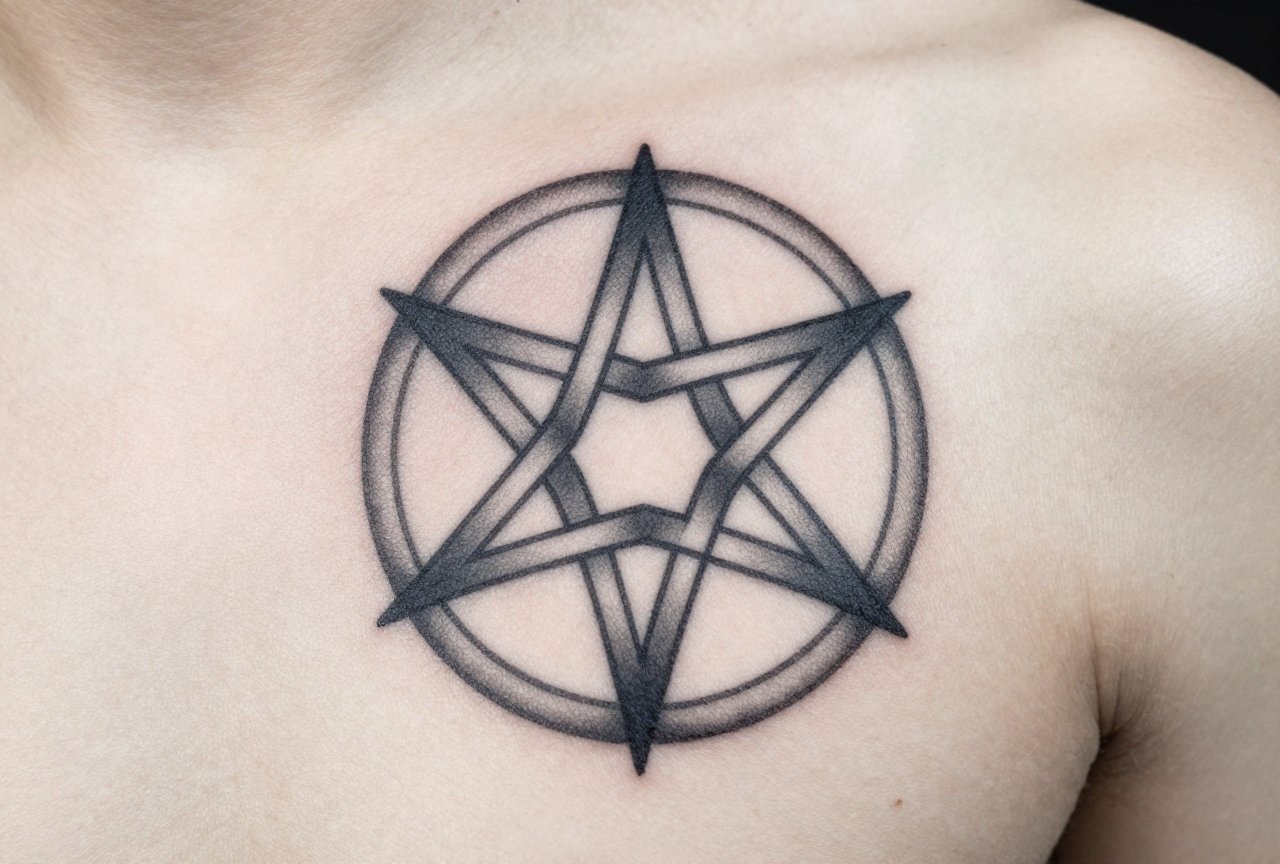
The pentagram enclosed within a circle, the pentacle, adds containment and cyclical association. Without the circle, the star stands more aggressively, its points extending into surrounding space. The circle softens; the bare star asserts.
What to Expect
Session length varies with size and complexity. A small, clean-lined pentagram behind the ear might conclude in under an hour. Larger pieces incorporating additional elements, ornamental framing, or significant fill demand longer sittings. The five-point structure, while seemingly simple, requires precise angle work; uneven points read immediately as error.
Pain levels depend heavily on placement. Over bone, the vibration intensifies. Fleshier areas permit steadier hand and more comfortable experience. The star’s linear nature means repeated needle passes along the same paths, which some find more intense than scattered shading work.
Healing follows standard protocol: keep clean, avoid submersion, resist picking at forming scabs. The straight lines of a pentagram heal relatively predictably, though any deviation from the original stencil becomes permanently visible. Choose your artist with this permanence in mind.
Choosing the Right Artist
Geometric precision demands specific skill. Review portfolios for evidence of straight lines that hold their weight, points that meet cleanly, symmetry that does not drift. Many talented artists excel in organic, flowing work; fewer command the technical discipline that five equal angles require.
Questions Worth Asking
- How do you approach stencil placement for symmetrical designs?
- What happens if a line needs correction mid-session?
- Can you show healed results of similar geometric work?
Comfort extends beyond technical competence. The pentagram’s loaded symbolism means some artists approach it with personal investment, others with detachment. Neither is wrong, but alignment matters. An artist who shares your relationship to the symbol, or respectfully holds space for yours, contributes to better outcome.
Common Variations & Styles
Blackwork dominates pentagram tattooing, the stark contrast suiting the symbol’s graphic nature. Solid black fill creates weight and permanence; outline-only preserves delicacy and negative space. Both read distinctly.
Dotwork and stippled shading introduce texture without softening the form’s geometry. This approach suits those seeking organic quality within rigid structure. The technique requires patience from artist and sitter alike; the density of stippling determines value gradation.
Ornamental framing, filigree extending from points, transforms the pentagram into something more decorative. Celtic knotwork, Art Nouveau curves, or architectural elements each redirect the symbol toward different cultural reference. These additions should complement rather than overwhelm the core five-point structure.
Contemporary Adaptations
Some incorporate botanical elements, vines threading through the star’s interior. Others fracture the form, incomplete segments suggesting deconstruction or emergence. The pentagram as negative space within larger blackwork has gained traction, the star defined by absence rather than presence.
Best Placements
The forearm offers visibility and moderate canvas size, the pentagram readable at conversational distance without dominating. Inner forearm softens the symbol’s assertiveness; outer placement amplifies it.
Behind the ear suits smaller, more private declarations. The curvature demands slight adaptation of the form, but the location carries intimacy. Chest placement, centered over sternum, aligns with heart-protection symbolism historically associated with the pentacle. The pectoral’s relative flatness aids geometric accuracy.
Upper back between shoulder blades provides substantial space for encircled or elaborated versions. Thigh and calf accommodate larger scale while permitting coverage. Hand and finger placement has grown more accepted, though the small surface area forces simplification and accelerated fading should be anticipated.
Scale Considerations
Below two inches, the pentagram’s points compress and detail vanishes. Above six inches without supporting elements, the form can feel isolated, floating on its canvas. The sweet spot for standalone pentagrams typically falls between three and five inches, large enough for clean construction, contained enough for versatile placement.
Similar & Related Symbols
The hexagram, six-pointed star, carries overlapping but distinct associations, more commonly linked to specific religious traditions. Its construction differs fundamentally; the overlapping triangles create a different energy than the pentagram’s continuous line.
The septagram, seven-pointed star, appears less frequently in tattooing but offers alternative for those seeking less common geometric spiritual symbol. The unicursal hexagram, associated with particular occult traditions, provides another variation for those drawn to Thelemic or ceremonial reference.
Sigils, personally constructed symbols of intention, sometimes incorporate pentagram structure or point arrangement. The difference lies in authorship: the pentagram arrives loaded with collective meaning, while sigils derive power from individual creation and charge.
Runes and bindrunes offer Norse-adjacent alternatives with comparable linear aesthetic but different cultural grounding. Ouroboros, the serpent consuming its tail, shares cyclical and protective associations with the encircled pentacle, though its form is entirely distinct.
Final Word
The pentagram endures because it compresses multitudes into five lines. Your orientation, framing, and accompanying elements determine which of those multitudes you participate in. The symbol does not resolve to single meaning; it concentrates possibility.
Technical execution matters disproportionately here. A wandering line in a floral piece might read as organic movement; in a pentagram, it reads as mistake. Invest in an artist who demonstrates geometric discipline. The simplicity of the form is deceptive; there is nowhere for error to hide.
What you carry forward is the accumulated weight of every eye that has recognized this shape across centuries, and your particular negotiation with that recognition. The pentagram offers no neutral ground. Choose your position within it deliberately.
Frequently Asked Questions
Does an upside-down pentagram always mean something negative?
Context determines interpretation. Inverted orientation has historically appeared in ceremonial traditions without malevolent intent, though popular culture has heavily associated it with darker symbolism. Your personal intention and surrounding design elements matter more than any fixed dictionary meaning.
Can a pentagram tattoo be covered up if I change my mind?
Covering geometric shapes presents specific challenges. The stark black lines and angular structure resist soft blending into organic cover designs. Laser fading before cover-up often proves necessary. Consider placement and potential future modifications carefully from the outset.
Is the pentagram the same as a pentacle?
The pentacle specifically refers to the pentagram enclosed within a circle. The circle adds layers of meaning, often associated with containment, cycles, and protection. Without the circle, the term pentagram applies. The distinction matters in some traditions more than others.
What style works best for a first tattoo?
Clean blackwork with moderate line weight offers the most predictable healing and longest clarity. Highly detailed dotwork or extremely fine lines demand more precise aftercare and may soften faster. A straightforward outline or solid black pentagram provides durable introduction to the form.