
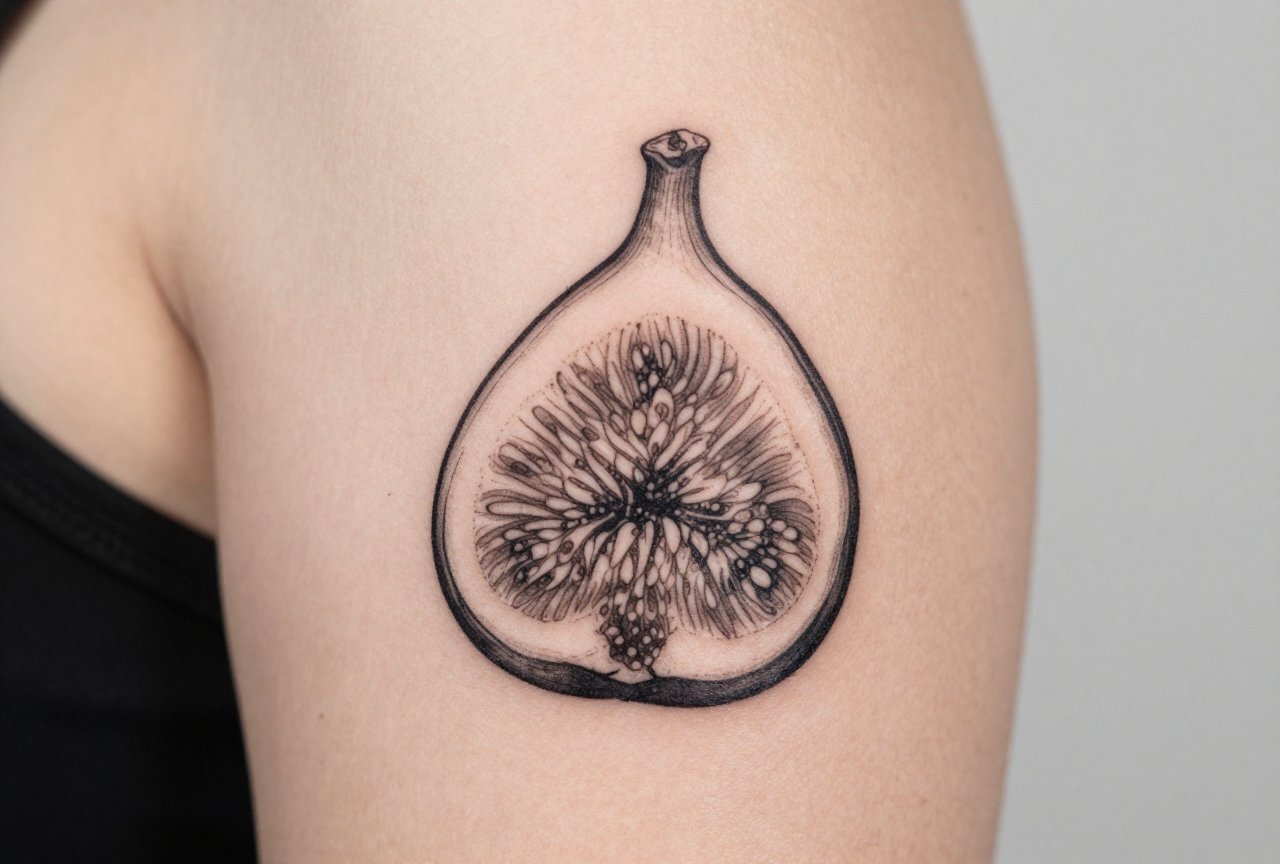
A fig tattoo typically symbolizes abundance, fertility, hidden knowledge, and quiet resilience. The fruit’s jam-packed interior and tough outer skin make it a favorite for people who’ve survived something and don’t need to broadcast it. I’ve tattooed figs on farmers, writers, and folks who just moved through a hard year and wanted something that felt earned.
Symbolism & History
The fig’s been around longer than most symbols people slap on their skin. We’re talking one of the oldest cultivated fruits, archaeologists found figs in Neolithic sites near Jericho, dating back about 11,000 years. That weight of history matters in a tattoo. It doesn’t hit the same as a trendy geometric shape that’ll feel dated in five years.
Religious & Mythological Roots
In the Bible, fig leaves cover Adam and Eve, the original modesty, sure, but also the original shame. Flip that though, and the fig becomes redemption. Buddha sat under a fig tree (the Bodhi tree, Ficus religiosa) when he reached enlightenment. The Greeks associated figs with Dionysus, god of wine and chaos, and the Romans considered them sacred. I’ve had clients bring in family Bibles with fig references bookmarked, wanting the verse worked into the leaves. That’s heavy. You feel it in the chair.
Modern Symbolism
Today, people gravitate toward figs for more personal reasons:
- Abundance without flash: The fig doesn’t look like much from outside. Cut it open and it’s complex, sweet, almost too much. That’s a specific personality type.
- Resilience: Fig trees grow in cracked concrete, abandoned lots, places nothing should survive. I did one on a woman who’d rebuilt her life after a bad divorce, she found a fig tree growing behind her new apartment.
- Hidden knowledge: The “fig” as slang for something valuable but concealed. Writers and programmers especially love this angle.
- Mediterranean heritage: Greek, Italian, Turkish, North African clients, it’s a homeland stamp without being literal.
Common Variations & Styles
Not all fig tattoos read the same. The style changes the meaning, and more importantly, it changes how the thing ages on your skin.
Botanical Illustration
Detailed, scientific, usually black and grey. Cross-sections showing the interior seeds, leaves with visible veins, maybe a branch with fruit at different stages. These age beautifully if done with consistent line weight. I’ve seen too many hyper-fine botanical pieces blow out after five years, the ink spreads, the delicate lines become mush. Good botanical work needs slightly heavier outlines than you’d think, especially on the leaf edges.
Minimalist & Line Work
Single-line figs, negative space interiors, tiny placements behind ears or on ribs. These are popular right now. The risk? Minimalist tattoos don’t always read as figs from a distance. I tell clients: “Do you want people to ask what it is, or know instantly?” Both are valid, but you should decide consciously. Single-line work also requires a steady artist, any wobble in that continuous stroke is permanent.
Traditional & Neo-Traditional
Bolder lines, limited color palette, maybe a dagger through the fig or a banner with text. Traditional figs read tough, almost ironic. The contrast of a “soft” fruit in a hard style is the point. These hold up better over decades than fine-line alternatives. We see this a lot in shops that do American traditional, clients want something unexpected in a familiar language.
Color Realism
Purple-black skin, pink-red interior, the milky sap that drips when you cut a fresh fig. Color realism here is stunning but demanding. The purples can heal muddy if the artist doesn’t understand fig skin specifically, it’s not uniform, it’s mottled, almost dusty. I’ve watched colleagues struggle with this, overworking the skin trying to get that dusty bloom right.
Best Placements
Where you put it changes how you live with it.
- Forearm: Visible, conversational. The fig’s irregular shape works with the arm’s natural curves. Easy to show, easy to cover with a long sleeve.
- Ribcage: Painful. The skin there moves a lot with breathing, so the tattoo settles slightly differently than static placements. Good for larger pieces with leaves and branches.
- Thigh: Fleshier, less pain, holds detail well. Popular with clients who want something private but substantial.
- Behind the ear / neck: Small, intimate. I’ve done tiny figs here for people who want the symbol without the statement. Healing is tricky, hair products, pillow contact, sun exposure.
- Hand or fingers: Bold choice. Figs don’t immediately read as figs at this scale; they can look like generic fruit or even abstract shapes. Also, hand tattoos fade fast. We warn everyone.
The fig’s natural asymmetry actually helps with placement, it flows with body contours better than a perfect circle or rigid geometric shape would.
Who Chooses This Tattoo / Personal Meanings
In my chair, I’ve noticed patterns. Not stereotypes, patterns.
Chefs and food writers get figs more than other fruits because figs carry narrative weight. An apple is generic. A fig is specific, seasonal, almost pretentious in the right way. One chef told me he wanted it because “figs are the only fruit that feels like it has a secret.”
People with agricultural backgrounds, actual farmers, not hobby gardeners, choose figs to honor that labor. The tree’s stubbornness mirrors their own. One guy grew up picking figs in California’s Central Valley, got the tattoo at sixty, cried in the chair. That happens more than you’d think. We don’t talk about it much, shop culture being what it is, but it happens.
Women recovering from body-related trauma sometimes choose figs for the hidden interior metaphor, the outside doesn’t tell the whole story. I’ve had three clients explicitly say this, unprompted. The fig becomes a private language.
Academics and librarians show up with fig references from literature, Sylvia Plath’s fig tree metaphor in The Bell Jar being the most common. That one’s bittersweet, given the novel’s themes, but people reclaim it.
Similar Symbols
If you’re drawn to figs but not sure, consider these relatives:
- Pomegranate: Similar interior complexity, more explicitly about death and rebirth (Persephone myth). Darker energy.
- Olive branch: Mediterranean roots, but peace rather than hidden abundance. Simpler visually, less personal.
- Acorn / oak: Potential and strength, but more masculine-coded in tattoo culture. The fig feels more neutral, more quietly defiant.
- Vine or grape cluster: Dionysus connection shared with fig, but more about excess and celebration. The fig is restraint.
I usually ask clients considering figs: “Do you want to be asked about it, or do you want it to be yours?” The fig accommodates both, but your answer shapes the design.
Final Thoughts
A fig tattoo isn’t loud. It won’t scan immediately in a crowd of flash designs. That’s the point. The meaning lives in the specificity, the particular fruit, your particular reason, the particular way your artist renders the skin and seeds.
I’ve watched this design grow more common over fifteen years in shops, but it hasn’t tipped into cliché. It holds that rare middle ground: recognizable enough to communicate, obscure enough to stay personal. If you’re considering one, spend time with actual figs. Cut them open. Notice the texture, the color variation, the way the sap dries sticky on your fingers. Bring that specificity to your artist. The best fig tattoos come from clients who’ve actually looked at the thing they’re asking to wear.
And find someone who understands botanical work, not just tattooing. The difference shows in how the leaves age, whether the interior reads as depth or just dark mush, whether the whole thing still looks like a fig in ten years or becomes an unidentifiable purple blob. Ask to see healed photos. Any artist worth your money has them.
Frequently Asked Questions
Does a fig tattoo work for someone who doesn’t have Mediterranean heritage?
Absolutely. I’ve tattooed figs on people with no connection to the region. The symbolism, resilience, hidden richness, quiet growth, transcends geography. Your personal meaning matters more than cultural ownership, though being respectful of religious contexts (Bodhi tree references, for instance) is worth discussing with your artist.
How well does fine-line fig tattooing age compared to bolder styles?
Fine-line figs are gorgeous fresh but risky long-term. The interior seed details and delicate leaf veins tend to blur as ink spreads under skin. I generally recommend slightly heavier line weight for botanical work, or going larger to give those details room to breathe. Ask your artist about their specific needle groupings and how they’ve seen similar pieces heal.
What’s the typical pain level for a fig tattoo on ribs versus forearm?
Ribs are genuinely rough, thin skin, bone proximity, constant movement from breathing. Forearm is manageable for most people, more like intense scratching. I’ve had clients chat through forearm figs and white-knuckle through ribs. The size and detail level matter too; a sprawling fig branch on ribs is a commitment.
Can a fig tattoo incorporate other elements like text or animals?
Common and effective. I’ve done figs with honeybees (pollination, labor), with script in the leaves, with split designs showing the interior and exterior. The fig’s organic shape plays well with other natural elements. Just avoid overcrowding, the fig’s power is partly its simplicity, and cluttering it dilutes that.
Related Tattoo Meanings
- Five Dots Tattoo Meaning: Symbolism, History What Artists Know
- Flail Tattoo Meaning: Power, Justice Ancient Authority
- Flame Tattoo Meaning: Symbolism, Styles What Fire Represents
- Explore more









