
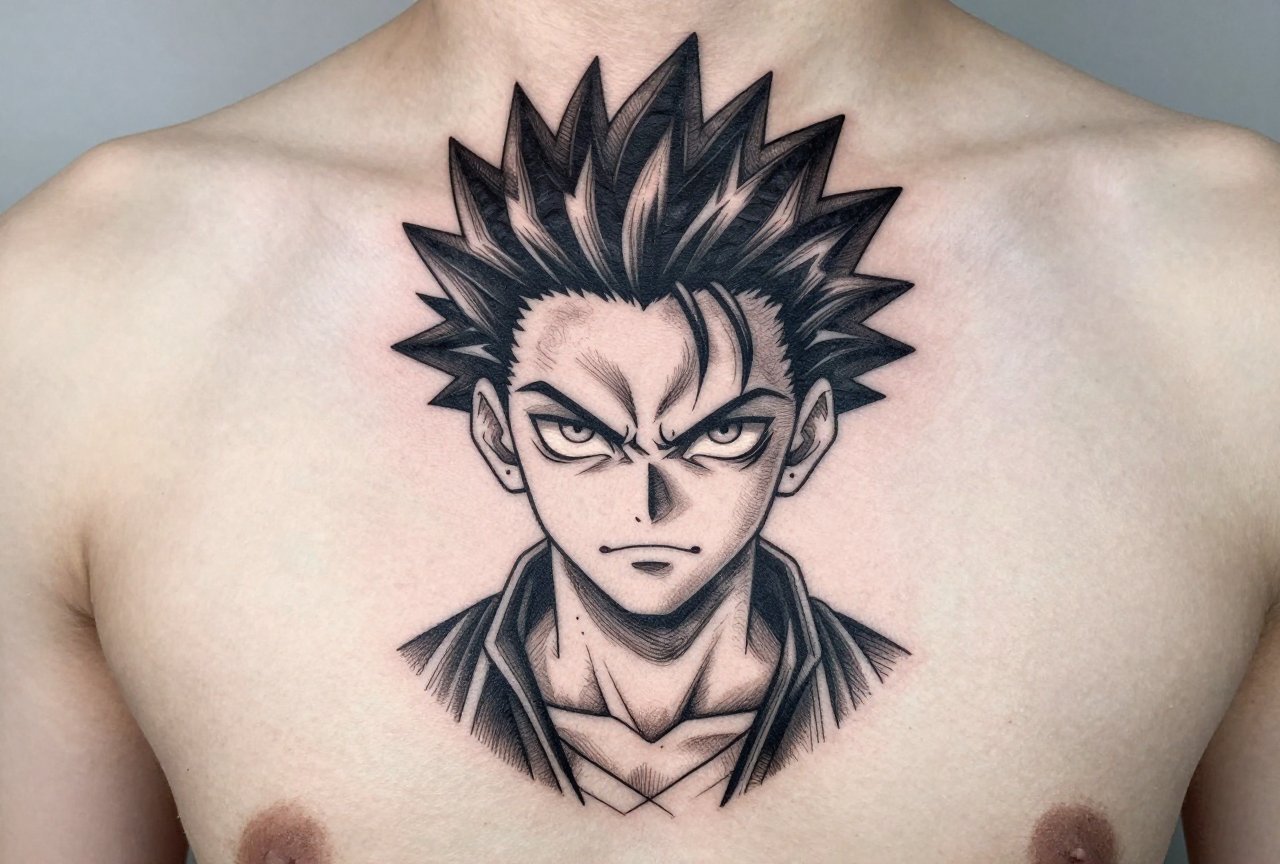
Akaza tattoos pull from Demon Slayer‘s most tragic villain, Upper Moon Three, the demon who chose eternal strength over human weakness. Most people who sit in my chair for this design aren’t just anime fans; they’re drawn to his duality: the relentless fighter who still mourns the humanity he threw away.
Symbolism & History
The character carries weight. Akaza was Hakuji once, a starving thief, a devoted son, a grieving lover. His transformation into a demon strips away compassion while amplifying everything violent in him. That tension lives in the tattoo.
The Flames and Fighting Stance
His Demon Blood Art manifests as shockwave-like flames, cobalt and violent. In skin, these read as motion, as something that won’t stay still. I’ve tattooed the stance, fists raised, foot forward, the moment before impact, on forearms and calves where the muscle movement actually animates the pose. The flames work as background filler or standalone pieces, but they need breathing room. Crowd them with too much black and they flatten into blue mush in two years.
The Compass Needle Markings
The geometric patterns on his face and body confuse some clients. They’re not random decoration. In the source material they tie to his martial discipline, his compass needle technique that detects fighting spirit. As tattoo imagery, they translate to geometric mandala-adjacent work, clean lines, dotwork, something that holds up better than fine illustrative detail on areas that see sun or friction.
- Flame motifs = transformation, destruction, uncontrolled power
- Compass patterns = direction, obsession, the hunt for stronger opponents
- Human Hakuji imagery = lost potential, grief, the road not taken
- Upper Moon eye = hierarchy, inhuman perception, removed from ordinary life
Common Variations & Styles
Not every Akaza piece looks the same, and thank god for that. I’ve seen gorgeous work and I’ve seen stuff that’ll need coverups.
Neo-Traditional and Japanese Fusion
This works. The character’s already rooted in Japanese visual language, flames read like hi-no-maru energy, the stance echoes musha-e warrior prints. Artists who actually understand Japanese tattoo structure (not just “I watched a YouTube”) build him with bold outlines, limited but saturated color, and background elements that flow with body contours. The blue flames against skin tones pop hardest with a warm underbase. I’ve watched clients wince through three sessions of this on ribs, and the result carried that weight.
Black and Grey Realism
Riskier. The character’s color palette, pale blue skin, pink hair, cobalt flames, doesn’t translate naturally to monochrome. Some artists solve this with heavy contrast and texture variation. Others produce muddy grey blobs where the flames should breathe. If you’re set on black and grey, commit to large scale. Small realistic Akaza portraits age into featureless smears faster than you’d think. I tell clients: palm-sized minimum for face detail, and even then, expect touch-ups.
Minimalist and Line Work
The compass needle patterns alone, rendered in single needle or fine line. Clean. Intellectual. Doesn’t scream anime tattoo to casual observers. But here’s the shop reality: fine lines on high-movement areas (wrists, ankles, collarbone) drop out. I’ve tattooed these patterns as rib pieces where the skin stays relatively stable, and they hold. Same design on a wrist? Plan for annual refresh sessions.
- Full color illustrative: highest impact, highest maintenance
- Neo-trad Japanese fusion: best longevity for the imagery
- Black and grey realism: demands skilled artist, larger scale
- Minimalist pattern work: subtle, but placement-critical
Best Placements
Where you put this matters more than most anime pieces. The character’s energy is forward, aggressive, exposed.
Thighs and outer arms carry the full figure well. The cylindrical shape matches his vertical stance. I’ve done two full-leg pieces where the flames wrap around the calf and the figure rises toward the knee, dynamic, follows the muscle flow, heals reliably on that meatier skin.
Chest and back work for the compass patterns expanded into larger geometric mandalas. The flat planes let those lines stay true. One regular client has the full upper moon eye design across his shoulder blades, scaled so the detail doesn’t crowd. Four years old now, still reads clean from conversation distance.
Hands and neck? I try to talk people down. Not because I’m conservative about visible ink, I have full sleeves, but because the detail density in most Akaza reference art doesn’t survive at that scale. The flames become blue blobs. The facial features blur. If you must, go with the minimalist compass pattern, not the portrait.
- Thigh/outer arm: full figure, dynamic flow
- Chest/back: expanded geometric work, pattern emphasis
- Ribs: the stance piece, painful but powerful placement
- Forearm: portrait or upper body focus, moderate detail
Who Chooses This Tattoo / Personal Meanings
I’ve tattooed enough Akaza pieces to notice patterns in who sits down for them.
The Competitors
Fighters, gym rats, people who structure their lives around measurable improvement. They respond to his obsession with strength, his refusal to accept weakness. One amateur boxer I tattooed had the stance piece placed where he could see it while shadowboxing. “He wasted his strength on the wrong thing,” the guy told me, “but he never stopped pushing.” That nuance matters, they’re not glorifying the villainy, they’re engaging with the tragedy.
The Survivors
More common than you’d expect. People who’ve lost someone to violence, addiction, or their own destructive choices. Akaza’s backstory, grief transforming into something monstrous, resonates. The tattoo becomes a warning, a memorial, a mirror. I’ve had clients cry in my chair explaining why the human Hakuji imagery matters more than the demon form. That’s heavy ink. That’s what separates meaningful tattooing from collecting pop culture stickers.
We see this a lot with villain portraits generally: the character’s flaw illuminates something the client recognizes in themselves. The best Akaza tattoos carry that self-awareness. The worst ones are just “cool demon guy.”
Similar Symbols
If Akaza doesn’t quite fit, artists and clients often pivot to related imagery.
Tanjiro offers the counter-narrative, same loss, different choice. His scar and hanafuda earrings carry protection and persistence without the destructive undertone. Rengoku, the Flame Hashira, shares the fire motif but channels it toward sacrifice rather than domination. I’ve tattooed both characters on clients who started asking for Akaza and realized they needed the hope, not the tragedy.
Outside Demon Slayer, the oni mask tradition in Japanese tattooing covers similar ground, demon imagery as spiritual protection, the feared becoming the ward. Fudo Myoo, the immovable wisdom king, surrounded by flames but serving enlightenment rather than destruction. These classical references often integrate with Akaza pieces, grounding the anime source in longer visual tradition.
- Tanjiro: chosen resilience, protection of family
- Rengoku: sacrifice, flame as gift rather than weapon
- Oni masks: traditional demon-as-guardian symbolism
- Fudo Myoo: wrathful compassion, flames of purification
Final Thoughts
Akaza tattoos work when the person wearing them understands what they’re carrying. The character’s not a hero. His strength is real but misdirected, his tragedy is self-inflicted, and the story doesn’t redeem him. That’s the point.
Good tattooing of this subject respects that complexity. It doesn’t flatten him into a cool blue guy for your Instagram. It finds the placement where the flames move with you, the scale where the detail survives, the personal reason that makes the pain of sitting through it worthwhile.
I’ve watched this design evolve from obscure reference to frequent request in my shop. The clients who love it most aren’t the ones who explain the lore to me, they’re the ones who sit down, show the reference, and say “this part, this feeling, I need that on me.” That’s where we start. Everything else is just technique.
Frequently Asked Questions
Does Akaza’s blue skin tone cause problems with tattoo aging?
Blue pigment can fade faster than black or red on some skin tones, and the pale cyan used for his skin needs a skilled colorist to avoid looking grey or green as it settles. I usually push clients toward the flame and pattern elements rather than full skin-tone replication if they want longevity.
Can I combine Akaza with traditional Japanese tattoo elements?
Absolutely, and it often works better than pure anime style. The character’s design already borrows from Japanese visual tradition. We integrate him with wind bars, cherry blossoms, or wave patterns that flow with the body, creating something that reads as tattoo rather than illustration.
How painful is an Akaza tattoo compared to other designs?
The pain depends on placement and your personal sensitivity, not the subject matter. However, his flame details often require heavy saturation in areas like ribs or inner arm that sting more. The compass patterns involve repetitive line work that can feel like scratching sunburn after the first hour.
Will people judge me for getting a villain tattoo?
In my experience, the people who recognize Akaza understand the nuance, he’s a tragic figure, not a simple villain. Clients who choose him usually have a specific personal connection to his story. Anyone who judges without asking why you chose it wasn’t going to appreciate your ink regardless of the subject.
Related Tattoo Meanings
- Arabic Word Meanings Tattoo Meaning: Script, Spirit, and Skin
- Baby Angel Tattoo Meaning: Grief, Innocence Protection
- Bird Cage Tattoo Meaning: Freedom, Loss, and Captivity
- Explore more









