The acorn represents potential, perseverance, and the quiet strength of small beginnings. It’s the seed of the mighty oak, everything needed to become something massive and enduring, packed into something tiny and unassuming. People choose this symbol to mark new chapters, personal growth, or the memory of someone who showed them what strength looks like.
Symbolism & History
I’ve tattooed acorns on wrists, ribs, behind ears, and across chests. Every person carries a different reason, but the core thread stays the same: this little nut holds the entire blueprint of an oak tree. That’s not poetic fluff, that’s biology, and it’s why the symbol hits so hard.
Ancient Roots and Cultural Weight
Celtic traditions treated the oak as sacred, and the acorn as its promise. Norse mythology connected it to Thor’s protection. Druids believed carrying an acorn brought luck and longevity. The Victorians tucked acorn imagery into jewelry for strength and independence. When someone sits in my chair and says “I want something small that means something big,” the acorn often surfaces in our conversation.
What strikes me is how universal it stays. I’ve done them for a grandmother who raised three kids alone, a guy getting sober, a college kid terrified of graduation. The acorn doesn’t shout. It waits. That patience is the point.
What the Oak Connection Means
The oak lives centuries. It survives lightning, drought, rot. An acorn tattoo often carries that inherited toughness, acknowledging you come from something resilient, or you’re building toward it. The visual contrast matters too: smooth cap, textured nut, eventual jagged leaves. Artists love playing with that texture shift.
Common Variations & Styles
Style changes everything about how an acorn reads on skin. I’ve seen delicate single-needle acorns that look like botanical illustrations, and I’ve blasted thick traditional ones with heavy black caps and saturated brown bodies. Both work. The difference is voice.
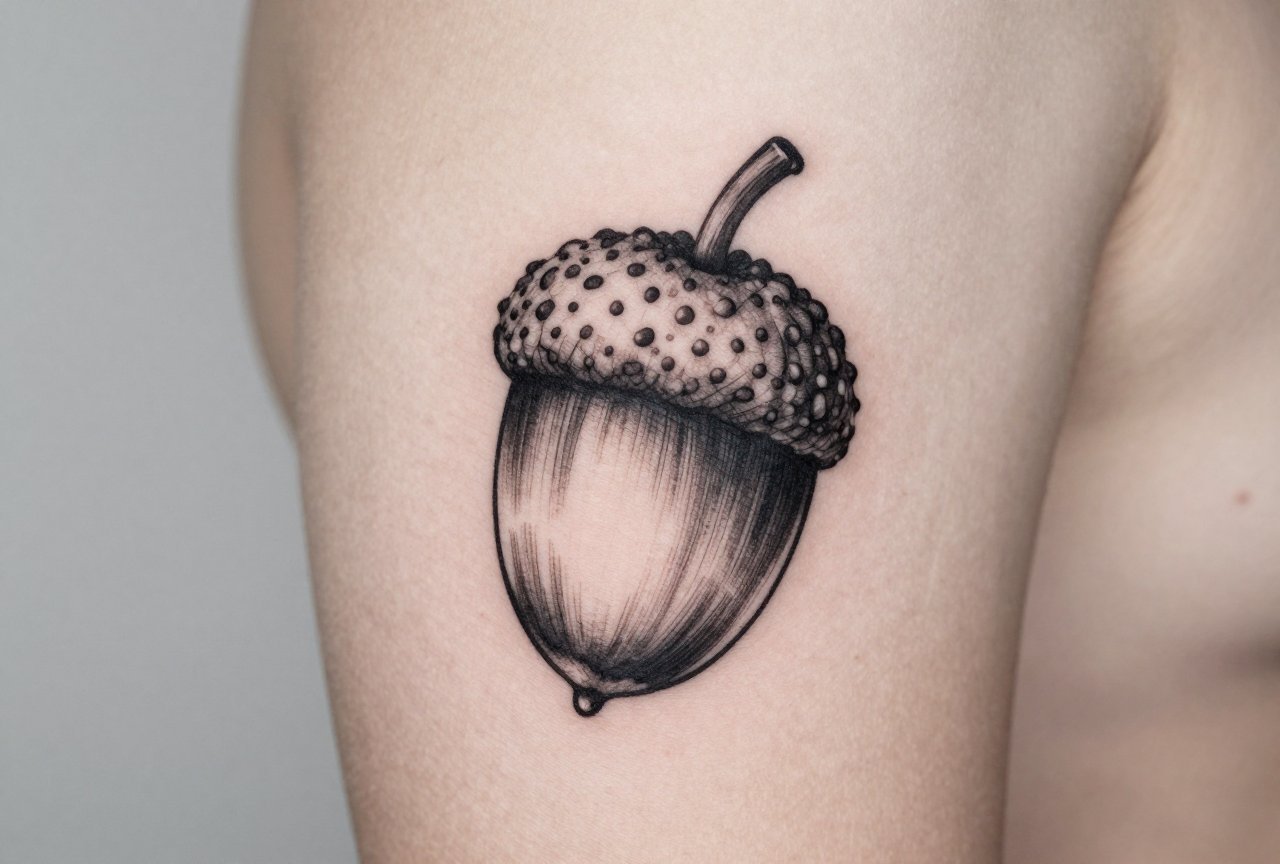
- Black and grey: Focuses on texture, shadow under the cap, the nut’s subtle ridges. Ages beautifully, stays readable at small sizes.
- Traditional/Americana: Bold lines, limited color palette, often paired with banners or leaves. Holds up for decades because the lines are generous.
- Fine line and minimalist: Single needle, light shading, often tiny. Gorgeous fresh, but I always warn clients, super thin lines in small acorns can soften faster than you’d like. Placement matters more here.
- Botanical/realistic: Detailed cap texture, accurate color, sometimes with attached stem and leaves. Requires an artist who understands how to layer brown tones without muddiness.
- Acorn and oak leaf pairing: The classic combo. The leaf adds movement, fills space, creates composition. I probably do this variation most often.
One thing I tell clients: the cap’s scalloped edge is where detail lives or dies. Too busy, it blurs. Too simple, it looks like a cartoon mushroom. Good artists find the middle.
Best Placements
Acorns work almost anywhere because they read well at small sizes. But placement changes the feeling.
Visible vs. Hidden
Wrists and forearms say “this is part of my story I want seen.” I’ve done them on inner biceps for private reminders, behind ears for whispered significance, on ankles for groundedness, literally. One client got hers on her left rib, over her heart, after her father died. He used to collect acorns with her as a kid. The placement wasn’t random.
Size and Aging Reality
Here’s what we see a lot in the shop: tiny tattoos in high-friction spots blur faster. An acorn on the side of the hand or top of the foot will need touch-ups sooner than one on the upper arm or thigh. The cap’s edge detail is usually the first to soften. I generally suggest at least 2-3 inches for anything with texture you want to keep. Smaller is possible, but simpler, think silhouette or heavy outline, not fine crosshatching.
Color choice affects longevity too. Warm browns fade warmer, sometimes orangey. Black and grey stays neutral. Neither is wrong; it’s about what you’re willing to maintain.
Who Chooses This Tattoo / Personal Meanings
In my chair, acorn people tend to be thoughtful. They’re not impulse tattoos. Often there’s a specific moment, a diagnosis survived, a child born, a parent lost, a sobriety date, a move across country.
- New beginnings: Graduations, career shifts, coming out. The acorn as unfulfilled but certain potential.
- Family and lineage: “From small things, great things grow.” Parents getting them for children, children for parents.
- Resilience through struggle: The oak grows slow and fights hard. People who’ve been through it recognize that.
- Connection to place: Oak trees anchor landscapes. I’ve done them for people leaving hometowns, or returning.
One guy told me his grandfather planted acorns every spring, never knowing if he’d see the trees. He got a simple acorn on his forearm the spring after the funeral. That’s the kind of story this symbol collects. It doesn’t need explaining, but it rewards it.
Similar Symbols
Clients sometimes compare the acorn to other growth symbols. Here’s how they differ in tattoo form:
- Seedling/sprout: More fragile, earlier stage. The acorn carries more implied weight, it’s already complete, just waiting.
- Tree of life: Grand, complex, often spiritual. The acorn is quieter, more personal.
- Lotus: Transformation through difficulty, but Eastern in origin. The acorn feels more grounded, Western, earthy.
- Semicolon: Mental health survival. The acorn overlaps but speaks more to potential than continuation.
- Pine cone: Similar structure, different energy. Pine is evergreen, constant. Oak is deciduous, cyclical, patient.
Sometimes clients combine, acorn and oak leaf, acorn with a semicolon, acorn inside a compass. The symbol plays well with others because its meaning is flexible without being vague.
Final Thoughts
The acorn works because it’s honest. It doesn’t pretend to be grand. It is small, overlooked, ordinary, and absolutely enough to become something extraordinary. That’s a hard truth to wear, and people who choose it usually know exactly why.
If you’re considering one, bring your story to the consultation. The best acorn tattoos I’ve done came from conversations, not Pinterest boards. Think about whether you want the moment of potential or the promise of what’s coming. Consider how much detail your skin and lifestyle can support. And find an artist who gets excited about texture, because that cap and nut deserve attention.
Tattoos about growth shouldn’t be rushed. The acorn itself teaches that. Good things take time, good ink takes planning, and both last longer than you expect.
Frequently Asked Questions
Does an acorn tattoo work for men or is it too delicate?
It works for anyone. I’ve done heavy black traditional acorns on construction workers and fine-line versions on dancers. The style determines the feel, not the symbol itself. Bring reference that matches your aesthetic.
How much does an acorn tattoo typically cost?
Small simple ones run $80-150 in most shops. Detailed botanical pieces with leaves might hit $200-400. Size, style, and artist rate determine it. Don’t bargain shop for something you’ll wear forever.
Will the brown ink in my acorn tattoo fade to orange?
Warm browns can shift orangey over time, especially with sun exposure. Blacks and cool greys stay more stable. I usually discuss this during color selection, some clients want that warmth, others prefer neutral longevity.
Can an acorn tattoo cover up a small old tattoo?
Sometimes. The cap’s rounded shape and dark potential works for covering small pieces, but it depends on what’s underneath. Bring it to a consultation. Artists need to see the existing ink in person to know if the acorn’s structure can handle it.
Related Tattoo Meanings
- Oak Tree Tattoo Meaning: Strength, Roots Time
- Four Leaf Clover Tattoo Meaning: Luck, Love Irish Heritage
- Blue Jay Tattoo Meaning
- Explore more