
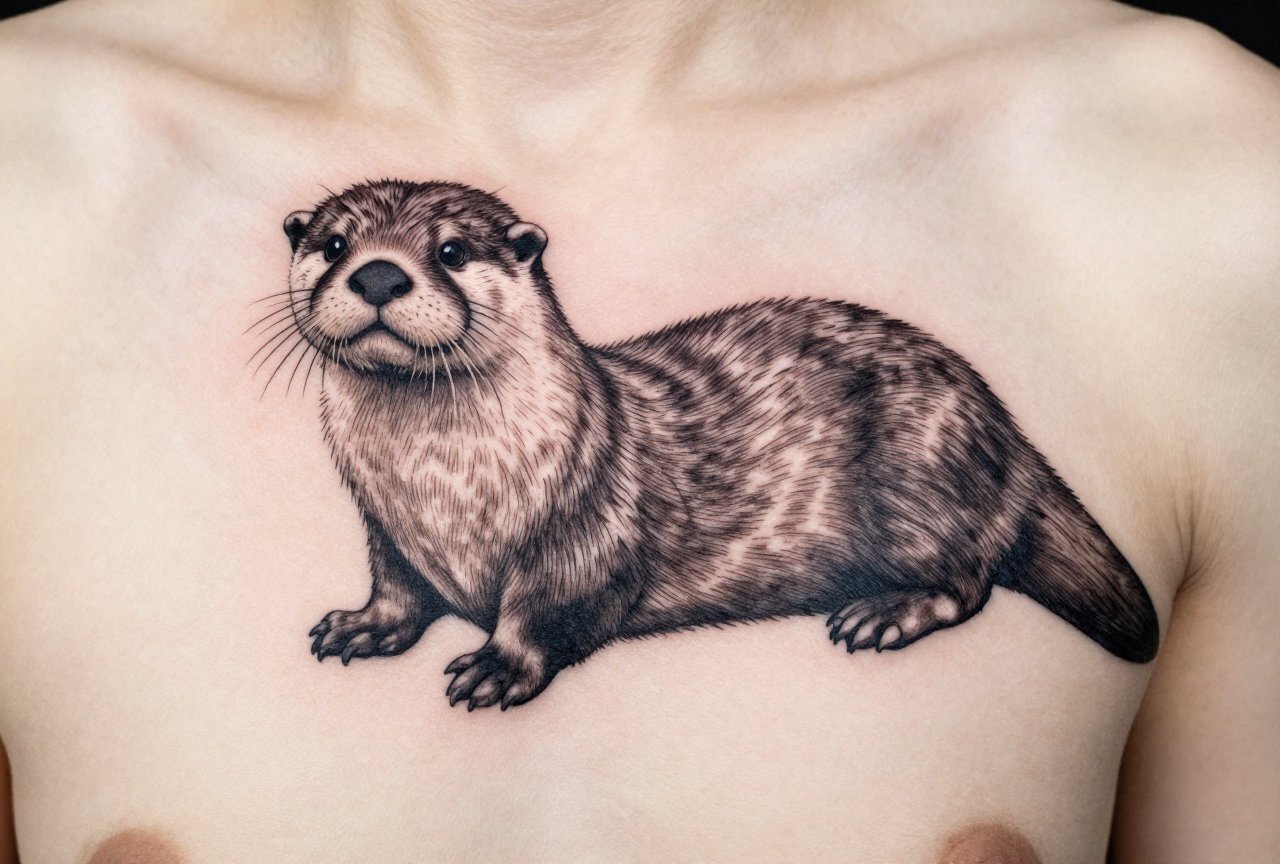
An otter tattoo usually means playfulness, close family bonds, and the ability to stay afloat through hard times. People choose this design because otters hold hands while sleeping so they don’t drift apart, and that image hits hard if you’ve ever lost someone or found your person. I’ve tattooed dozens of these over the years, and every single client has a story about connection, survival, or refusing to take life too seriously.
Symbolism & History
What Otters Represent
Otters carry weight across cultures. Native American traditions, especially Pacific Northwest tribes, see them as symbols of honesty and primal feminine energy. In Celtic lore, they’re shape-shifters and guides between worlds. Japanese folklore paints them as tricksters who can transform into beautiful women to lure men. That duality matters, playful but cunning, gentle but wild.
I’ve had clients bring in reference photos of sea otters floating on their backs with rocks on their bellies, cracking shellfish. That specific image, the tool-use, the casual problem-solving, speaks to people who’ve figured out how to make their own circumstances work. The river otter, sleek and darting through murky water, appeals to folks who value adaptability and quick thinking. Both carry the same core meaning: you can thrive without losing your joy.
Historical Tattoo Context
Otter imagery isn’t ancient in tattoo history the way dragons or anchors are. It gained traction in the 1990s and 2000s as nature tattoos moved beyond the traditional flash sheets. I’ve seen old Sailor Jerry-era flash with otters maybe twice in my life, and they looked like weasels with bad proportions. The modern otter tattoo owes more to wildlife illustration and the rise of fine-line nature work. Clients started requesting them after seeing documentary footage of sea otter behavior, that viral hand-holding thing, and artists had to actually study otter anatomy because most of us had never drawn one from life.
Common Variations & Styles
Design Approaches
The style you choose changes how the meaning reads. I’ve done otters in several approaches, and each hits differently:
- Fine line and illustrative: This is the most common request now. Delicate whiskers, soft fur texture, usually floating on their back or curled in a ball. Reads gentle, intimate, feminine or gender-neutral. Ages well if the line weight is consistent and you don’t go microscopic on detail.
- Traditional/Americana: Bold outlines, limited color palette, more aggressive and graphic. I’ve done these for clients who want the otter’s playful spirit but with some grit. The meaning shifts slightly toward resilience and toughness.
- Blackwork and dotwork: Fur rendered through stippling or solid black negative space. Striking, high contrast, but tricky, otters are soft animals, and too much hard black can fight that energy.
- Watercolor or painterly: Loose color washes around a defined otter form. Captures the aquatic environment. I warn clients that these fade faster, especially the lighter blues and greens. The otter itself needs enough structure to hold up.
- Neo-traditional with ornamental framing: Otter as central figure surrounded by flowers, waves, or geometric elements. Adds layers of meaning, roses for love, waves for emotion, etc.
Specific Imagery and Combinations
Hand-holding pairs are the most emotionally loaded. I’ve tattooed matching otters on couples, siblings, parent and child. One person gets the left-pawed otter, the other gets the right. The rock-on-belly image appeals to self-sufficient types. A single otter emerging from water, just eyes and whiskers breaking the surface, works for people who’ve been through trauma and are cautiously re-engaging with life.
Adding objects changes the meaning: an otter with a key, unlocking something; with a heart, obvious but effective; with a specific shell or stone that references a real memory. I had a client bring her grandmother’s actual river stone, we photographed it and the otter in her design holds that exact rock.
Best Placements
Where you put it matters for how the design flows and how it ages. Otters have long, curved bodies, so they lend themselves to certain spots.
- Forearm: The classic. Enough length for a floating otter, visible for the client, heals relatively predictably. Inner forearm is more private, outer is more public statement.
- Ribcage/side: Follows the natural curve of the floating position. I’ve placed several here, the otter’s spine echoing the rib arc. Painful, but the composition works beautifully.
- Upper arm/shoulder: Room for environment, water, kelp, rocks. Good for larger pieces with narrative elements.
- Ankle or calf: Smaller, simpler designs. The ankle bone is tricky for detail, I usually simplify fur texture there.
- Behind the ear or neck: Tiny otter heads, minimalist. Trendy, but I talk clients through how fast neck tattoos fade with sun exposure.
- Chest: Over the heart for the hand-holding pair, or single otter. The sternum area is tender and the skin moves a lot, so I design with that stretch in mind.
I always tell clients: the back of your arm, the outer thigh, the upper back, these spots age the cleanest. If you want fine whisker detail that lasts, consider placement carefully. Sun and friction are the enemy of delicate linework.
Who Chooses This Tattoo / Personal Meanings
Patterns I’ve Seen in the Chair
After years of booking these, I notice types. Not everyone fits, but patterns emerge. Parents who’ve lost children sometimes choose otter mothers with pups, the floating position, the protective hold. People in recovery select the rock-cracking image, the self-reliance metaphor. Couples in solid long-term relationships get the hand-holders, not new couples, interestingly, it’s people who’ve already proven they won’t drift.
I’ve tattooed otters on a marine biologist who studied sea otter population recovery after the Exxon Valdez spill. On a woman whose grandmother called her “little otter.” On a man who survived a river accident and wanted to reclaim water as something positive. The meaning is never generic, even when the imagery is similar.
Gender and Cultural Considerations
Otter tattoos read fairly gender-neutral, which clients appreciate. In some LGBTQ+ communities, otter is also a body-type descriptor, and I’ve had clients play with that double meaning deliberately. The design itself doesn’t code strongly masculine or feminine unless you push it with style choices, aggressive traditional versus soft fine-line.
I do caution non-Native clients about combining otters with specific tribal motifs from Pacific Northwest formline design. That visual language belongs to specific nations and their stories. Appreciation versus appropriation is a real conversation in shops, and most artists I know will redirect toward respectful alternatives.
Similar Symbols
Clients sometimes compare otters to other animals before deciding. Here’s how they differ in tattoo meaning:
- Beaver: Also aquatic, rodent-adjacent, but beaver means industry, building, hard work. Otter is the counterpoint, play as survival strategy.
- Seal or sea lion: Similar environment, but seals carry more vulnerability, the hunted, the trusting. Otters have more active agency.
- Fox: Trickster energy, but land-based, more solitary. Otter trickster is communal, social.
- Dolphin: Intelligence, joy, but more generic, less specific personal symbolism. Otter feels more niche, more chosen deliberately.
- Penguin: Also monogamous, also aquatic, but colder, more rigid. Otter has fluidity and warmth.
I sometimes suggest otter to clients who come in wanting wolves but can’t articulate why beyond “lone wolf” clichés. The otter pack, the raft of holding hands, offers a different kind of strength.
Final Thoughts
Otter tattoos work because the animal itself is unexpected. Not the wolf everyone chooses, not the lion, not the dragon. It’s small, it’s wet, it plays through survival. The meaning lands harder for being specific. I’ve watched clients cry in my chair looking at their finished otter, not from pain, from that recognition of something true about themselves.
If you’re considering one, bring your real reason to the consultation. The best otter tattoos I’ve done came from clients who knew exactly which behavior they connected to, the hand-holding, the rock-cracking, the pup on the belly. The worst were vague “I just think they’re cute.” Cute fades. Meaning holds. An otter done with intention, placed well, lined cleanly, it’ll age with you, and every time you catch it in the mirror, you’ll remember why you needed that particular reminder of how to stay afloat.
Frequently Asked Questions
Do otter tattoos fade faster than other animal designs because of the fine details?
They can if the fur texture is too microscopic or the placement gets heavy sun. I tell clients to prioritize readable line weight over hyper-realistic detail, and to use sunscreen religiously. A slightly bolder otter at five years looks better than a perfectly delicate one that’s turned to mush.
What’s the average cost for a quality otter tattoo?
It depends on size, style, and your artist’s rate. A small fine-line otter might run $150-300, while a detailed illustrative piece with environment could be $500-800 or more. Good work isn’t cheap, and this isn’t a design to bargain hunt on.
Can an otter tattoo work as a cover-up?
The curved body shape can work well for covering smaller pieces, especially if the old tattoo is in a spot that aligns with the otter’s form. Darker traditional styles give more coverage than fine-line. Bring your old tattoo to the consultation so the artist can design around what’s there.
Is there a specific direction an otter should face for meaning?
Some clients prefer the otter facing toward them as a personal reminder, others away as if moving forward. In my experience, the direction matters less than the specific imagery and your personal connection to it. I design both ways depending on placement and flow.
Related Tattoo Meanings
- Penguin Tattoo Meaning: Loyalty, Resilience Playful Spirit
- Stitches Tattoo Meaning: Healing, Scars Survival
- Duck Symbolize Tattoo Meaning: Adaptability, Loyalty Playful Spirit
- Explore more









