
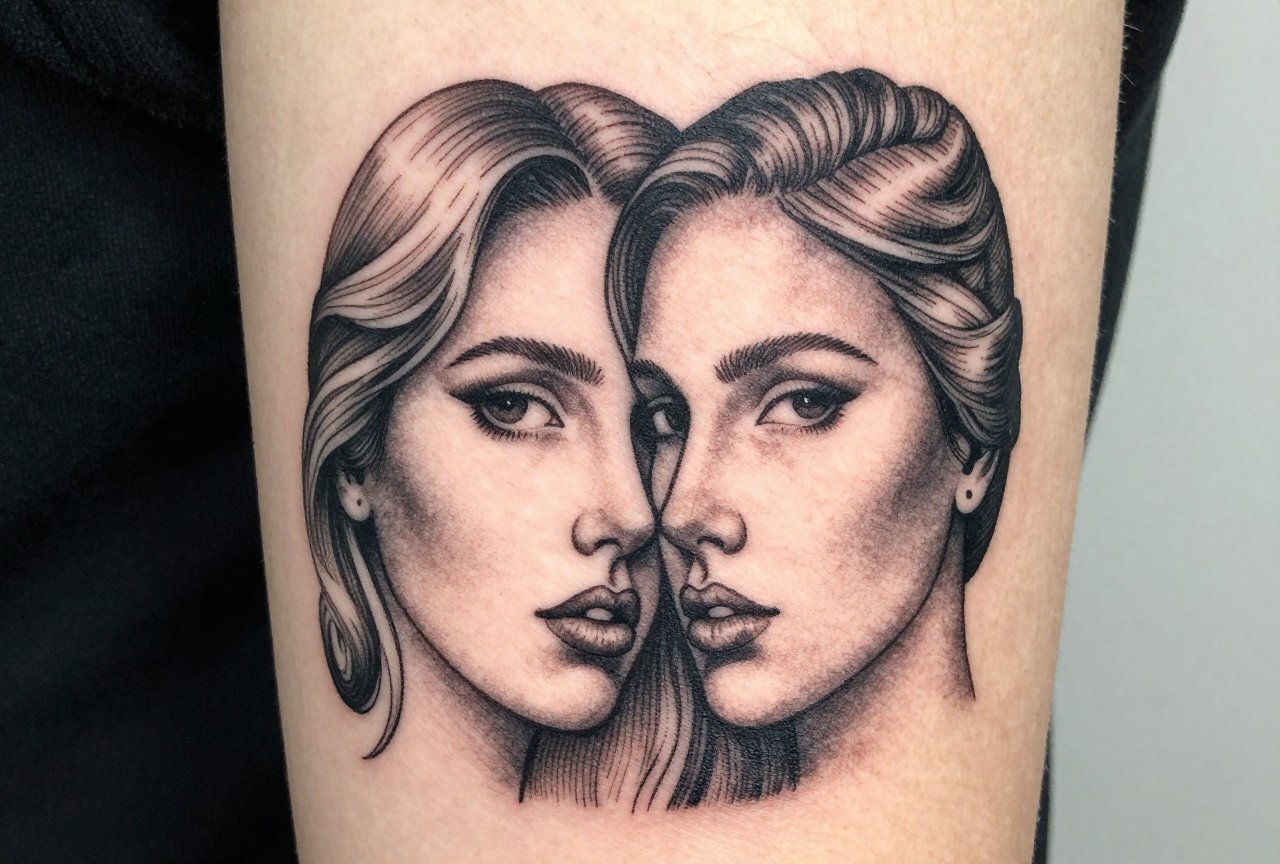
A two face tattoo typically represents duality, the coexistence of opposing forces within one person. Think light and dark, public face versus private truth, the person you show versus who you actually are. I’ve tattooed this design on people grappling with everything from bipolar disorder to simply feeling like they wear a mask at work.
Symbolism & History
The image of two faces isn’t new. It’s ancient. Roman Janus, the god of beginnings and transitions, had two faces looking opposite directions, past and future. In my chair, I hear clients reference that less often than you’d think. More often, they talk about feeling split. The guy who manages a restaurant all day with a smile, then goes home and can’t feel anything. The mother who presents perfect calm but inside is screaming.
Light & Dark
This is the version I see most. One face serene or beautiful, the other distorted, demonic, or decaying. The line weight matters here, I’ve done pieces where the “good” face is fine line and delicate, the “dark” face heavy blackwork or whip-shaded roughness. That contrast in technique reinforces the meaning. Over time, the fine line side may soften more than the bold side, which actually becomes its own kind of truth: the darkness stays legible, the light becomes harder to read.
Mask & Truth
Some clients want a face peeling away to reveal another beneath. The theatrical mask tradition, comedy and tragedy, feeds into this. I’ve done pieces where the mask is literally cracking, the “real” face showing through the fissures. These heal tricky; the crack lines need to be bold enough to hold, or they blur into mush. I always tell clients: if you want that cracked-mask effect, commit to the black.
Common Variations & Styles
Not all two face tattoos look alike. The style choice changes how the meaning lands.
- Split vertically down the middle: Classic. One half smiling, one half screaming. Clean, immediate, reads from across the room. I’ve done this on forearms, calves, the side of the neck.
- Two faces overlapping or merging: More abstract, harder to execute. Requires an artist who understands facial anatomy enough to distort it. The meaning shifts toward integration rather than opposition, becoming whole rather than split.
- One face in profile, another emerging from the back of the head: Surrealist, Dalí-esque. I did one of these on a musician who said his “stage self” was the forward face, the backstage self the hidden one. The placement on his ribcage meant it was private, for him.
- Traditional/Americana: Bold lines, limited color. The meaning becomes more archetypal, less personal. These age like tanks.
- Black and grey realism: The emotional weight hits harder. Every pore, every shadow. But the healing is unforgiving, any scabbing or sun damage shows in the smooth gradients.
Color versus black and grey is a conversation I have a lot. Red tears on one face. Gold halos. Blue lips. Color adds symbolic layers but requires commitment to sunscreen and touch-ups. Black and grey says something more solemn, more permanent in its mood.
Best Placements
Where you put it changes who sees it, which changes what it means to you.
Visible vs. Hidden
Forearm: You see it, others see it. Daily reminder, daily conversation. I’ve had clients say that’s the point, they don’t want to hide their duality anymore.
Chest, over the heart: The meaning becomes internal. The two faces face you in the mirror. I did one on a chest piece where the faces were his own, age 20 and age 40, the younger one weeping, the older one calm. He was 35 at the time. “I’m almost there,” he said.
Thigh, back of calf, ribs: Hidden by default. For the wearer, not the viewer. These placements suit the mask-and-truth version especially well.
Size Reality
Two faces need room. Trying to cram this concept into something under 4 inches usually fails, the features mush together, the meaning gets lost. I tell people: minimum palm-sized, preferably larger. If you want detail in both expressions, budget for a session or two. Single-needle micro-realism of two faces sounds cool on Instagram, heals into a smudge in three years.
Who Chooses This Tattoo / Personal Meanings
After fifteen years in shops, I can tell you who sits down for this design. It’s not one type.
- People in recovery: The face they were, the face they’re becoming. The “before” often looks dead-eyed, the “after” isn’t necessarily happy, sometimes it’s just present, aware.
- Performers: Musicians, actors, sex workers, anyone whose income depends on becoming someone else. The stage face versus the exhausted one.
- People who’ve changed radically: Religious converts, detransitioners, anyone who’s lived two lives in one body. The tattoo becomes a memorial and a map.
- Those with mental health struggles: Not as cliché as it sounds. I’ve had clients explicitly reject the “Joker/Harley” crazy-person trope and want something dignified, almost classical. The two faces as Greek tragedy, not Halloween costume.
One client, a firefighter, wanted his own face split: one side soot-covered, screaming, the other clean, blank, almost robotic. “That’s how I go into a building,” he said. “Then I come out and feel everything later.” We put it on his inner bicep, where his turnout gear covers it. Only he and his partner see it.
Similar Symbols
Clients sometimes come in asking for a two face tattoo but actually want something adjacent. I steer them if the image doesn’t match the meaning.
- Janus: More historical, less psychological. Good for transitions, new chapters, looking forward while honoring the past.
- Comedy and tragedy masks: Theatrical, performative. Less about internal split, more about life’s ups and downs. These read as “actor” to most people.
- Shadow self / Jungian imagery: Often one figure and its literal shadow. More integrated than two faces, more about accepting darkness than displaying conflict.
- Skull and living face: Memento mori, mortality. The split is life versus death, not personality versus personality.
- Mirror reflections: The reflection doing something different. More supernatural, less psychological. Good for horror fans, dissociative experiences.
I always ask: do you want to show two things that are both you, or you versus something else? That question usually clarifies the design direction fast.
Final Thoughts
A two face tattoo isn’t a trend. It’s a confession made visible. The best ones I’ve done weren’t about looking cool, they were about surviving something, or surviving between two somethings. The technical side matters: bold enough to age, big enough to read, placed where the meaning holds. But the real work is the conversation before the needle touches skin. What are these two faces? Who gets to see them? Are they at war, or finally meeting?
I tell every client: this image will change as you change. The face you think is your darkness now might become your strength later. The mask you hate wearing might turn out to be a skill that saved you. The tattoo stays. Make sure it can hold more than one truth.
Frequently Asked Questions
Does a two face tattoo always mean someone has mental illness?
Not at all. I’ve tattooed this on teachers, parents, performers, anyone who feels they live a double life. The meaning is broader than clinical diagnosis, though some wearers do reference specific struggles.
Will a two face tattoo with lots of fine detail still look good in ten years?
It depends on placement and sun exposure. Faces with tiny details blur over time, especially on areas that move or stretch. I always recommend bolder lines for longevity, with fine detail reserved for areas that see less wear.
Can I use my own face in a two face tattoo design?
Absolutely, and many clients do. Using your actual features makes it deeply personal. Bring clear reference photos from multiple angles, your artist needs to understand your bone structure to create a convincing split or transformation.
Is the two face design considered bad luck or negative energy?
Some cultures and individuals may read it that way, but in my experience most wearers intend it as honest, not ominous. It’s about acknowledging complexity, not inviting harm. Your intent and the specific imagery matter more than any universal symbolism.
Related Tattoo Meanings
- Weeping Willow Tattoo Meaning: Grief, Resilience Deep Roots
- Parrot Tattoo Meaning: Symbolism, Styles What Artists Notice
- Gun Look Like Tattoo Meaning: Power, Rebellion Raw Identity
- Explore more









