Star of David Tattoo Meaning: Faith, Identity & Art
The Star of David, or Magen David, carries weight that extends far beyond its simple geometry. Two overlapping triangles form a hexagram recognized across cultures, yet its meaning shifts dramatically depending on who wears it and why. For those considering this symbol as permanent ink, understanding its layered significance matters deeply. This guide examines the Star of David as tattoo art: its historical roots, personal interpretations, design variations, and what to weigh before committing.
Origins and Historical Context
The six-pointed star’s earliest appearances predate its Jewish association by centuries. Archaeological evidence shows hexagrams in ancient Mesopotamian and Hindu contexts, often serving as decorative or protective motifs. Its connection to Judaism solidified gradually, not through single decree but through centuries of evolving usage.
From Medieval Seal to Modern Emblem
Medieval Jewish communities in Prague and elsewhere began using the Star of David on seals and flags during the 17th century. The symbol gained broader recognition when chosen for the flag of the Zionist movement in 1897, later becoming central to Israel’s national identity in 1948. This trajectory matters for tattoo wearers: the symbol carries both religious and secular nationalist dimensions, sometimes simultaneously, sometimes in tension.
The Holocaust irrevocably altered how the Star of David functions in visual culture. Nazi forced identification transformed it from chosen emblem to imposed mark of persecution. Some contemporary wearers incorporate this history deliberately; others seek to reclaim the symbol from trauma. Neither approach is more valid, but each carries different visual and emotional weight.
Religious Significance and Spiritual Interpretation
Within Judaism, the Star of David lacks the explicit scriptural foundation of symbols like the menorah or shofar. Its theological significance emerged through Kabbalistic and later rabbinic interpretation, creating space for personal meaning-making that more codified religious symbols sometimes restrict.
Kabbalistic Dimensions
Kabbalistic tradition often links the hexagram to the sefirot, the ten divine emanations through which God interacts with creation. The upward triangle traditionally represents masculine, active, spiritual forces; the downward triangle, feminine, receptive, material existence. Their union suggests cosmic balance rather than opposition. Tattoo designs drawing on this tradition sometimes incorporate Hebrew letter combinations, color correspondences, or related symbols like the Tree of Life.
Contemporary Jewish Practice
Orthodox Jewish law generally prohibits tattooing based on Levitical interpretation, creating genuine tension for observant individuals drawn to the symbol. Some wear the Star of David despite this prohibition, viewing it as an expression of ethnic or cultural identity distinct from religious practice. Others choose temporary alternatives or locate designs in concealable placements. Reform and Reconstructionist movements generally exercise more latitude, though individual congregations vary.
- Placement choices often reflect this religious calculus: visible locations signal public identification, concealed ones permit participation in traditionally observant spaces
- Some wearers pair the star with explanatory text or complementary symbols that clarify personal intent
- The intersection of tattoo art and Jewish observance continues evolving, particularly among younger generations
Personal and Cultural Identity Expressions
Beyond formal religious frames, the Star of David functions as a marker of ethnic belonging, familial connection, and historical consciousness. Many wearers lack synagogue affiliation yet feel profound attachment to Jewish heritage. The tattoo becomes a bodily declaration of continuity across generations.
Heritage and Ancestral Connection
Family narratives frequently motivate these choices. Grandparents who survived displacement, parents who emigrated, or simply the accumulated weight of minoritarian experience in majority cultures: the star compresses complex lineages into immediately legible form. Tattoo artists working with such clients often benefit from understanding which generation’s story predominates, as this shapes appropriate stylistic treatment.
Intersectional Identities
The Star of David increasingly appears alongside other identity markers: LGBTQ+ symbols, feminist iconography, or markers of other ethnic affiliations. Jewish feminists may integrate the star with Venus symbols or Hebrew goddess names. Queer Jewish wearers sometimes combine it with rainbow elements or specific community emblems. These hybrid designs require particular technical care to maintain visual coherence without reducing any constituent element to mere decoration.
Design Variations and Artistic Approaches
The geometric simplicity of the Star of David offers remarkable versatility while presenting specific technical challenges. Symmetry demands precision; minor deviations become immediately apparent. Experienced artists approach the form with mathematical attention uncommon in more organic designs.
Geometric Precision and Sacred Geometry
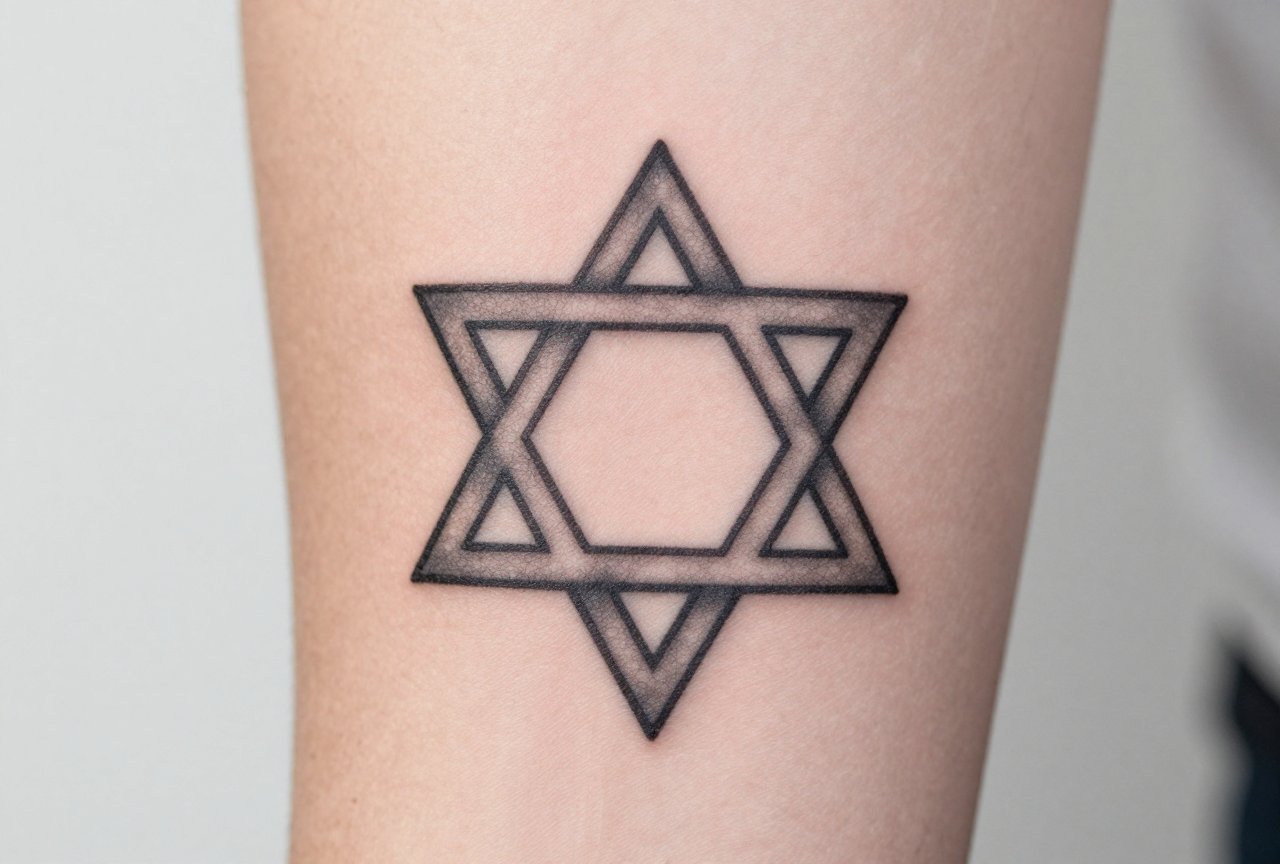
Pure line-work executions emphasize the form’s mathematical elegance. Some artists explore three-dimensional interpretations, impossible geometries, or tessellated repetitions that create larger patterns from multiple stars. The hexagram’s relationship to the flower of life and other sacred geometric figures permits sophisticated compositional expansion. These approaches particularly suit wearers drawn to the symbol’s universalist or mystical dimensions rather than specifically Jewish identification.
Integrated Symbolic Elements
Common additions include:
- Hebrew text: names, biblical verses, or words like chai (life) or shalom (peace)
- Natural imagery: olive branches, pomegranates, or Jerusalem stone textures
- Memorial elements: dates, coordinates, or names of specific individuals
- Color interventions: blue and white reference Israeli national identity; black and grey emphasize solemnity or historical gravity
Each addition alters the star’s primary reading. Olive branches soften political associations; memorial dates deepen personal significance; Hebrew text anchors specifically Jewish meaning against universalist interpretation.
Style-Specific Considerations
Traditional American treatments render the star with bold outlines and limited color, emphasizing graphic legibility. Blackwork and dotwork approaches exploit the form’s geometric potential for intricate patterning. Fine-line contemporary styles risk appearing insubstantial at small scales; the star’s angles can blur or soften without adequate weight. Watercolor techniques, while popular, sometimes clash with the symbol’s inherent precision unless applied with deliberate asymmetry around rather than within the core form.
Placement, Practicality, and Long-Term Thinking
The Star of David’s visibility carries social consequences that abstract or purely aesthetic designs typically avoid. Prospective wearers should consider how placement affects daily interaction, professional contexts, and evolving personal circumstances.
Visibility and Social Context
Visible locations (forearm, hand, neck) constitute unambiguous public statements. This suits wearers seeking community recognition or committed to visible Jewish identification. Concealed placements (ribcage, upper thigh, back) permit selective disclosure, valuable in contexts where antisemitism remains a lived concern or where professional environments reward conformity. The choice itself communicates something about the wearer’s relationship to Jewish identity and their assessment of surrounding social conditions.
Long-term considerations include aging’s effect on geometric precision. The star’s straight lines and sharp angles blur more noticeably than organic forms as skin loses elasticity. Locations with significant movement or sun exposure require particular foresight. Artists often recommend slightly heavier line weight than initially aesthetically preferred to accommodate predictable softening over decades.
Final Thoughts
The Star of David as tattoo art occupies a singular position: simultaneously ancient and modern, religious and secular, universal and particular. Its very ambiguity enables personal investment that more definitively coded symbols sometimes prevent. Whether chosen for faith, heritage, aesthetic preference, or complex combination, the tattoo commits the wearer to ongoing negotiation with what the symbol has meant and continues to mean.
Quality execution matters especially here. The form’s simplicity exposes technical shortcomings; its cultural weight demands respectful treatment. Seek artists with demonstrated geometric precision and genuine understanding of the symbol’s dimensions, not merely technical competence. The best Star of David tattoos honor both the individual story and the collective history they temporarily embody.
Permanent marks deserve permanent consideration. The star you choose today will accompany you through unforeseen transformations of belief, circumstance, and self-understanding. That durability, properly respected in the choosing, becomes part of the symbol’s enduring power.
Frequently Asked Questions
Is it culturally appropriate for non-Jewish people to get a Star of David tattoo?
Context matters significantly. Non-Jewish wearers with genuine connection, partners in interfaith relationships, converts, those raised in Jewish environments, sometimes choose the star with community support. However, casual adoption risks appropriation, particularly given the symbol’s specific history of persecution and survival. Thoughtful consultation with Jewish friends, community members, or knowledgeable artists helps distinguish respectful engagement from problematic use. The symbol is not ‘just geometry’ for many who wear it.
What does the Star of David tattoo mean in prison or gang contexts?
Certain prison systems have seen the Star of David adopted by white supremacist gangs, a bitter irony given the symbol’s Jewish association. This usage remains geographically specific and relatively uncommon, but tattoo artists in affected regions sometimes recognize particular stylistic conventions (heavy black fill, accompanying numbers or symbols) that distinguish these from Jewish-identified stars. Context and accompanying elements typically clarify intent for informed observers.
How much should I expect to pay for a quality Star of David tattoo?
Geometric precision commands premium pricing. Small, simple designs (2-3 inches) from established artists typically range from $150-400 depending on location and artist reputation. Larger pieces with integrated elements, complex patterning, or color work extend accordingly. The Star of David particularly rewards investment in technical skill; savings from less experienced artists often become visible in asymmetry or line inconsistency that geometric forms mercilessly reveal.
Can a Star of David tattoo be effectively covered or removed if my circumstances change?
The star’s strong lines and solid areas present challenges for both cover-up and laser removal. Black ink responds best to laser treatment, but complete removal typically requires multiple sessions over years with variable results depending on skin type and ink depth. Cover-up possibilities depend on size, placement, and surrounding skin condition; the geometric form sometimes limits effective concealment without significantly larger replacement designs. These realities underscore the importance of confident, well-considered initial commitment.