
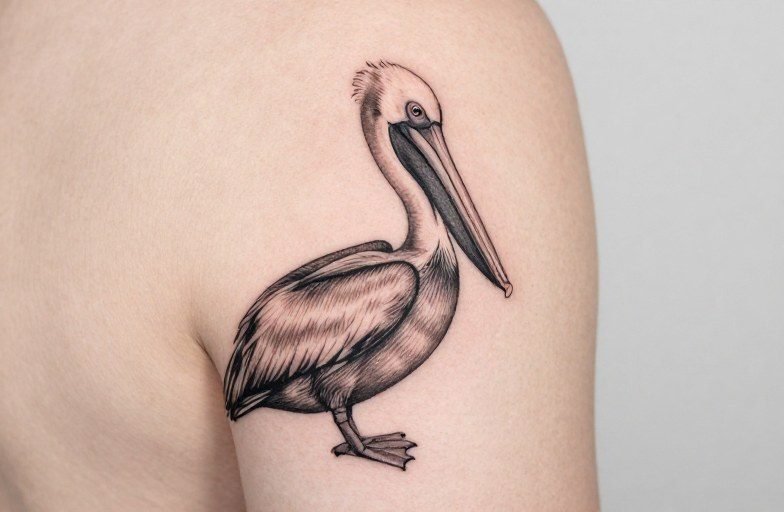
The pelican tattoo most commonly represents self-sacrifice, parental devotion, and spiritual renewal, drawn from centuries-old legends of the bird wounding its own breast to feed its young. Beyond that core meaning, it functions as a marker of coastal identity, fishing culture, and personal resilience for those who choose it. The symbol carries enough weight to work as a small, quiet piece or as the centerpiece of a larger composition.
Symbolism & History
The Medieval Legend
European bestiaries from the Middle Ages often linked the pelican to Christ’s sacrifice, depicting the bird piercing its own chest to draw blood for starving chicks. This “pelican in her piety” imagery became a staple of Christian iconography, carved into church lecterns and stained glass. The symbol transferred to tattoo culture through sailors and coastal communities who already lived with the bird as a daily presence. Some trace the specific tattoo usage to Gulf Coast and Chesapeake Bay watermen in the early 20th century, though concrete documentation remains sparse.
Modern Interpretations
Contemporary wearers frequently detach the pelican from its religious origins, emphasizing instead:
- Resourcefulness and adaptability, the pelican’s dramatic dive-and-scoop hunting method
- Protection of family, particularly the father’s role as provider
- Return and homecoming, since pelicans remain in fixed territories rather than migrating long distances
- Environmental awareness, especially after DDT-era population crashes and subsequent recovery
The Louisiana state flag features a pelican feeding its young, which has driven significant regional adoption of the symbol as cultural pride.
Common Variations & Styles
Traditional & Neo-Traditional
American traditional pelican tattoos typically show the bird in profile, wings folded or slightly spread, beak pouch emphasized, often with a banner or ribbon for text. The limited color palette, navy, red, yellow, black, holds up exceptionally well over decades. Neo-traditional versions introduce more dynamic posing: diving, taking flight, or standing on a piling with fish in bill. The pouch offers natural opportunity for rounded shading that ages better than fine-line detail in that area.
Realistic & Black-and-Grey
Photorealistic pelican pieces concentrate on the bird’s almost prehistoric proportions, the massive bill, the throat pouch capable of holding three gallons, the awkward dignity of its stance. Black-and-grey realism suits the subject naturally; the birds are already monochrome in life, with white, grey, and soft black plumage. Water backgrounds in this style require careful planning, too much dark shading behind the bird can swallow the outline within ten years.
Minimalist & Line Work
Single-needle and fine-line pelicans work best when the artist commits to extreme simplicity: the elongated beak and pouch create a recognizable silhouette with minimal marks. These pieces demand precise aftercare; the thin lines in the pouch area are prone to blowout and fading. A minimalist pelican carrying a fish in its bill reads immediately even at two inches across.
Combinations & Secondary Elements
- Roses or flowers tucked into the beak or framing the composition
- Lighthouses, piers, or shrimp boats for geographic specificity
- Script banners with names, coordinates, or dates
- Broken chains or open cages for recovery narratives
- Crosses or halos when the religious meaning remains central
Best Placements
The pelican’s proportions, long neck, heavy body, extended bill, create specific placement constraints and opportunities.
Forearm and calf: The vertical format suits the bird’s standing posture naturally. A forearm placement allows the beak to point toward the hand or elbow, creating directional flow. Calf pieces work similarly, with the bird’s height matching the muscle’s length.
Thigh and upper arm: More room for wingspread poses, water backgrounds, or companion elements. The thigh’s flat plane supports detailed pouch shading that won’t distort significantly with movement.
Chest and back: Large-scale compositions with the wings extended fully, sometimes incorporating the “in her piety” pose with blood drops or chicks visible. The chest placement carries obvious resonance given the sacrifice symbolism.
Ribs and side: The bird’s neck follows the body’s natural curve, though this placement demands tolerance for extended sessions. The pouch sits at the waist’s natural fold, which can blur fine detail over time.
Small placements: Behind the ear, ankle, or wrist work for silhouettes or minimal designs. The ankle’s round surface distorts the bird’s straight legs; artists usually compensate by curving the body slightly.
Who Chooses This Tattoo / Personal Meanings
Regional identity drives significant pelican adoption. Gulf Coast natives, Louisiana residents, and Florida locals frequently choose the bird as permanent identification with place. The symbol functions as a shibboleth, recognizable to insiders, merely decorative to outsiders.
Parents, particularly fathers, select the design after childbirth or adoption, invoking the sacrifice and provision aspects without explicit religious framing. Some choose it after personal loss, the blood imagery transmuted into grief and continuation.
Fishing industry workers, commercial crews, charter captains, seafood processors, use the pelican as occupational marker, sometimes with specific boat names or registration numbers incorporated. Recovery community members occasionally adopt the bird for its “wounding to sustain” narrative, though this interpretation requires careful handling to avoid melodrama.
The environmental contingent has grown as pelican populations have rebounded from near-extinction in specific regions. These pieces sometimes include pollution imagery, oil, plastic, hooks, transformed into the bird’s overcoming rather than victimhood.
Similar Symbols
Collectors sometimes compare the pelican to overlapping symbols:
- Phoenix: Both involve sacrifice and renewal, but the phoenix emphasizes destruction and rebirth rather than sustained provision. The pelican’s meaning is quieter, more continuous.
- Stork: Shared association with childbirth and family, but the stork lacks the self-wounding aspect and carries more European than American regional identity.
- Albatross: Sailor tradition and ocean connection, though the albatross carries more negative connotations (Coleridge’s burden, bad luck) and less parental symbolism.
- Phoenix and pelican together: Occasionally combined for recovery narratives, but this pairing risks visual clutter and diluted meaning.
The pelican occupies a distinct niche: a bird of the Americas with specific coastal ecology, carrying medieval European symbolic weight, adaptable to secular modern usage without losing recognizability.
Final Thoughts
The pelican tattoo endures because its core image, awkward, ancient-looking, somehow both comic and dignified, resists becoming merely decorative. The symbolism has enough depth to support personal meaning without demanding it, enough regional specificity to signal belonging without excluding outsiders. For a well-executed piece, prioritize the beak and pouch relationship; that’s where the bird’s character lives. Choose an artist with experience in bird anatomy, not just general wildlife work. The pelican’s proportions are unforgiving, a bill too short or a pouch too shallow destroys the likeness entirely. Whether the meaning is spiritual, parental, regional, or simply aesthetic, the image itself must read as a pelican first. Everything else follows from that recognition.
Frequently Asked Questions
Does a pelican tattoo always have religious meaning?
No. While the symbol originated in Christian iconography, most contemporary pelican tattoos emphasize parental sacrifice, coastal identity, or personal resilience without religious framing. The meaning depends entirely on the wearer’s intention and any accompanying elements.
How well does pelican tattoo ink hold up over time?
The pouch and white plumage areas are prone to yellowing and blurring as skin ages. Traditional bold-line versions age most reliably; fine-line realism in the throat pouch often requires touch-ups within five to seven years. Black-and-grey designs generally outlast heavy color saturation.
What’s the typical cost range for a quality pelican tattoo?
A small minimalist pelican runs $150-$300, while detailed forearm or thigh pieces typically fall between $400-$800. Large back or chest compositions with background elements can reach $1,500-$2,500. Coastal artists in pelican-dense regions sometimes charge premium rates for their specialized familiarity with the subject.
Can a pelican tattoo work if I don’t live near the coast?
Absolutely, though the regional association may read differently. Inland wearers usually emphasize the parental or sacrifice aspects explicitly through added elements, names, dates, religious iconography, rather than relying on geographic recognition. The bird’s distinctive form carries symbolic weight independent of location.
Related Tattoo Meanings
- Still I Rise Tattoo Meaning: Resilience Inked in Skin
- Fleur de Lis Tattoo Meaning: Royalty, Faith Identity
- Pete Hegseth Deus Vult Tattoo Meaning: Symbolism Explained
- Explore more









