
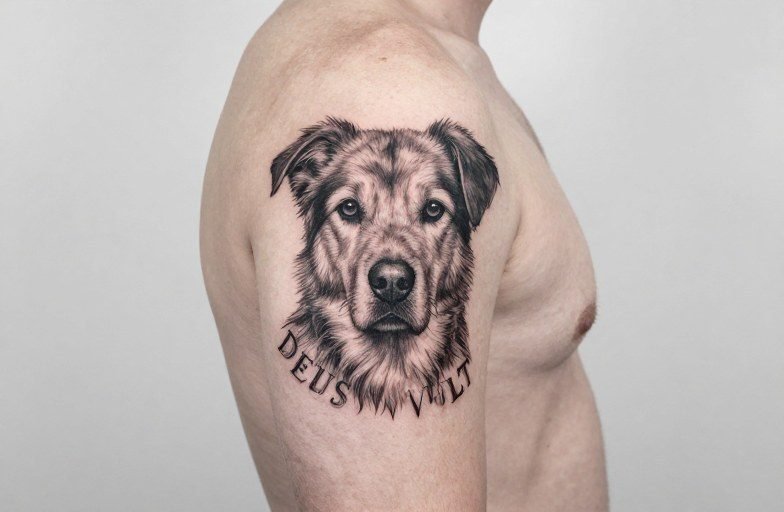
“Deus Vult”, Latin for “God wills it”, functions as a tattoo loaded with historical weight and modern ambiguity. Originally a battle cry of the First Crusade, it has resurfaced in military circles, political commentary, and internet culture, making its tattooed form a statement that reads differently depending on context, placement, and accompanying imagery.
Symbolism & History
The phrase emerged from medieval sources, commonly associated with Pope Urban II’s call to crusade in 1095. As a tattoo, it draws on that lineage of religious warfare, sacrifice, and collective purpose. The words themselves are compact, punchy, and visually balanced, three syllables that carry well across the skin.
Religious vs. Secular Interpretation
For some wearers, the phrase remains genuinely devotional: a declaration of faith-driven destiny, surrender to divine will, or acceptance of hardship as ordained. The lettering might appear with crosses, ichthys symbols, or scriptural references. For others, particularly in military and veteran communities, the religious language operates more as historical shorthand, an evocation of warrior brotherhood, mission focus, and the moral certainty that combat sometimes demands. Pete Hegseth, with his Army National Guard background and conservative media presence, embodies this overlap: the tattooed phrase can signal both faith identity and service culture without fully separating the two.
Contemporary Political Resonance
Since roughly 2015, the phrase has circulated in online nationalist and alt-right spaces, which has complicated its public meaning. A tattoo today exists in that context whether the wearer intends it or not. Placement and accompanying imagery become crucial signals: Gothic or blackletter typefaces lean medieval; clean Roman caps read more classical; pairing with crusader crosses, Templar imagery, or modern military insignia pushes interpretation in specific directions. Anyone considering this tattoo should understand that observers, including employers, fellow service members, and strangers, may read political affiliation into the choice regardless of personal intent.
Common Variations & Styles
The phrase adapts to several tattoo approaches, each carrying different tonal weight.
- Blackletter/Gothic script: The most common choice, directly evoking medieval manuscripts and crusader aesthetics. Heavy, dense lines work best on flat surfaces like chest, forearm, or calf. Aging tends to soften the sharp internal details, so simpler blackletter variants hold up better over decades than highly ornamental Fraktur styles.
- Roman capital letters: Cleaner, more architectural, less immediately associated with internet meme culture. Works well as a band around the arm or across the upper back. The straight lines and consistent stroke weight age predictably, no thin spots to blur prematurely.
- Integrated with crusader cross: The cross potent or “crusader cross” (four small crosses at the quadrants) frames or anchors the text. This composition demands more space; the chest plate or upper back provides adequate canvas. The cross adds explicit Christian identification that text alone leaves ambiguous.
- Helmet or armor imagery: Some designs incorporate medieval great helms or modern tactical helmets, bridging historical and military references. These require skilled shading to avoid muddying the text; a strong artist separates foreground text from background imagery with deliberate negative space.
Language Variations
Some wearers choose the Greek “Deus Vult” equivalent or the full Latin phrase “Deus lo vult” (God wills it). The shorter form dominates tattoo culture for its visual compactness. Hebrew or Arabic script versions exist but carry entirely different, and often appropriative, implications that most reputable artists will discuss frankly before agreeing to execute.
Best Placements
Forearm and outer bicep dominate for visibility, these are statements meant to be seen, not hidden. The text reads at a scale that requires minimum 4-5 inches in length for legibility; smaller sizes blur within five to seven years as ink spreads in the dermis. Chest placement over the sternum or across the pectorals allows larger compositions with accompanying imagery. Rib and side placements suit more private commitments but heal more painfully and distort with body movement. The calf provides flat, stable skin that ages text well, though it’s less commonly exposed in professional settings. Finger or hand placement is rare and generally inadvisable, the fine lines required for small text degrade rapidly, and the political visibility of the phrase makes hand placement a career-limiting move for most professions.
Who Chooses This Tattoo / Personal Meanings
The wearers fall into rough categories without being mutually exclusive.
- Practicing Christians in military service: The phrase merges faith and profession, often chosen post-deployment or during religious reawakening. The tattoo functions as personal reminder, not public provocation, and placement often reflects this, chest, back, or upper arm rather than forearm.
- Medieval history enthusiasts: Reenactors, scholars, and hobbyists drawn to the period’s aesthetics. These tattoos often lean more heavily on historically accurate script and accompanying period imagery, sometimes with subtle anachronisms that signal genuine knowledge rather than surface adoption.
- Political identity markers: The most contentious category, often younger wearers engaging with online conservative or nationalist communities. The tattoo here functions as in-group signaling, sometimes without deep historical engagement. Artists in politically mixed shops report fielding these requests with increasing frequency since 2016, and many have developed personal policies about execution.
- Recovery and redemption narratives: Less common but documented: wearers who encountered the phrase during personal crisis, addiction recovery, prison, near-death experience, and adopted it as a marker of survived ordeal divinely sanctioned. These tattoos often incorporate dates, names, or additional text that personalizes beyond the standard phrase.
The meaning any individual intends matters less in public space than the meaning audiences receive. This is a tattoo that requires ownership of its full baggage, not selective appeal to preferred interpretations.
Similar Symbols
Wearers drawn to Deus Vult often consider related imagery that carries overlapping but distinct connotations.
- “Molon labe” (Come and take them): Spartan origin, gun-rights and military adoption, less explicitly religious but similarly defiant. The Greek script offers aesthetic variation.
- Cross potent / Crusader cross: Visual rather than textual, more immediately readable as Christian but less linguistically specific. Often combined with Deus Vult rather than replacing it.
- Knights Templar symbols: Beauceant, two knights on one horse, or specific seal imagery. More historically niche, carrying similar political contamination in modern usage.
- Unit mottos and service creeds: “De oppresso liber,” “Semper fi,” “This we’ll defend”, military-specific alternatives that carry institutional legitimacy rather than adopted historical weight. These age better in professional contexts and carry less ambiguous political freight.
- Scriptural text tattoos: Direct Bible verses (Ephesians 6:10-18 on armor of God is common among the same demographic) offer explicit religious content without the crusader historical overlay.
Final Thoughts
The Deus Vult tattoo occupies uncomfortable territory: genuinely meaningful to some wearers as expression of faith and service, genuinely alarming to others as signal of exclusionary politics. The skin doesn’t permit footnotes. Before committing, the serious prospective wearer should consider not just personal intent but probable reception, by family, employers, fellow worshippers, and strangers in public space. The best tattoos earn their permanence through full acknowledgment of what they communicate, not selective emphasis on preferred readings. If the phrase survives that scrutiny, it deserves a skilled artist who understands blackletter legibility, adequate scale, and the technical demands of text that must remain readable for decades. The meaning you intend and the meaning that exists are not the same thing; a tattoo this charged demands comfort with both.
Frequently Asked Questions
Is a Deus Vult tattoo automatically considered a hate symbol?
Not automatically, but context matters enormously. The phrase has documented use in white nationalist and far-right online spaces since the mid-2010s, which means many viewers will associate it with those movements regardless of the wearer’s intent. Placement, accompanying imagery, and the wearer’s known affiliations all shape how it’s read.
What font style works best for long-term legibility?
Simpler blackletter or clean Roman capitals age most predictably. Highly ornamental Gothic scripts with fine internal details blur within 5-10 years as ink naturally spreads. Bold, consistent stroke weights and adequate size, minimum 4-5 inches across, maintain readability decades longer.
Can this tattoo be easily covered or removed if needed?
Covering black text requires larger, darker imagery; it’s not a simple fix. Laser removal is possible but challenging for dense black lettering, typically requiring 8-12 sessions minimum. The chest and back cover more easily than forearm or hand placement, which is worth considering before committing.
Do tattoo artists commonly refuse this request?
Increasingly, yes. Many shops have developed policies around politically charged imagery, and Deus Vult specifically falls into contested territory. Artists may decline based on personal ethics, shop policy, or concern for their professional reputation. Respectful shops will explain their reasoning rather than simply refusing.
Related Tattoo Meanings
- Star of David Tattoo Meaning: Faith, Identity Art
- Tinkerbell Tattoo Meaning: Magic, Rebellion, and Never Growing Up
- 10Th Planet Tattoo Meaning: Jiu-Jitsu Loyalty Rebellion
- Explore more









