
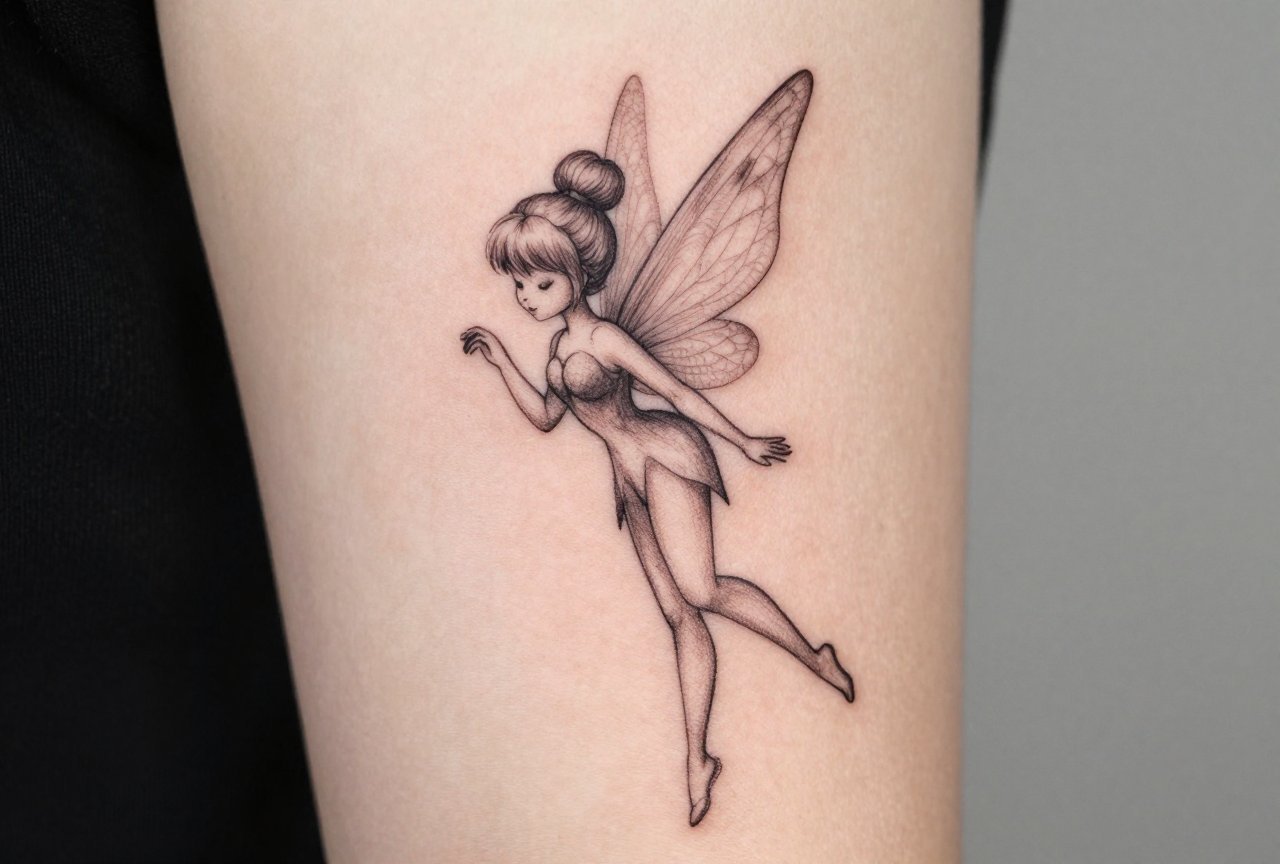
A Tinkerbell tattoo means you still believe in something invisible. Most people who sit in my chair for this design aren’t thinking about Disney merchandising, they’re marking a personal pact with magic, rebellion, or the part of themselves that refuses to go numb. The meaning shifts hard depending on placement, style, and what specific moment the person is trying to hold onto.
Symbolism & History
Tinker Bell started as J.M. Barrie’s spiteful, jealous, magnificent fairy in the 1904 play Peter Pan; or, the Boy Who Wouldn’t Grow Up. She was dangerous. She tried to have Wendy killed. She drank poison to save Peter. Disney sanded her edges into a mascot, but the original character carries way more weight for tattoo symbolism.
The Darker Roots
I’ve tattooed Tinkerbell on women who left abusive relationships, on recovering addicts, on people who survived something they don’t talk about. They gravitate toward her original fierceness, the fairy who was small enough to be underestimated and vicious enough to matter. The glow isn’t always pretty. Sometimes it’s the light you carry through something ugly.
The name itself comes from “tinker,” a traveling mender of pots and pans. Barrie gave her a working-class surname, then made her proud of it. That blue-collar stubbornness still resonates. I hear it in consultations: “She wasn’t born special, she made herself matter.”
Disney’s Shadow
The 1953 animated version locked her silhouette into global consciousness. That green dress, the upswept bun, the wand raised mid-sparkle, it’s instantly readable. But it also creates tension. Some clients want pure nostalgia, the childhood bedroom poster come to life. Others specifically reject the sanitized version, asking for grittier interpretations: Tinkerbell with a cigarette, with torn wings, with dead eyes. Both approaches are valid. The tattoo lives on your body, not in a brand style guide.
- Original Barrie: dangerous loyalty, violent love, the cost of devotion
- Disney classic: innocence, wonder, the safety of childhood belief
- Modern reimagining: resilience, subversion, reclaimed femininity
Common Variations & Styles
I’ve done maybe forty Tinkerbells over fifteen years. The style choices split the meaning as much as the imagery itself.
Classic Silhouette vs. Detailed Portrait
The solid black silhouette, just that profile with the wand, heals cleaner and ages better. I’ve watched detailed color portraits blur after five years, especially on areas that see sun. The silhouette reads from across a room. It’s graphic, bold, almost punk when placed right. Detailed work demands commitment to touch-ups.
Watercolor Tinkerbells exploded around 2012 and they’re already aging badly in my opinion. The colors bleed unpredictably, the “splashes” turn to bruise-like blobs. I tell clients straight: if you want color, go traditional or neo-traditional where the linework holds the design together even as pigments shift.
Common Combinations
- “Believe” script: Usually small, wrist or collarbone. The word anchors the magic in something concrete. I’ve seen this on teachers, social workers, people whose jobs drain them and need the reminder.
- Pixie dust trail: Stars, music notes, children’s names. The trail turns the static image into movement, story. It works beautifully curving around an ankle or shoulder.
- Tinkerbell with skull: Popular in the 2000s, less now. The juxtaposition feels dated unless the client has a specific narrative.
- Broken wings: Recovery imagery. These hit me hardest. The fairy who still flies damaged.
Best Placements
Where you put her changes how the meaning lands.
Wrist/forearm: Visible, declarative. “I choose to believe.” I’ve done these on people who need to see it during hard days. The downside: everyone sees it, everyone comments, you become the Tinkerbell person at work.
Ankle/foot: Classic 90s-2000s placement. Still popular, still prone to blowout from thin skin and movement. The meaning here tends toward private, something the wearer knows is there, a secret kept in plain sight.
Ribcage/side: Painful. The people who choose this want the commitment to hurt. It’s intimate, rarely shown, often tied to deep personal significance. The curve of the ribs can make the flying pose look natural.
Shoulder blade: My favorite for the silhouette. The flat plane holds detail, the wing can extend toward the arm, and it’s coverable for professional settings. The meaning here is often protective, guardian fairy at your back.
Behind the ear: Tiny, whispered. Usually just the head and wand, maybe an inch. These clients want the symbol without the performance. It’s for them, not for exhibition.
Who Chooses This Tattoo / Personal Meanings
There’s no single type. I’ve tattooed Tinkerbell on a 60-year-old grandmother who read Barrie to her kids, on a 19-year-old guy who called her his “patron saint of not giving a fuck,” on a mother with three small stars trailing from the wand representing miscarriages she never named aloud.
What They Actually Say
In consultations, people rarely lead with “magic.” They say:
- “I don’t want to become bitter.”
- “I was told I’d never amount to anything.”
- “My daughter loved her before she died.”
- “I was small and angry and it worked out.”
The tattoo becomes a conversation they have with their own body. That’s the real meaning, not what Tinkerbell represents in theory, but what she holds for this specific person at this specific time.
Shop culture has shifted too. Fifteen years ago, male artists sometimes mocked Tinkerbell requests as “basic girl tattoos.” That attitude’s dying, thankfully. Good artists recognize that popular imagery becomes popular because it works, because it carries weight for millions. The skill is in making it specific to the wearer, not in choosing obscure reference points to impress other tattooers.
Similar Symbols
Clients sometimes compare Tinkerbell to other magical or defiant feminine icons. Here’s how they differ in tattoo practice:
- Fairy (generic): Softer, less defined, more nature-spirit than personality. Less baggage, less specificity.
- Angel: Religious or memorial weight. Tinkerbell carries none of that unless the client adds it. She’s secular, almost pagan in her stubbornness.
- Butterfly: Transformation, lightness. Tinkerbell adds agency, she acts, she chooses, she fails and tries again.
- Peter Pan himself: Rare in tattoo form. The boy who won’t grow up reads as immature; the fairy who enables him reads as loyal. Gender flips the morality.
- Wendy: Growing up, maternal, narrative closure. The opposite choice. I’ve seen them paired as sister tattoos, the two paths.
Final Thoughts
Tinkerbell endures because she’s contradictory enough to hold real lives. She can mean innocence or its loss, magic or the desperate need for it, feminine delicacy or feminine rage. The tattoo works when the person wearing her knows which version they’re claiming.
I’ve watched these tattoos age on returning clients. The ones that hold up best emotionally, not just technically, came from honest consultation. The person knew why they wanted her. They weren’t chasing a trend or filling a Pinterest board. They needed a small, bright, dangerous thing on their skin to remind them of something true.
If you’re considering this, spend time with the source. Read Barrie’s original stage directions. Watch the Disney version with adult eyes. Notice what you resist, what you mourn, what you still want to believe. Then bring that to your artist. The best Tinkerbell tattoos don’t come from reference images. They come from knowing exactly what you’re asking to carry.
Frequently Asked Questions
Does a Tinkerbell tattoo always mean something about Disney or childhood?
Not necessarily. Many people connect her to the original, darker Barrie character or use her as a personal symbol of resilience. The meaning depends entirely on which version speaks to you and why you’re choosing it now.
How well does a detailed Tinkerbell tattoo age compared to a simple silhouette?
Silhouettes age much cleaner. Fine facial details and soft watercolor blends tend to blur and fade within five to ten years, especially on sun-exposed areas. Bold lines and solid blacks hold their readability longer.
Is it okay for a man to get a Tinkerbell tattoo?
Absolutely. I’ve tattooed Tinkerbell on men who connect to her defiance, her loyalty, or her refusal to be dismissed. Good artists don’t gender symbols, your meaning is what matters.
What should I bring to my consultation to get the best result?
Bring specific references for style and mood, not just one image to copy. Tell your artist what Tinkerbell represents for you personally. The more context you share, the more they can adapt the design to actually mean something on your body.
Related Tattoo Meanings
- Torch Tattoo Meaning: Light, Resistance Hope
- Treble Clef Tattoo Meaning: Music, Identity Self-Expression
- Triskele Tattoo Meaning: Triple Spiral Symbolism History
- Explore more









