
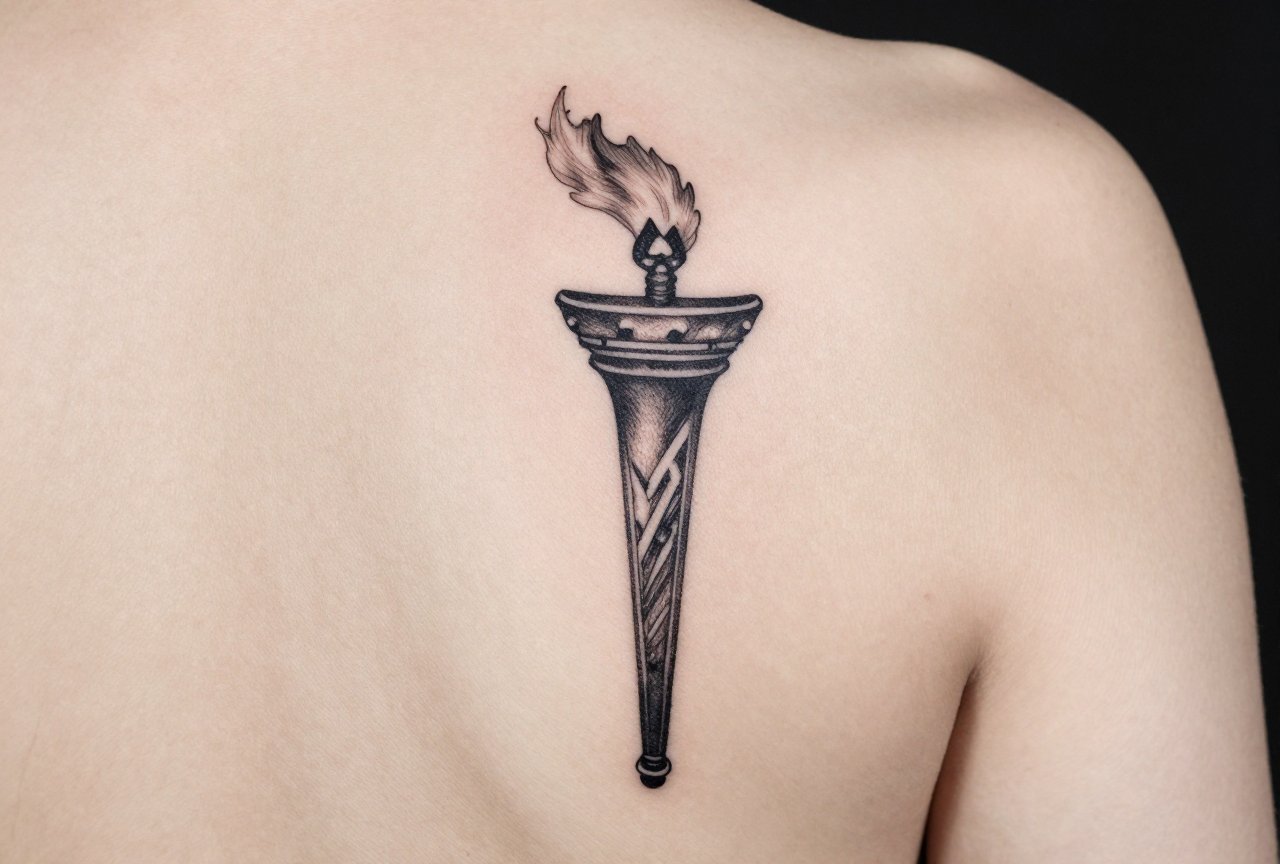
A torch tattoo is about carrying light through darkness. It can mean knowledge, rebellion, hope, or memory, whatever the bearer needs it to be. I’ve tattooed torches on bikers and librarians, and the meaning always shifts with the person wearing it.
Symbolism & History
The torch goes back. Way back. Prometheus stealing fire from the gods. The Statue of Liberty’s flame. Olympic torches. Punk rock show flyers. It’s one of those symbols that keeps getting picked up by different movements because it works, fire is transformation, light is guidance, and holding it up is an act of defiance or devotion.
Light in Darkness
This is the big one. Clients tell me they want a torch “for the hard times.” Someone walking through depression, grief, a divorce. The flame becomes a thing they can look at when they forget they made it through. I did one on a guy’s forearm after he got sober, simple black and grey, flame curling up toward his elbow. He said it was “the light he couldn’t see back then.”
- Guidance through personal struggle
- Memory of someone lost (the “keep their light alive” angle)
- Spiritual awakening or seeking truth
- Resistance against oppression or personal demons
Knowledge & Enlightenment
The torch as education, as burning away ignorance. I’ve seen this on teachers, professors, people who came from nothing and clawed their way to something. Often paired with books, open doors, or broken chains. The flame here is usually drawn cleaner, more controlled, less wildfire, more lantern.
Common Variations & Styles
How you draw the torch changes everything. A Greek-style bronze holder with a steady flame reads classical, timeless. A molotov cocktail with a burning rag? That’s punk, protest, rage. I’ve done both, and the vibe in the chair is completely different.
Traditional & Neo-Traditional
Bold lines, limited color palette, that classic sailor-jerry feel. The flame gets those teardrop shapes, yellow and orange packed solid. These age beautifully, the heavy black outline holds, and the simple color shapes don’t muddy over time. I tell clients: if you want this to read as “torch” in twenty years, traditional is your safest bet. The flame stays readable even when the colors soften.
Realistic & Black and Grey
Photographic flames, smoke, maybe a hand gripping the metal. This is where skill really shows. Fire is hard to tattoo well. Too much black and it looks like a weird blob; too little and it disappears into skin tone. I spend more time on reference photos for realistic flames than almost anything else. The best ones use negative space for the hottest parts, letting the skin be the white-hot core.
- Abstract/geometric: broken lines, minimal flame, modern aesthetic
- Skull + torch: memento mori, life and death intertwined
- Heart + torch: burning passion, sometimes heartbreak
- Liberty-style: freedom, immigration stories, American identity
Best Placements
Torches are vertical. That shapes where they work. I’ve seen great horizontal ones wrapped around limbs, but the natural flow is up-and-down, flame rising.
Forearm: Classic. The flame draws the eye upward, elongates the arm. Easy to show or hide. I did a beautiful one on a woman’s inner forearm, delicate lines, single needle, flame barely there. She was a poet. It fit.
Thigh: Room for detail. Big flames, smoke, maybe a hand holding it. Heals well, less sun damage than arms. We see this a lot on people who want something substantial but private.
Ribcage: Painful. Always painful. But the vertical space is perfect, and there’s something about a torch over the heart that hits different. I’ve had clients cry in the chair, not from pain, from the moment of finally getting it.
Calf/ankle: Smaller torches, often matching or part of a larger leg piece. The flame can point up toward the knee or down toward the foot depending on orientation.
Avoid: tiny spots where the flame becomes unrecognizable. I’ve had to fix a torch on a finger that looked like a candle after two years. Not every symbol shrinks well.
Who Chooses This Tattoo / Personal Meanings
In my chair, torch people are usually one of three types. The survivors, something happened, they made it, they want the mark. The seekers, still in process, figuring it out, the torch is a question as much as an answer. And the fighters, activists, organizers, people who’ve been in the streets. The meaning they attach is never abstract. It’s always a story.
Commemoration & Grief
This is more common than you’d think. A parent who lost a child. A sibling to overdose. The torch becomes “keeping their light alive.” Often paired with dates, names, or something the person loved. I tattooed a torch with a baseball wrapped in the flame for a dad whose son died at sixteen. He didn’t explain. I didn’t ask. We just worked in silence for two hours.
Identity & Belonging
Some groups use the torch as a shared symbol. Certain recovery communities. First-generation college students. Immigrants referencing the Statue of Liberty. When someone comes in with a specific reference, “like this, but mine”, that’s when the tattoo becomes theirs instead of just a image.
Similar Symbols
Clients sometimes waffle between a torch and something adjacent. Here’s how I talk them through it:
- Candle: More intimate, quieter, often religious or memorial. A torch is public, carried, active.
- Lantern: Contained light, safety, guidance on a path. Less rebellious than a torch.
- Phoenix: Rebirth through destruction. The torch is the tool; the phoenix is the transformation itself.
- Sun: Universal, constant, less personal agency. You carry a torch. You don’t carry the sun.
I had a guy who wanted a torch and a phoenix together. We ended up with the phoenix becoming the flame, bird and fire inseparable. That’s the good stuff, when two symbols merge into something that only works for that person.
Final Thoughts
A torch tattoo is never just decoration. It carries weight, light against dark, holding something up, keeping something alive. The best ones I’ve done weren’t about the technical flash of the flame. They were about why someone needed to carry that light on their skin.
If you’re thinking about one, ask yourself: whose light is this? Yours? Someone else’s? A light you’re still looking for? The answer shapes everything, the style, the placement, whether the flame is steady or wild, whether the hand holding it is visible or not. Get it right, and you’ll have something that keeps meaning more as the years pass. That’s the whole point of this work.
Frequently Asked Questions
Do torch tattoos fade faster because of all the light colors?
Yellows and oranges do fade faster than black, especially with sun exposure. That’s why I push for heavy black outlines and darker orange-red cores in the flame. A well-built torch will age readable even as the bright tones mellow.
Can a torch tattoo work as a cover-up?
Sometimes, but flames are tricky for cover-ups because of the negative space. The dark parts of the torch holder can hide old ink, but the flame itself needs clean skin to glow. I usually assess the old piece first, some situations work, others need a different symbol.
What’s the most meaningful torch tattoo you’ve done?
A woman in her sixties got a small torch on her wrist after leaving a decades-long marriage. Nothing fancy, just black linework. She said it was the first thing she’d ever chosen purely for herself. We both teared up when she saw it finished.
Is there any cultural appropriation concern with torch imagery?
The torch is broadly universal, but specific contexts matter, the Olympic torch, certain religious processions, or political movements. If your reference ties to a specific group’s struggle, talk to your artist about whether your personal connection justifies using that particular imagery. Most torch tattoos are general enough to avoid issues.
Related Tattoo Meanings
- Baphomet Tattoo Meaning: Symbolism, Styles Shop Talk
- Flame Tattoo Meaning: Symbolism, Styles What Fire Represents
- Burn the Boats Tattoo Meaning: Commitment No Turning Back
- Explore more









