
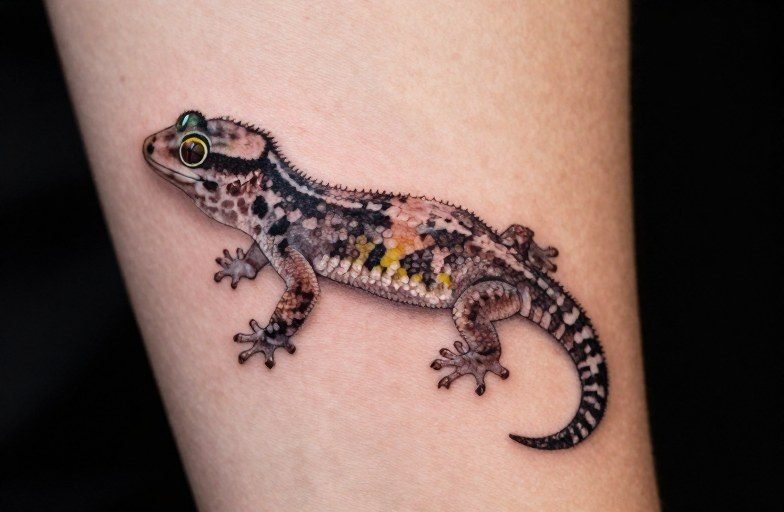
A gecko tattoo most commonly represents survival, adaptability, and the ability to thrive in harsh conditions. The lizard’s real-world traits, shedding and regrowing its tail, clinging to vertical surfaces, hunting at night, translate into personal symbolism about resilience, resourcefulness, and navigating difficult circumstances. Depending on the design and cultural context, it can also signal protection, luck, or a connection to nature’s quiet persistence.
Religious & Spiritual Angles
Geckos don’t carry the heavy doctrinal weight of crosses or lotus flowers, but they surface in spiritual frameworks in specific, meaningful ways.
Christian Interpretations
Some Christian contexts associate geckos with renewal and resurrection, drawing on the tail regeneration as a metaphor for spiritual rebirth. The creature’s ability to climb seemingly impossible surfaces also gets read as faith overcoming obstacles. This isn’t mainstream theology, more a personal devotional symbol that individual wearers develop with their artists.
Broader Spiritual Readings
Outside organized religion, geckos often represent shadow work and nocturnal awareness. Their night hunting translates spiritually into seeing through deception, trusting intuition when visibility is low, and operating effectively in life’s darker periods. The gecko’s stillness before sudden movement also maps onto meditation and mindful action practices.
- Tail loss/regrowth = letting go of what no longer serves, rebuilding
- Toe pads gripping glass = holding faith under impossible pressure
- Shedding skin = continuous transformation, not one-time change
- Nocturnal habits = comfort with uncertainty, shadow integration
How It Ages on Skin
Gecko designs present specific aging challenges that affect how you should plan the piece with your artist.
Line-Heavy vs. Shaded Designs
Geckos work well as fine-line silhouettes, but those thin toe details and delicate tail whips blur faster than bolder imagery. A gecko’s recognizable shape, elongated body, splayed feet, tapering tail, survives aging better than intricate scale patterns. If you want heavy detail, concentrate it on the body core where ink holds more reliably; let the extremities stay cleaner. Shaded geckos with dotwork or stippled backgrounds age more gracefully than pure linework, since subtle blur reads as texture rather than mistake.
Color Considerations
Day gecko greens and electric blues are gorgeous fresh but fade to muddy teal within five to seven years without touchups. Earth-toned geckos, rust, ochre, brown, maintain readable contrast longer on most skin tones. The white spots common in leopard gecko designs often yellow or disappear entirely; plan them as negative space rather than inked highlights if longevity matters.
- Silhouette designs: bold, readable for decades, limited detail
- Realistic color: stunning initially, requires maintenance commitment
- Tribal/stylized: excellent longevity, cultural specificity to consider
- Small sizes (under 3 inches): lose toe definition, better medium+
Mythology & Folklore
Gecko symbolism varies sharply by region, and much of it is often linked to protective rather than threatening associations, unlike snakes or spiders in many cultures.
Pacific and Southeast Asian Traditions
In Polynesian cultures, geckos are commonly associated with good fortune and household protection. Their presence in a home traditionally signals a healthy environment; their tattooed form extends that guardian function to the wearer. Some trace the gecko’s vocalizations to communication with ancestral spirits, making the tattoo a potential bridge between living and dead family lines. Filipino folklore specifically credits geckos with warning calls before danger, earthquakes, intruders, illness, so the tattoo can function as a talismanic alert system.
African and Mediterranean Threads
West African traditions often link geckos to fertility and feminine power through their prolific breeding and protective maternal behaviors. Ancient Mediterranean cultures were more ambivalent, Pliny the Elder recorded gecko-based medicinal preparations, while some North African folklore treated them as witchcraft familiars. The tattoo wearer drawing on these traditions should understand which specific lineage they’re referencing, since the symbolism isn’t uniformly positive.
- Polynesia: household protection, ancestral communication
- Philippines: early warning, danger sensing
- West Africa: fertility, maternal resilience
- Mediterranean: healing knowledge, but also occult suspicion
Who Chooses This Tattoo
There’s no single demographic for gecko wearers, but certain life patterns recur in the consultation chair.
Survivors and Adapters
People who’ve rebuilt after divorce, career collapse, health crises, or geographic displacement gravitate toward gecko imagery specifically for the tail-regeneration narrative. Unlike phoenix tattoos with their dramatic conflagration, gecko symbolism emphasizes quiet, practical rebuilding, the kind that happens in private, without spectacle. The gecko doesn’t rise from ashes; it keeps eating, keeps climbing, grows back what it lost.
Nature Workers and Travelers
Biologists, herpetology enthusiasts, and field researchers sometimes choose accurate species-specific geckos, leopard geckos, tokay geckos, day geckos, as professional-identification pieces. Long-term travelers and expatriates also favor geckos for their cross-cultural recognition and their literal adaptability to new environments. The tattoo marks someone who functions across multiple contexts without losing coherence.
Best Placements
Gecko anatomy dictates natural placement flows, but the tattoo’s purpose should drive location choice.
Flowing with the Body
The gecko’s elongated form follows limbs beautifully, wrapping forearms, climbing calves, ascending ribs. The tail can extend toward joints (wrist, ankle) while the body anchors on more stable muscle mass. This creates dynamic movement without fighting the body’s natural lines. Side placements work well for geckos in crawling poses, using the torso’s natural curve as the ground plane.
Visibility and Intention
Hand and finger geckos are popular but punishing, frequent movement, sun exposure, and thin skin mean rapid degradation. The toe details that make a gecko recognizable become unidentifiable blobs within a few years. For protective symbolism, upper back or chest placements keep the guardian close to vital organs. For personal-reminder purposes, inner bicep or thigh locations maintain privacy while allowing occasional self-viewing.
- Forearm wrap: excellent visibility, moderate aging, dynamic movement
- Calf climb: natural ground plane, easy to show or conceal
- Ribcage ascent: painful, private, follows body curve elegantly
- Shoulder cap: stable aging, limited pose options, good for coiled geckos
Common Variations & Styles
The gecko’s simple silhouette adapts across tattoo traditions, but each style carries different connotations and technical demands.
Tribal and Blackwork Interpretations
Maori-influenced geckos with koru spirals and moko patterns are common, though wearers should understand whether they’re appropriating specific cultural vocabulary or using generic “tribal” aesthetics. Authentic Polynesian gecko work connects to genuine whakapapa (genealogy) and should be approached with cultural consultation. Non-Polynesian blackwork geckos, geometric, heavy solid fill, read more as graphic design than cultural statement, which some wearers prefer for ethical simplicity.
Realistic and Scientific Renderings
Species-accurate geckos require artists comfortable with reptile texture: translucent skin, granular scales, distinctive eye structure (vertical pupils in nocturnal species, round in diurnal). The toe pad lamellae, the microscopic hair-like structures that enable climbing, are nearly impossible to render accurately at small sizes; most artists suggest stylizing them into recognizable but not photorealistic patterns. Realistic color work demands understanding of how gecko pigments shift between natural and artificial light.
- Traditional/Americana: bold lines, limited color, readable from distance
- Japanese-inspired: often paired with specific plants, seasonal references
- Minimalist/single line: elegant, fast to execute, risks aging poorly
- Biomechanical: gecko as machine-organism hybrid, popular in 1990s revival
Final Thoughts
A gecko tattoo works because its subject is genuinely remarkable, not mythologized beyond recognition, but biologically impressive in ways that map cleanly onto human experience. The tail drops, the gecko survives. The surface seems smooth, the feet grip anyway. The darkness falls, the hunting continues. These aren’t poetic inventions; they’re observable behaviors that people have watched and drawn meaning from across millennia.
Choose this tattoo if you want symbolism grounded in real creature behavior rather than abstract archetype. Work with an artist who understands reptile anatomy enough to make the form recognizable even as style abstracts it. Plan for aging by prioritizing bold silhouette over delicate detail, especially at smaller scales. And know which cultural threads you’re pulling, Polynesian protection, Filipino warning, African fertility, or simply personal survival, so the tattoo carries specific weight rather than generic “spirit animal” vagueness.
The gecko doesn’t demand attention. It persists. That’s the point.
Frequently Asked Questions
Does a gecko tattoo always mean good luck?
Not universally. Polynesian and Filipino traditions often associate geckos with protection and fortune, but Mediterranean folklore sometimes treated them with suspicion. The meaning depends on which cultural framework you’re referencing and your personal intention. Most contemporary wearers choose geckos for resilience symbolism rather than luck specifically.
How big should a gecko tattoo be to keep its details?
Minimum three inches for the body length to maintain recognizable toe structure and tail taper. Smaller than that, and the splayed feet blur into indistinct blobs within a few years. If you want heavy detail, scales, specific species accuracy, eye structure, plan for four to five inches minimum.
Can a gecko tattoo cover scars or stretch marks?
Geckos can work over scar tissue if the scarring is fully healed and flat, but the tail-regeneration symbolism makes them psychologically fitting for that purpose. Stretch marks on areas like hips or thighs can incorporate into the body curve naturally. Consult an artist experienced in scar-covering work; gecko skin texture can camouflage uneven skin surfaces effectively.
What’s the difference between a gecko and lizard tattoo symbolically?
Geckos specifically carry associations with vertical climbing, nocturnal adaptation, and tail autotomy (voluntary detachment). General lizard tattoos often emphasize sun-basking, speed, or ground-dwelling alertness. The gecko’s symbolic niche is persistence through environmental difficulty, while broader lizard imagery leans toward transformation or primal energy.
Related Tattoo Meanings
- Chameleon Tattoo Meaning: Adaptation, Patience Disguise
- Lizard Tattoo Meaning: Symbolism, Styles What Artists See
- Thai Yantra Tattoo Meaning: Sacred Geometry Spiritual Protection
- Explore more









