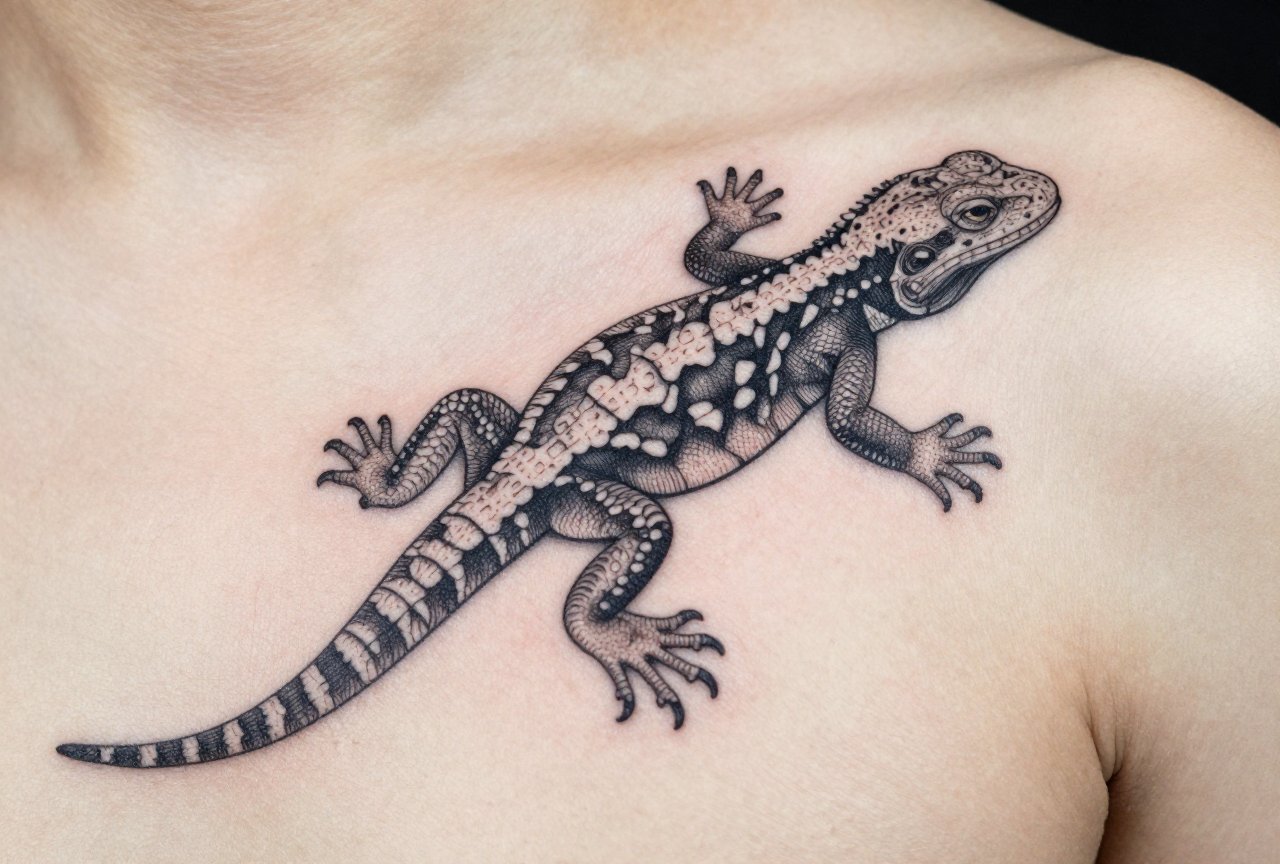
A lizard tattoo generally symbolizes regeneration, adaptability, and primal survival instinct. Across cultures, from Polynesian navigation to Native American dream symbolism, the lizard represents someone who can shed what’s dead and keep moving. In my chair, I’ve found people rarely pick this creature randomly, they’re usually drawn to its quiet resilience.
Symbolism & History
The lizard’s most powerful association is regeneration. Lose a tail, grow it back. That biological fact has made it a totem for people rebuilding after divorce, addiction, trauma, or plain bad luck. I’ve tattooed lizards on clients who needed a visual reminder that damage isn’t final.
Polynesian & Pacific Roots
In Polynesian tradition, geckos and lizards appear heavily in tribal work. They weren’t just decorative, these creatures were seen as messengers, sometimes ancestors watching over the living. The patterns you see in Samoan or Maori-influenced lizard tattoos carry specific genealogical meaning. Lines represent paths, the unfilled spaces are protection. I’ve had Hawaiian clients request these specifically for shoulder-to-chest placements where the curve of the muscle makes the lizard look alive.
Native American & Southwestern Ties
Desert cultures especially revered the lizard for its ability to survive harsh conditions. Pueblo and Navajo traditions associate lizards with dreams and protection. A horned lizard, the “horny toad”, shows up in Southwest tattooing as a regional pride piece. I’ve done these on Texans and New Mexicans who grew up catching them as kids. The spines translate beautifully to linework, but you need an artist who understands texture, not just outline.
- Regeneration: Tail loss and regrowth as metaphor for personal recovery
- Dreams & Visions: Southwest traditions link lizards to the dream world
- Survival: Thriving in extreme heat, minimal water, hostile terrain
- Stealth & Patience: The ambush predator’s stillness before striking
Common Variations & Styles
Not all lizard tattoos read the same. The species matters, the style matters more. A green tree skink rendered in full color realism carries completely different energy than a black tribal gecko.
Realistic & Species-Specific
Geckos with their toe pads and lidless eyes, chameleons mid-color-change, iguanas with their dewlap and crest, each has distinct visual challenges. Realistic lizard work demands attention to scale texture. I’ve seen beautiful pieces where the artist used white ink highlights to catch the gloss of wet-looking scales. These age better with slightly larger sizing; tiny realistic lizards blur into green blobs over five years. I tell clients: if you want realism, commit to at least palm-sized or bigger.
Tribal & Blackwork
The 90s and early 2000s saw every beach town pumping out tribal gecko flash. Some of it aged poorly, heavy black with no negative space turns to mush. But done well, with proper line weight variation and skin breaks, tribal lizards still work. The key is contrast. I prefer needle groupings that give thick bold outlines with finer interior patterning. These heal faster than shaded work too, which matters for clients who can’t take time off.
- Gecko: Most common, associated with good luck and protection
- Chameleon: Adaptability, blending in, strategic camouflage
- Komodo Dragon: Raw power, dominance, apex predator energy
- Horned Lizard: Regional identity, defensiveness, desert survival
- Salamander: Fire resistance in European alchemy, elemental connection
Best Placements
Lizards conform to body curves naturally. Their elongated bodies flow with limbs, torsos, even necks. I’ve placed them wrapping forearms, climbing ribcages, sprinting across shoulder blades. The direction matters, head up suggests aspiration, climbing; head down reads more grounded, watchful.
Forearm and calf are workhorses for this design. The cylindrical shape lets the lizard wrap slightly, giving dimension. Ribs work for larger pieces but hurt more; lizard claws digging into imagined skin at the rib edge is a classic motif. Hands and fingers? I’ve done small geckos there, but they fade fast. The constant washing, the thin skin, the movement, expect touch-ups every few years. I warn people: finger tattoos aren’t forever tattoos.
One placement I love: the side of the neck, lizard climbing toward the ear. Bold choice, but the anatomy lines up. The tail follows the sternocleidomastoid muscle, the head reaches the mastoid bone. Not for first-timers, and definitely job-limiting for some professions.
Who Chooses This Tattoo / Personal Meanings
After fifteen years, I see patterns. Lizard people aren’t usually the loud ones. They don’t walk in wanting the biggest piece in the shop. Often they’re quiet, deliberate, sometimes recovering from something they don’t volunteer until hour two of the session.
The Recovery Narrative
I’ve tattooed lizards on people post-chemo, post-incarceration, post-rehab. The shedding skin metaphor writes itself. One client, a wildland firefighter, got a horned lizard after a burnover that should have killed him. He didn’t say much, just: “This thing survives fire.” That was enough.
The Quiet Observers
Chameleon tattoos attract a different type, people who’ve learned to read rooms, adapt personas, survive corporate or social environments where authenticity gets punished. They don’t brag about the symbolism. They just know. I’ve had therapists, intelligence workers, and bartenders all choose chameleons. The unifying thread: watching before acting.
- People rebuilding identity after major life disruption
- Outdoor workers and wilderness enthusiasts with regional ties
- Survivors of medical trauma drawn to regeneration imagery
- Quiet strategists who value patience over confrontation
- Military and first responders who’ve operated in harsh environments
Similar Symbols
Clients often waver between lizards and related imagery. Snakes share the shedding symbolism but carry more danger, more biblical weight. Spiders share patience and survival but read more sinister to some. Frogs and toads touch transformation but lack the lizard’s dry, tough resilience.
Koi fish overlap with perseverance and rebirth, especially in Japanese tradition, but they’re wet, fluid, decorative. Lizards are dusty, sun-baked, stripped-down. The person who wants a koi and the person who wants a lizard usually aren’t the same person. I’ve had clients switch from phoenixes to lizards specifically because the phoenix felt too dramatic, too fiery. They wanted something that survives by stillness, not explosion.
Dragon tattoos share reptilian DNA but operate in fantasy register. Lizards stay grounded, observable, real. That matters to people who’ve learned that actual survival is mundane, daily, not heroic.
Final Thoughts
A lizard tattoo won’t impress strangers at a glance. It’s not a wolf, not a skull, not a rose. Its power is quieter, more patient, more specific to the wearer. I’ve watched clients stare at their fresh lizard work in the mirror and see something settle in their face, not excitement, but recognition.
If you’re considering this design, think about species, about placement, about whether you want the lizard still or in motion. Bring reference photos of actual lizards, not other tattoos. The best lizard work I’ve done started with a client showing me a photo from a hike, a moment of encounter. That specificity carries through the needle. And be honest with your artist about why you’re choosing this. The meaning doesn’t need to be shouted, but it should be understood. It shows in the work.
Frequently Asked Questions
Do lizard tattoos fade faster than other animal designs?
Not inherently, but small lizards with intricate scale detail can blur over time. I recommend going slightly larger than you might for a simpler design, and placing them away from high-friction areas like inner fingers or palms.
Is it disrespectful to get a tribal gecko if I’m not Polynesian?
It depends on execution. Straight copying sacred patterns without understanding is frowned upon, but many artists create Polynesian-inspired work with proper consultation. If you want that aesthetic, find an artist who specializes in Pacific styles and have an honest conversation about appropriation versus appreciation.
What’s the most painful placement for a lizard tattoo?
Ribs and sternum hurt most due to thin skin over bone, plus the vibration from the machine. The belly of the lizard stretching across the ribs is a classic placement, but budget for shorter sessions. Forearms and outer calves are much more manageable.
Can a lizard tattoo cover up an older piece?
Absolutely. The lizard’s body shape covers well, tail for narrow areas, torso for denser old ink. Darker species like Komodo dragons or black iguanas work best. I always do a test spot first when covering heavy blackwork to see how the old ink lifts.
Related Tattoo Meanings
- Polynesian Tattoo Meaning
- Quetzalcoatl Tattoo Meaning
- Love Yourz Tattoo Meaning: J. Cole s Message of Self-Acceptance
- Explore more