
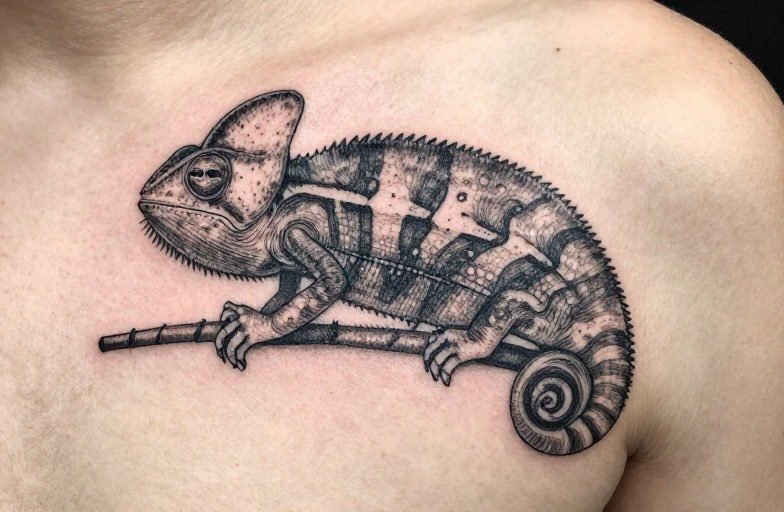
The chameleon tattoo most commonly represents adaptability, patience, and the power of strategic camouflage, knowing when to blend in and when to reveal your true colors. For many, it becomes a personal emblem of survival through change, of watching and waiting rather than forcing outcomes. The symbolism runs in two directions at once: the creature’s color-shifting skin speaks to transformation and reinvention, while its slow, deliberate movements suggest calm observation and measured response.
Symbolism & History
Chameleons carry layered meanings that have accumulated across cultures and centuries, though no single origin story dominates. The animal’s biological realities, actual color change for temperature and communication, not mere background matching, give the tattoo a foundation in observable nature rather than pure myth.
Core Symbolic Meanings
Adaptability sits at the center. Unlike the butterfly’s dramatic metamorphosis, the chameleon changes continuously, in real time, in response to its immediate environment. This makes it a symbol of living responsiveness rather than one-time transformation. The tattoo often appeals to people who’ve moved between cultures, careers, or social circles and learned to code-switch without losing core identity.
Patience and stillness matter too. Chameleons hunt by waiting, motionless for long stretches, then striking with explosive speed. The tattoo can mark someone who prefers calculated action over constant motion, who values the watchful phase that precedes decisive movement.
Camouflage carries its own complexity. It can signify protection and self-preservation, the wisdom of not revealing everything to everyone. For others, it touches on invisibility, the exhaustion of constantly adjusting to surroundings, or the desire to be seen for what they truly are beneath all adaptation.
Cultural and Historical Threads
Ancient Egyptian art sometimes linked the chameleon to solar symbolism and rebirth, though this connection is often linked to broader reptile veneration rather than specific chameleon cults. Some trace the animal’s symbolic use in African traditions to its perceived ability to bridge worlds, earth and tree, stillness and sudden action, visible and hidden. In Madagascar, where most chameleon species originate, the creature holds particular ecological and cultural significance, though specific tattoo traditions there are not well documented in available sources.
Common Variations & Styles
The chameleon lends itself to distinct visual approaches, each carrying slightly different emphases.
- Realistic/naturalistic: Heavy on texture, rough skin, curled tail, independently rotating eyes. Often rendered in full color to show the animal’s actual bold hues (greens, blues, oranges, yellows). This style emphasizes the creature as itself, a specimen of natural wonder.
- Geometric/dotwork: The chameleon’s angular body and zygodactyl feet (two toes forward, two back) translate well to geometric abstraction. Dotwork can suggest the granular texture of skin. This approach often highlights pattern and structure over organic flow.
- Neo-traditional/Americana: Bold outlines, limited but saturated color palette, simplified forms. The curled tail becomes a decorative spiral; the eye grows oversized and expressive. This style tends toward the symbolic and iconic.
- Black and grey: Without color, the focus shifts to form, shadow, and the creature’s almost alien anatomy. Works well for emphasizing the chameleon as something strange, ancient, or slightly unsettling.
- Color-changing as visual motif: Some designs incorporate rainbow gradients, split-color bodies, or sections dissolving into patterns (leaves, flames, water) to literalize the transformation theme.
Line weight matters significantly. Fine lines around the face and eyes capture the chameleon’s peculiar alertness; heavier lines on the body ground the design. The tail, capable of grasping branches, offers natural compositional flow, it can wrap around limbs, follow body curves, or frame other elements.
Best Placements
The chameleon’s body shape creates natural opportunities and constraints.
Areas That Work With the Form
The forearm and calf allow the tail to curl naturally along the limb’s length, the body perched at a joint. The shoulder blade provides a flat canvas for the chameleon in profile, crest raised, eye swiveled toward the viewer. Ribs and side torso suit the stretched, climbing posture, feet splayed, body elongated, following the body’s vertical axis.
Hands and feet are less ideal. The chameleon’s detailed anatomy requires space; cramming it into small areas loses the distinctive eye structure and foot configuration that make it recognizable. Finger tattoos of chameleon silhouettes exist but read as generic lizards to most viewers.
Practical Considerations
Color saturation affects longevity. The bright greens and blues that make chameleon tattoos visually striking are also the first to fade and shift toward grey or muddy tones. Yellows particularly struggle. Black linework holds; color will need refreshment. Areas with frequent sun exposure, forearms, calves in shorts season, accelerate this fading.
Skin movement matters too. The chameleon’s precise anatomy (those distinctive feet, the prehensile tail) distorts more noticeably than flowing designs when skin stretches or compresses. Placements near joints require careful planning to anticipate how the image settles at rest versus in motion.
Who Chooses This Tattoo / Personal Meanings
Certain life situations and identities recur among people drawn to this image.
- Immigrants and third-culture individuals: The experience of shifting behavior, language, presentation across contexts without losing an inner core maps cleanly onto chameleon symbolism.
- Neurodivergent people: Some describe lifelong masking, camouflaging natural responses to pass in neurotypical spaces, and find the chameleon resonates with this exhausting but sometimes necessary practice.
- Survivors of unstable environments: Childhood chaos, unpredictable family systems, or volatile relationships can develop hypervigilance and adaptive skills that the chameleon honors rather than pathologizes.
- People in strategic professions: Negotiators, therapists, performers, diplomats, roles requiring reading rooms and adjusting approach.
- Those reclaiming camouflage: For some, the tattoo marks a shift from involuntary hiding to chosen, empowered discretion, deciding when to blend and when to display.
The personal meaning often centers control: the chameleon chooses to change, responds rather than reacts, maintains agency within adaptation. This distinguishes it from passive victimhood or inauthenticity.
Similar Symbols
People considering chameleon tattoos often weigh related imagery. Understanding distinctions helps clarify choice.
- Octopus: Also masters camouflage, but emphasizes intelligence, escape, multiplicity (many arms, many approaches). More oceanic, more tentacular, less patient-watcher.
- Butterfly: Transformation as singular event, dramatic and complete. The chameleon transforms continuously, incrementally, in response to environment rather than internal development.
- Wolf in sheep’s clothing: Deception with predatory intent. The chameleon’s camouflage is defensive, survival-oriented, not inherently aggressive.
- Snake (shedding skin): Renewal through discarding the old. The chameleon keeps its skin, changes its appearance, integration rather than replacement.
- Chameleon vs. gecko: Geckos share some visual vocabulary but carry different associations: good luck (Polynesian, Japanese), vocalization (they call), wall-climbing persistence. The chameleon’s rotating eyes and projectile tongue are its own.
Some combine chameleon with other elements: a branch (grounding, growth), an eye (watching, being watched), or abstract color fields (the full spectrum of possible selves).
Final Thoughts
The chameleon tattoo works best when it acknowledges the full complexity of its subject, not just the flashy color change, but the stillness, the strange anatomy, the survival function of blending in. It’s a design that rewards technical precision in tattooing: those eyes, those feet, that skin texture separate a recognizable chameleon from a generic lizard. Choose an artist with experience in reptile or creature work, and expect to invest in color maintenance if you go bright. Most importantly, know if you’re drawn to the chameleon as celebration of adaptability or as commentary on its costs, both are valid, but they produce different designs and different placements on the body. The tattoo should feel as specific as the creature itself: odd, deliberate, watchful, and ultimately unmistakable.
Frequently Asked Questions
Does a chameleon tattoo have to be colorful to be recognizable?
No, black and grey chameleon tattoos work well, though they emphasize form and texture over the species’ signature color-shifting. The distinctive eye structure, curled tail, and zygodactyl feet do the identification work. That said, color is the most immediate visual association, so muted palettes shift the meaning toward shadow and concealment rather than bold transformation.
How well does chameleon tattoo color hold up over time?
Greens and blues fade fastest, shifting toward grey or muddy olive within five to ten years depending on sun exposure and skin type. Yellows are particularly vulnerable. Black linework provides lasting structure. Plan for touch-ups if you want saturated color long-term, or choose deeper, jewel-toned bases rather than bright neons.
What’s the difference between a chameleon and gecko tattoo in meaning?
Geckos carry luck and vocal persistence across Polynesian and Japanese traditions; they’re wall-climbers, survivors through tenacity. Chameleons emphasize environmental responsiveness, strategic visibility, and patient observation. The gecko pushes through; the chameleon adjusts to. Visually, chameleons have bulkier bodies, prehensile tails, and those independently rotating eyes.
Can a chameleon tattoo work as a cover-up?
The chameleon’s natural camouflage makes it conceptually fitting for cover-up work, but practically challenging. Its detailed anatomy, especially the eyes and feet, requires clean skin to read clearly. Large, dark-bodied chameleon designs with heavy black or deep green can cover smaller existing tattoos, but the form doesn’t lend itself to the heavy blasting often needed for substantial cover-ups. Consult specifically with artists experienced in both creature realism and cover-up techniques.
Related Tattoo Meanings
- Lizard Tattoo Meaning: Symbolism, Styles What Artists See
- Chevron Tattoo Meaning: Symbolism, Styles Placement Guide
- Chucky Tattoo Meaning: Horror, Rebellion Dark Playfulness
- Explore more









