
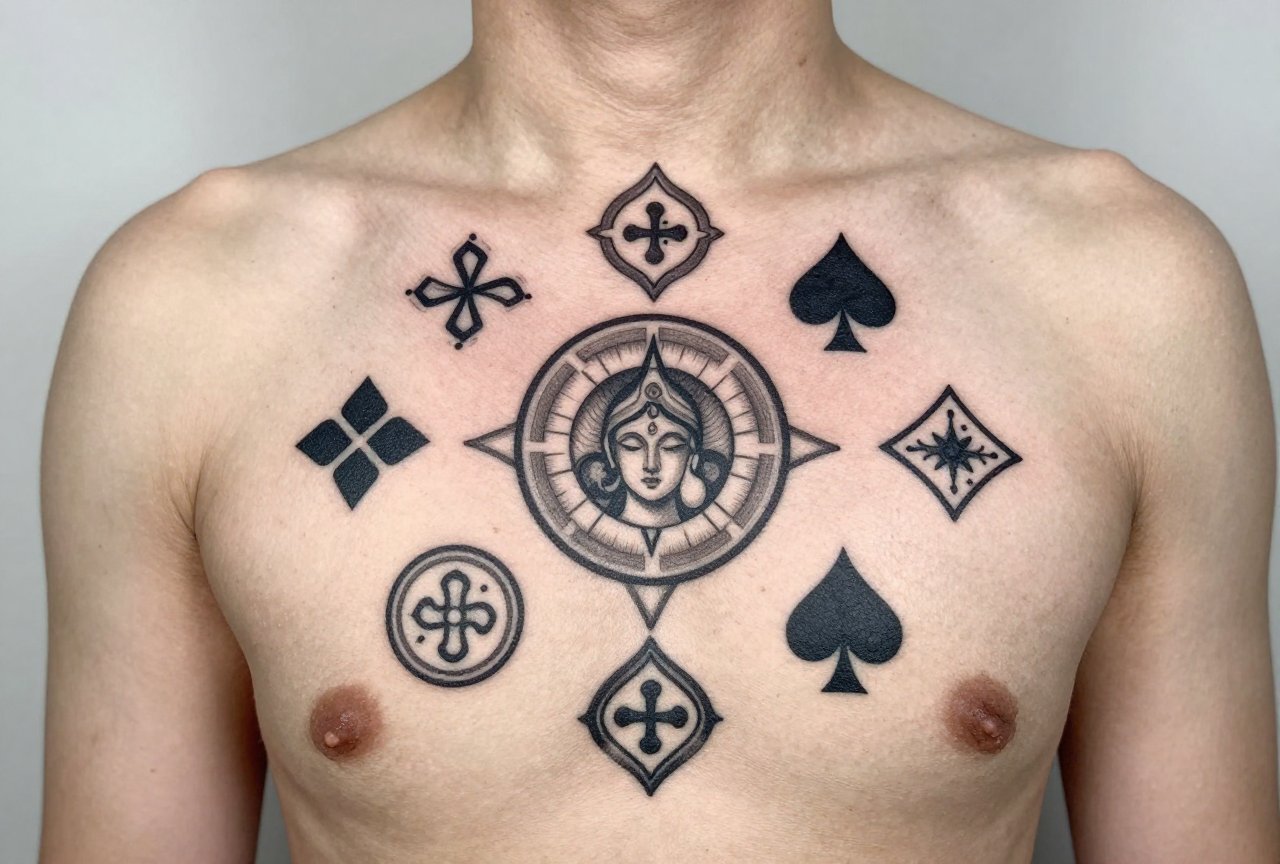
Spiritual symbol tattoos mark something internal that most people have a hard time putting directly into words. They carry the weight of traditions that developed over hundreds or thousands of years, and they work best when the person wearing them has done the work to understand what they are borrowing and why. This article covers the major symbols, where they come from, and what to think about before you sit in the chair.
Major Spiritual Symbols and Their Origins
Each of these has a specific history worth knowing, not to gatekeep who can wear them, but because the history is part of what gives them weight.
Om (Aum)
The Om symbol comes from Hindu and later Buddhist traditions and represents the primordial sound from which creation emerged. It appears at the beginning of mantras and prayers as an opening vibration. The written symbol in Devanagari script encodes the three states of consciousness: waking, dreaming, and deep sleep. It is probably the most widely tattooed spiritual symbol in Western countries among people who practice yoga, which has created ongoing discussion about casual versus respectful use among practitioners.
Hamsa hand
The hamsa appears across Middle Eastern, North African, and Mediterranean cultures as protective imagery, specifically against the evil eye. The hand with an eye at the center is found in Jewish, Islamic, and some Christian traditions. The name comes from the Arabic word for five. Different cultural contexts emphasize different aspects: protection, blessing, and power are the main threads.
Mandala
Mandala means circle in Sanskrit. In Hindu and Buddhist ritual contexts, mandalas are used as meditative tools to represent the cosmos and aid in concentration during practice. They appear as sand paintings, architectural plans, and paintings meant to be destroyed after completion. In tattoo form they are usually permanent, which sits in tension with the original impermanence emphasis. That tension is worth sitting with if you practice in these traditions.
Tree of Life
The Tree of Life appears independently across Norse, Celtic, Kabbalistic, and various indigenous traditions. In Norse mythology it is the Yggdrasil. In Kabbalah it is a diagram of divine attributes. In Celtic traditions it represents the connection between the underworld, the living world, and the upper world. The general concept, a tree whose roots and branches connect different planes of existence, appears in too many cultures to be attributed to any single origin.
Sacred geometry
The Flower of Life, Metatron’s Cube, the Vesica Piscis. These patterns appear in ancient architecture and spiritual texts across multiple traditions under the belief that certain mathematical ratios are embedded in creation itself. Whether you hold that belief or not, the geometric precision of these designs produces work that ages well if the lines are executed cleanly.
Unalome
A spiraling line that leads to a straight path and a dot. The symbol represents the Buddhist path from confusion toward enlightenment, the spiral indicating the wandering before the path clarifies. It has moved significantly into mainstream Western tattoo culture over the last decade. Buddhist practitioners I have spoken with have mixed feelings about this, ranging from genuine openness to concern about context-stripped use.
Artistic Styles
The style you choose shapes how the symbol reads on your skin and how it ages.
- Minimalist linework: Fine single-needle renditions of Om, unalome, or lotus outlines. Clean, subtle, works at small scales. The lines soften over time on high-movement areas like wrists.
- Dotwork and stippling: Mandalas and geometric patterns built from stippled texture. Meditative to look at, takes time to execute well. The dense dot clusters in the center can fill in as the tattoo ages if the artist did not leave enough breathing room.
- Blackwork: Bold, heavy designs with strong contrast. Ages better than most styles. Suits larger compositions where the symbol needs to hold attention from a distance.
- Fusion pieces: A lotus emerging from an Om symbol. A Tree of Life built from sacred geometry. These combine symbols from sometimes different traditions, which can work aesthetically while muddying the individual meanings.
Placement
Some practitioners choose placements that align with chakra locations along the spine. Others select spots based on personal significance or practical visibility. The most common reasoning I hear in consultations:
- Inner wrist or forearm: You see it throughout the day. Useful if the symbol is meant as a meditation reminder or a grounding anchor during stressful moments.
- Behind the ear or nape: Subtle. Visible when you choose to show it. Works well for something private.
- Upper back, between shoulder blades: Larger canvases here for mandalas or Tree of Life designs. Some people prefer the symbol to sit on the body’s central axis, echoing the way these designs function in certain traditions.
- Chest over heart: Deep personal symbols, protective intentions, devotional pieces.
Who Chooses These Tattoos
The most common situations I see in shops:
People who have been practicing yoga, meditation, or a spiritual tradition for several years and want a marker of that practice. These clients usually know exactly what they want and why.
People coming out of a hard period who want to mark the turn. The symbol is chosen for what it represents about the direction they are moving rather than a doctrine they have committed to. The lotus works well here because the image of emergence from difficult conditions does not require religious subscription.
People reconnecting with a cultural or religious heritage. A second-generation Indian-American getting an Om symbol, or a person reconnecting with Scandinavian roots getting a Yggdrasil. These carry a different weight than aesthetic adoption.
The meaning evolves over time for most people. Someone who chooses a lotus for its visual appeal often develops a deeper relationship to the symbol’s meaning over the years. That is fine. The permanence of the tattoo and the living nature of meaning are not in conflict.
Related Symbols
- Lotus flower: Purity and emergence from difficult conditions, closely linked to Buddhist and Hindu iconography
- Dharma wheel: Buddhist path teachings and the concept of cyclical existence
- Yin-yang: Taoist balance of complementary forces, the dark within the light and the light within the dark
- Eye of Horus: Ancient Egyptian protection and royal power
- Enso circle: Zen expression of enlightenment, imperfection, and the moment of creation, usually painted in a single brushstroke
Final Thoughts
The symbols with the most staying power in spiritual tattoos are the ones where the wearer has done some work. Not necessarily formal study, but actual engagement: reading about the tradition, talking to practitioners, sitting with the question of what they are borrowing and from whom.
That does not mean every spiritual tattoo needs a thesis attached to it. It means the consultation with your artist should involve a real conversation about what the symbol means to you, not just a reference image. The best work I have seen in this category comes from that kind of exchange.
Frequently Asked Questions
Is it disrespectful to get a spiritual symbol tattoo if you do not practice that tradition?
It depends on the symbol and the tradition. Some symbols are considered open cultural heritage by practitioners within those traditions. Others are considered sacred and require community membership or explicit permission. Research the specific symbol and talk to practitioners if you are uncertain. There is no universal answer that covers all spiritual symbols equally.
What is the difference between a mandala tattoo and a geometric tattoo?
A mandala has specific origins in Hindu and Buddhist ritual practice and carries spiritual meaning in that context. A geometric tattoo uses similar visual elements, radial symmetry, precise patterns, without necessarily referencing those traditions. Both can look similar; the distinction is in intention and reference.
How do I find an artist who understands spiritual tattoos?
Look for artists who have done the specific symbol you want and who can talk about what different versions of it mean. An artist who has tattooed mandalas for ten years has had conversations that shaped their understanding of how clients relate to the symbol. That knowledge shows in the consultation and the work.
Do spiritual tattoos need to be large to have impact?
No. A small, precise Om symbol or unalome can carry as much weight as a full-back mandala. Scale affects how the piece reads from a distance, but meaning is not a function of size. Many of the most personal spiritual tattoos I have done were small enough to cover with a thumb.









