
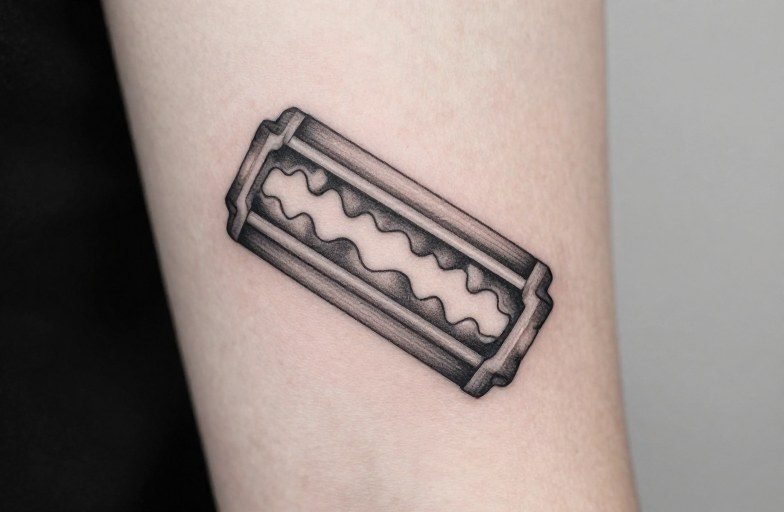
A razor blade tattoo typically signals something sharp-edged in the wearer’s life: danger survived, self-destruction resisted, a cutting sense of humor, or a willingness to fight when cornered. The meaning depends heavily on context, style, and what accompanies the blade in the design.
Symbolism & History
The razor blade entered tattoo culture through multiple doors. In traditional American and European tattooing, it often appeared alongside gambling motifs, prison iconography, and street imagery as a symbol of someone who lived dangerously or made their own rules. The straight razor and safety blade both carried connotations of violence, but also of self-reliance and the tools of a trade.
Associations with Self-Harm and Recovery
For many, the razor blade tattoo marks a specific, painful chapter. Some who have struggled with self-harm choose the image as a permanent acknowledgment of what they’ve survived, not glorification, but a refusal to hide the history. The tattoo can function as a reminder of the choice to stop, or of the scars that remain. Others find the imagery too triggering and deliberately avoid it. There’s no universal stance here; the meaning is genuinely personal and sometimes deliberately private.
Dark Humor and Subcultural Edge
Blades also appear in punk, horror, and gothic tattoo traditions where the aesthetic leans toward the macabre. A razor blade with a smile, a heart, or absurdly cheerful coloring can signal dark humor, an embrace of life’s rougher edges, or membership in subcultures that reject polished mainstream presentation. The juxtaposition of something dangerous with something cute or mundane is a deliberate stylistic choice that softens the threat without erasing it.
Common Variations & Styles
The specific style of a razor blade tattoo changes its tone significantly. A photorealistic straight razor with wood grain handle and worn metal reads as vintage, masculine, and often connected to barbering or old-school toughness. A simplified safety razor blade, by contrast, feels more modern, more industrial, and more closely tied to punk or street associations.
- Single blade, plain: Minimalist, stark, often personal or memorial in intent. Reads as serious.
- Blade with banner or scroll: Traditional American style, often carrying a name, date, or short phrase. Softens the aggression with sentiment.
- Blade cutting through skin, rope, or another object: Active imagery suggesting severance, liberation, or conflict.
- Blade with dripping blood or wound: Horror-influenced, deliberately unsettling, sometimes referencing specific films or music.
- Blade paired with roses, hearts, or feminine imagery: Contrast and balance, danger alongside vulnerability or love.
Line weight matters here. Heavy black outlines hold up better over time and suit the bold, graphic nature of blade imagery. Fine-line single-needle work can look delicate and precise when fresh, but the thin edges of a blade design are particularly vulnerable to blowout and fading as the ink spreads slightly under the skin. A blade that looks crisp at six months may look fuzzy at five years if the lines were too thin or the artist worked too shallow.
Best Placements
Razor blade tattoos work best where their linear shape makes sense. The natural length of a blade suits forearms, ribs, the side of the neck, and the outer thigh. These are also placements where the tattoo can be shown or covered with reasonable ease, which matters for an image that carries charged associations.
Visibility Considerations
A blade on the hand, neck, or face reads as more aggressive and more publicly confrontational than the same design on a rib or upper arm. Some employers and social situations still react negatively to visible blade imagery regardless of personal meaning. The wrist placement carries particular weight given its proximity to actual self-harm locations; some choose it deliberately for that resonance, others specifically avoid it.
How Ink Ages on Blade Designs
Blade tattoos rely on contrast between metal shine and shadow. Gray wash and white ink highlights create the illusion of reflective steel, but white ink fades fastest and may yellow or disappear entirely within a few years. Solid black with minimal gray can age more gracefully, though it sacrifices some dimension. The etched or engraved look, fine lines suggesting manufacturer marks or decorative patterning, often blurs over time and may need touchup to remain legible.
Who Chooses This Tattoo / Personal Meanings
There’s no single demographic. The blade appeals to people who have survived something, who identify with sharpness as a necessary trait, who work in professions where precision cutting matters, or who simply respond to the visual starkness. Some barbers and stylists choose straight razors as professional markers. Others with no personal crisis behind the choice simply like the clean geometry and the cultural weight the image carries.
What distinguishes a meaningful blade tattoo from a generic one is usually the surrounding context. Dates, names, or paired symbols transform a stock image into something specific. A blade with a broken chain suggests liberation. A blade with a clock suggests time running out or time cut short. A blade with a bird in flight suggests escape. The blade itself is a versatile anchor; what you attach to it determines the direction.
Similar Symbols
People considering razor blade tattoos often also look at related imagery. Each carries slightly different baggage:
- Knives and daggers: More overtly aggressive, more common in military or combat-associated tattooing, less industrial than the razor.
- Scissors: Professional tool for stylists and tailors, less violent connotation, more creative association.
- Broken glass or shattered mirror: Similar fragility and danger, but less control; the blade implies deliberate action.
- Barbed wire: Confinement, restriction, often prison-associated in popular culture, less precise than blade imagery.
- Swords: Heroic or historical framing, more mythic, less personal and immediate than the everyday razor.
The razor blade occupies a middle space: too mundane to be mythic, too dangerous to be neutral. That ambiguity is part of its power as tattoo imagery.
Final Thoughts
A razor blade tattoo carries enough cultural weight that you should know why you’re getting it and be prepared to own that meaning, even if you don’t explain it to strangers. The image provokes reaction. Choose your artist carefully for this one, straight lines and consistent gray wash separate a convincing blade from a blob that reads as abstract metal. Consider how the placement affects interpretation, how the style will age, and whether you want the option of privacy. The best blade tattoos look like they mean something specific, because they do.
Frequently Asked Questions
Does a razor blade tattoo always mean someone used to self-harm?
No. While some people do choose this imagery for recovery-related reasons, others connect it to barbering, dark humor, punk aesthetics, or surviving difficult circumstances. The meaning isn’t automatic, context and accompanying imagery matter more than the blade alone.
Is a straight razor different symbolically from a safety razor blade?
Yes. The straight razor leans more vintage, masculine, and professional, often barber-related or old-school tough. The safety razor blade reads more industrial, modern, and is more commonly linked to punk, street, or self-harm associations.
How well do detailed blade tattoos hold up over time?
Fine etched details and white highlights tend to fade or blur within a few years. Bold black outlines with selective gray wash age more reliably. If you want the engraved manufacturer-mark look, plan for touchups down the line.
Are there workplaces where this tattoo could cause problems?
Yes. Visible blade imagery, especially on hands, neck, or face, can read as threatening in customer-facing jobs, healthcare, education, and corporate settings. Consider placement carefully if you need flexibility in professional environments.
Related Tattoo Meanings
- Flame Tattoo Meaning: Symbolism, Styles What Fire Represents
- Heartagram Tattoo Meaning: Love, Life Rock Roots
- Meaningful Moon Stars Tattoo Meaning: Symbolism What It Means
- Explore more









