
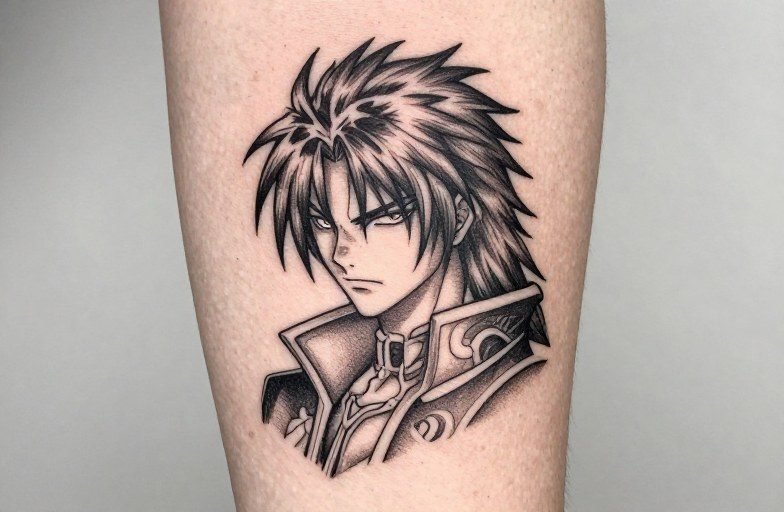
A Meliodas tattoo typically channels imagery from The Seven Deadly Sins manga and anime, centering on the Dragon’s Sin of Wrath himself. Most designs revolve around his demon mark, a black spade-like symbol, or the broken sword hilt, paired with themes of loyalty, redemption, and suppressed power. The meaning shifts depending on which visual element you choose and what resonated with you in the story.
Symbolism & Source Material
The Demon Mark
Meliodas’s most recognizable tattoo element is the black mark that spreads across his forehead when he unleashes his demonic power. In the series, this signifies his true nature as the Demon King’s son and his struggle against that lineage. As body art, it functions as a compact, instantly readable symbol. The mark works as a small standalone piece, behind the ear, on the wrist, or at the nape of the neck, where a simple black shape carries the full weight of the reference. Some people extend this into a larger composition showing the mark cracking or bleeding, visualizing the tension between control and release.
The Dragon Symbol & Broken Sword
The Dragon’s Sin emblem and Meliodas’s shattered blade, Liz’s Sword, represent duty and loss. The broken sword especially carries emotional weight in the narrative, tied to his failure to protect someone he loved. Tattoo renditions range from a clean geometric hilt to weathered, rusted interpretations with wrapped cloth or blood details. This imagery suits people drawn to the character’s burden of outliving those he cares about, immortality as curse rather than gift.
Assault Mode & Darker Imagery
Full demon-form depictions show Meliodas with sclera-black eyes, the complete facial mark, and often wings or clawed hands. These designs lean into shadow work, guilt, and the idea of dangerous potential kept in check. The visual contrast between his cheerful tavern-owner facade and this form gives the tattoo dynamic range, you can play with duality, splitting the design across both arms or using negative space to hide the darker elements within a lighter composition.
Common Variations & Styles
How you render a Meliodas tattoo changes its impact significantly. The same symbol in different hands reads entirely differently.
- Blackwork / bold line: The demon mark translates naturally to thick, saturated black. This ages cleanly, holds contrast on all skin tones, and stays readable at small sizes. A skilled blackwork artist can vary line weight to give the simple shape dimension without adding graywash.
- Anime / neotraditional hybrid: Full-character pieces borrow the cel-shaded color palette of the source, pale skin, blond hair, emerald eyes, then ground it with neotraditional linework and background elements. This prevents the “sticker” look that pure anime tattoos sometimes suffer from.
- Trash polka / abstract: The broken sword and blood splatter motifs fit surprisingly well into trash polka’s red-and-black chaos. Smudged demon marks, partial quotes in German or English, and geometric fragments create a grittier take that distances the piece from pure fandom into something more atmospheric.
- Fine line / minimalist: A single unshaded demon mark, roughly the size of a quarter, placed with precision. This demands an artist with steady hands and proper needle grouping, wobbly fine line on a symbol this geometric looks unintentional, not restrained.
Color choices matter beyond style. Meliodas’s green eyes are iconic; including them requires either saturated teal pigment (which can fade blue-green over time) or strategic use of white highlights that may yellow slightly as they settle. The black of the demon mark itself should be dense enough that it doesn’t gray out as the tattoo ages, this means proper saturation passes, not a single light pass that looks crisp day-one but patchy by year three.
Best Placements
The demon mark’s canonical placement on the forehead makes forehead tattoos tempting, but the reality of that placement deserves honest consideration. Forehead skin moves constantly with expression, sees heavy sun exposure, and carries significant social visibility. A skilled artist can place a small mark at the hairline or temple where it echoes the reference without committing to full facial visibility. More commonly, people adapt the placement: inner forearm (visible to the wearer, mirroring how Meliodas sees his own reflection), over the heart, or at the center of the upper back.
Full-character or scene pieces need real estate. The outer thigh, calf, or side of the torso provide flat planes for the composition. The upper arm can work but limits horizontal spread, Meliodas’s dynamic poses often read better vertically. For the broken sword specifically, the forearm’s natural line invites a vertical hilt-to-tip (or hilt-to-break) arrangement that follows the bone structure.
Scale affects longevity. Tiny demon marks blur over time as ink spreads slightly in the dermis. A mark under an inch wide may need touch-ups within five years. At two to three inches with consistent line weight, the same design stays sharp for a decade or more with proper aftercare and sun protection.
Who Chooses This Tattoo & Personal Meanings
The people drawn to Meliodas imagery typically connect with specific aspects of his character arc rather than generic “strength” or “power.” Common threads include:
- Redemption narratives: Meliodas’s history of violence and his choice to resist his nature resonates with people in recovery, those who’ve harmed others and committed to change, or anyone who feels defined by past mistakes they’re actively working against.
- Loyalty to chosen family: His dedication to the Sins, particularly his centuries-long patience and willingness to endure repeated loss, speaks to people who value steadfastness in relationships over biological ties.
- Hidden capability: The cheerful surface concealing serious capacity, this attracts people in competitive fields, military or emergency services backgrounds, or anyone who prefers understatement until action becomes necessary.
- Processing grief: The Liz’s Sword element specifically, and the broader theme of outliving loved ones, draws people who’ve experienced significant loss and found the character’s endless mourning strangely validating.
There’s no requirement to have watched or read the entire series. Some people encounter the imagery through AMVs, fan art, or a single resonant scene. What matters is whether the specific visual element carries personal weight, not encyclopedic knowledge of the source.
Similar Symbols & Related Designs
If the Meliodas imagery appeals but you’re weighing alternatives, several adjacent symbols share thematic territory:
- Other Sins marks: Ban’s fox, King’s bear, or Diane’s serpent offer different animal associations within the same visual system. The consistency of mark-style across characters makes matching or complementary pieces viable for people who connected to the group dynamic.
- Oni masks / Japanese demon imagery: Traditional Japanese tattooing has long explored the demon-human tension. An oni mask with cracked or restrained elements shares DNA with Meliodas’s demon mark but carries cultural weight independent of anime reference.
- Broken blades generally: The snapped sword as symbol of failed protection appears across cultures, from Excalibur variants to kintsugi-adjacent repair imagery. This broadens the reference while keeping the core meaning.
- Mark of Cain variations: The biblical parallel of a marked outcast who retains divine protection offers similar thematic territory for those who want the narrative without the anime source.
Some people combine approaches: a demon mark rendered in traditional Japanese tebori technique, or a broken sword with Celtic knotwork wrapping the hilt. These fusions work when the visual languages genuinely complement rather than collide.
Final Thoughts
A Meliodas tattoo succeeds when the specific element chosen, mark, sword, full character, abstracted form, connects to something lived rather than something admired from distance. The best pieces I’ve seen carry wear in the linework, intentional aging built into the design, or placement that means the wearer confronts the image daily. The worst read as temporary enthusiasm frozen in skin. Take time with reference gathering. Study how the demon mark’s geometry actually works, not how you remember it. Consider how black ink behaves on your specific skin tone over decades, not how it photographs fresh. The source material gives you vocabulary; what you say with it is yours.
Frequently Asked Questions
Does the demon mark tattoo have to go on the forehead like in the anime?
No. While the forehead is canonically accurate, most people choose more practical placements like the inner forearm, upper back, or behind the ear. These locations honor the reference without the social and practical complications of a facial tattoo.
How well does a small demon mark tattoo age over time?
Small black symbols generally age well if properly saturated, but anything under one inch risks blurring as ink naturally spreads slightly in the skin. Aim for at least two inches with consistent line weight, and protect it from sun exposure to maintain crisp edges.
Can I combine Meliodas imagery with other anime characters in one tattoo?
You can, but it requires careful composition to avoid a cluttered collage. Better approaches include thematic pairing, similar visual languages, shared color palettes, or complementary placement on different body parts rather than cramming multiple references into one dense design.
Is a Meliodas tattoo considered cultural appropriation?
The specific imagery from The Seven Deadly Sins is original manga/anime creation, not traditional cultural symbolism. However, if you incorporate actual Japanese religious or cultural elements (oni masks, Buddhist imagery) alongside it, research and respect those traditions separately rather than treating them as interchangeable anime aesthetics.
Related Tattoo Meanings
- Mike Tyson Face Tattoo Meaning: Tribal Mark, Modern Icon
- Mjolnir Tattoo Meaning: Thor s Hammer Symbolism Style Guide
- Mob Tattoo Meaning: Symbolism, History What It Actually Represents
- Explore more









