
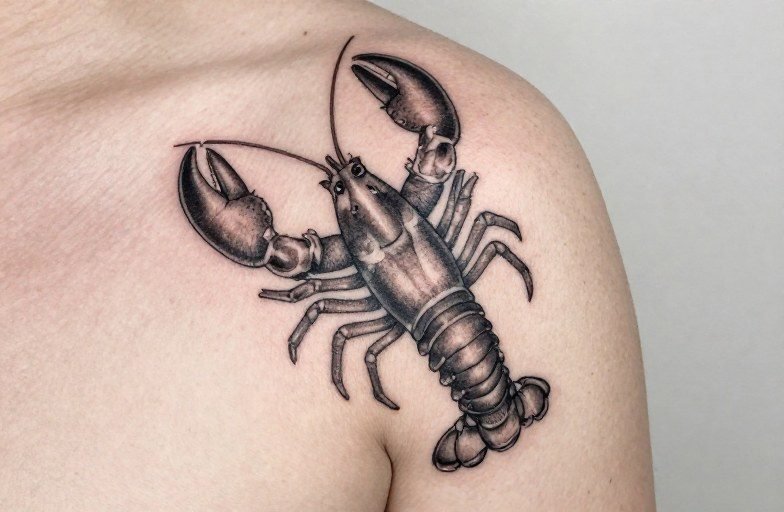
A lobster tattoo most commonly signals resilience, transformation, and a deep connection to coastal life or working-class roots. The creature’s ability to regenerate claws, survive extreme pressure, and thrive in harsh ocean environments makes it a natural emblem of endurance. For many, it also carries personal weight tied to specific places, Maine, the Maritimes, Nova Scotia, or family histories in fishing and maritime trade.
Symbolism & History
Lobsters occupy a strange space in cultural memory: once considered peasant food, now luxury cuisine, once abundant enough to feed prisoners, now a marker of special occasions. That reversal mirrors how the symbol gets used in tattooing, often representing someone who started at the bottom and clawed upward, or who values the grind over the glamour.
Regeneration & Tenacity
Unlike most animals, lobsters can regenerate lost claws and legs. This biological fact makes them a straightforward symbol for recovery, whether from injury, addiction, divorce, or financial collapse. The imagery works without needing explanation: a clawed creature that grows back what it loses. Some designs emphasize this by depicting a lobster with one oversized regenerating claw, or showing the molting process where the old shell splits away.
Class & Coastal Identity
The lobster’s shift from “poor man’s protein” to high-end menu item tracks with how working-class coastal communities view themselves. A lobster tattoo can assert pride in a place and livelihood that outsiders romanticize or misunderstand. It’s not uncommon to see the design paired with specific geographic coordinates, boat names, or family fishing license numbers. The symbol says: this is where I’m from, not where I vacation.
Common Variations & Styles
The lobster translates surprisingly well across tattoo traditions, though some approaches handle its anatomy better than others.
- Traditional American: Bold outlines, limited color palette (red, blue-black, yellow), simplified claws. Holds up well over time because the heavy line weight prevents the spindly legs from blurring into mush.
- Black and grey realism: Requires a skilled hand. The segmented shell, antennae, and leg joints demand precise shading or they age into indistinct grey blobs. Best at larger sizes (4+ inches).
- Neo-traditional: Allows for decorative elements, frames, banners, ornamental shells, while keeping the readable silhouette. Popular for adding personal symbolism (roses, anchors, dates) without cluttering the core image.
- Minimalist/line work: Single-needle or fine-line approaches work only if the design stays large enough and simple enough. A tiny lobster behind the ear will likely become a red smear within five years.
- Stylized or cartoon: Think Rock Lobster energy, or the famous Friends reference. These read as playful, sometimes ironic, and tend to appeal to people who want the symbol without the maritime gravitas.
Color vs. Black and Grey
Red lobsters are cooked lobsters. Live lobsters are blue-green, brown, or orange depending on species and location. This distinction matters. A bright red lobster tattoo reads as cooked/dead to anyone who knows the animal, which may or may not be the intended symbolism. Blue or natural-toned lobsters carry more “alive” energy. Black and grey sidesteps the issue entirely and ages more gracefully on most skin tones.
Best Placements
The lobster’s elongated body and multiple appendages create specific placement challenges and opportunities.
- Forearm: The natural length of the lobster follows the bone structure well. Claws can wrap slightly toward the inner or outer arm. Visibility is high, which suits designs with personal significance you want to display.
- Thigh or calf: Offers enough flat real estate for detailed shell texture and full leg spread. The calf’s curve can distort the body if the design isn’t adapted to the muscle shape.
- Back or ribs: Accommodates larger compositions, sometimes paired with ocean floor scenery, traps, or nautical charts. The ribs hurt more and the skin moves more, which can affect fine detail over time.
- Hand or foot: Generally inadvisable for complex lobster designs. The small bones and thin skin cause faster ink spread, and the numerous thin legs blur quickly. Simplified claws or single-claw designs work better here.
- Chest: A central lobster with claws spread can fill the pectoral space symmetrically. Popular among those who want the creature to read as protective or guarding.
One practical consideration: lobster antennae and walking legs are thin and numerous. On any placement, these details will soften first. A good artist builds in enough line weight or negative space so the design still reads as “lobster” even when the finest elements fade.
Who Chooses This Tattoo / Personal Meanings
There’s no single demographic. The design attracts commercial fishermen and their descendants, obviously, but also people with no maritime connection who respond to the animal’s physical characteristics.
Recovery and Resilience Narratives
The regeneration symbolism draws people who’ve rebuilt themselves after trauma. Cancer survivors, veterans, people who’ve left abusive relationships or survived overdoses, the lobster’s literal ability to grow back what it loses provides concrete imagery for abstract recovery. These designs often incorporate dates, coordinates of hospitals or treatment centers, or other personal markers.
Regional and Family Pride
In Maine, Massachusetts, and the Canadian Maritimes, the lobster functions almost like a state symbol. Tattoos here often reference specific harbors, family boats, or generations in the trade. The design becomes a permanent answer to “where are you from?”
Counter-Cultural or Ironic Use
Some wearers deliberately lean into the lobster’s absurdity, its alien appearance, its cultural status as overpriced dinner, its brief internet meme life. These tattoos tend toward bright colors, unexpected pairings (lobster with top hat, lobster in space), or deliberately amateurish execution as aesthetic choice.
Similar Symbols
People considering lobster tattoos often also look at related imagery. Understanding the distinctions helps clarify what you actually want.
- Crab: More defensive, more lunar/astrological (Cancer), more associated with sideways movement or indirect approaches. The crab carries more astrological baggage; the lobster reads more working-class and direct.
- Scorpion: Aggression, danger, betrayal. The lobster shares the clawed/arachnid form but without the venomous threat. Choose scorpion for danger; lobster for endurance.
- Anchor: Stability, rootedness, naval service. More passive than the lobster, which suggests active struggle and survival. Often paired with lobster in larger nautical compositions.
- Koi or other fish: Perseverance through adversity (koi upstream), transformation (dragon gate legend). The lobster offers a less culturally borrowed alternative for similar themes, especially for those with actual coastal ties.
- Octopus: Intelligence, adaptability, mystery. The octopus is cerebral; the lobster is physical, almost stubborn in its persistence.
Final Thoughts
The lobster tattoo works because it’s specific. It carries enough cultural weight to communicate something, but not so much that it becomes generic. The animal’s actual biology, regeneration, pressure survival, the dramatic molt, gives the symbol substance that holds up to scrutiny. If you’re drawn to coastal heritage, personal recovery, or the sheer visual strangeness of the creature, the design rewards thoughtful placement and honest execution. Choose an artist who understands how thin lines age, decide whether you want your lobster alive or cooked, and let the claws do their work.
Frequently Asked Questions
Do lobster tattoos have to be red?
No, and there’s a good argument against it. Live lobsters are naturally blue-green or brown; red indicates a cooked, dead animal. Many people prefer natural tones or black and grey for this reason, though red remains popular for visibility and cultural recognition.
How well do detailed lobster tattoos age over time?
The numerous thin legs and antennae are vulnerable to blurring. Designs that rely on heavy outline work and solid color fields age better than fine-line realism. Expect detail softening within 5-10 years regardless of technique.
What’s the difference between a lobster and crawfish tattoo symbolically?
Geography and scale mostly. Crawfish dominate Gulf Coast and Louisiana identity, with stronger party/festival associations. Lobsters signal Northeast and Maritime regions, with more emphasis on cold-water resilience and commercial fishing heritage. The biological similarity means regeneration symbolism applies to both.
Can a lobster tattoo work as a couples or matching design?
Yes, though it requires creativity. Some pairs get matching claws (one left, one right) that align when placed together. Others use the lobster’s natural pairing behavior, lobsters don’t mate for life, despite myths, so be careful with that symbolism. Coordinate-based designs referencing shared locations work better than forced romantic metaphors.
Related Tattoo Meanings
- Crab Tattoo Meaning: Symbolism, Styles What It Says About You
- Longhorn Tattoo Meaning: Symbolism, Styles Placement
- Make Tokyo Great Again Tattoo Meaning: Symbolism Style
- Explore more









