
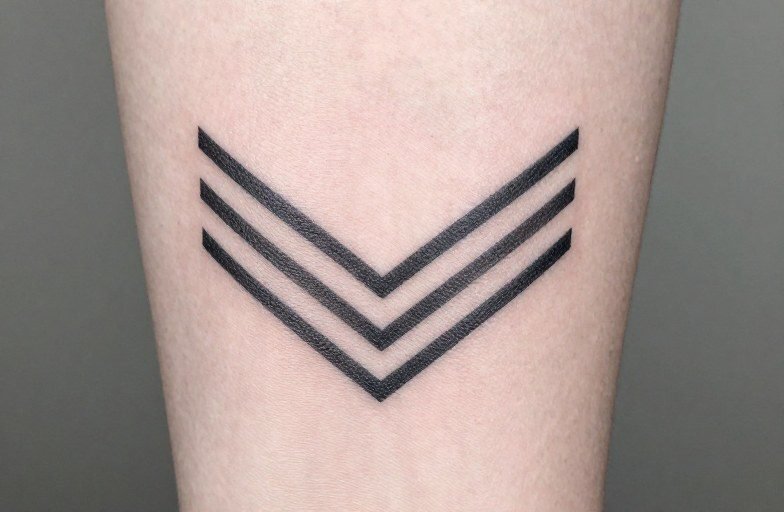
The chevron tattoo draws from a simple V-shaped or inverted V symbol that carries surprisingly layered meaning. Most commonly, it represents forward movement, rank or achievement, and protection, though the specific meaning depends heavily on context, placement, and how many chevrons appear in the design. What starts as a clean geometric mark often accumulates personal significance through the wearer’s own history.
Symbolism & History
Military and Rank Associations
Chevrons have served as insignia across armed forces for centuries, marking enlisted rank on sleeves and shoulders. A single chevron might indicate a private or lance corporal; multiple stacked chevrons climb through sergeant and beyond. This association makes the tattoo a natural choice for veterans, active service members, and family honoring someone’s service. The symbol here isn’t abstract, it’s a direct translation of lived hierarchy and earned progression.
Beyond rank, the shape itself suggests upward momentum. Pointing skyward, stacked chevrons create a ladder-like visual that reads as advancement, overcoming, or climbing out of difficulty. Some wearers choose this specifically to mark a period of personal elevation, sobriety milestones, career changes, surviving hardship, without needing to explain the backstory to anyone who sees it.
Protection and Heraldic Roots
The chevron shape appears in European heraldry, often linked to builders, roofers, or those who provided protection to a household. In this context, the inverted V resembles a roof structure, shelter, stability, guardianship. Some trace it to Norman French origins where the pattern appeared on shields of families with architectural or defensive roles. This lineage gives the tattoo a quieter, less militaristic reading: home, safekeeping, the person who holds things together for others.
Common Variations & Styles
How the chevron is rendered dramatically changes its impact and longevity. The most durable versions lean into bold simplicity rather than delicate detail.
- Single bold outline: A thick black or dark grey V, either pointing up or down. Clean, readable at small sizes, ages well because the negative space does the visual work. Works in American traditional, neo-traditional, or pure blackwork.
- Stacked multiples: Three to five chevrons layered, often decreasing in width toward the top. Creates a stronger sense of ascent or accumulation. Risk here is muddying if lines are too close together, spacing matters more than intricacy.
- Broken or dotted lines: The chevron rendered as negative space within a solid band, or as a dashed/stippled line. More contemporary, but stippling can soften and blur over years depending on placement and sun exposure.
- Integrated with other elements: Arrows, compass roses, geometric mandalas. The chevron becomes directional within a larger composition. Requires a skilled hand to maintain the symbol’s clarity when embedded in complexity.
- Color fills: Solid color blocks (red for military accuracy, black for stark contrast, earth tones for organic feel). Color holds reasonably well on chevrons because of the straight lines and limited gradient, but will need refreshment eventually.
Line weight deserves specific attention. Chevrons with lines thinner than 2mm risk blowout and blurring within five to ten years, especially on high-movement areas. A bold 3-5mm line with consistent machine saturation gives the cleanest long-term result. Shading inside the V can add dimension but isn’t necessary, the power of this symbol is in its silhouette.
Best Placements
High-Visibility Spots
Forearms, outer biceps, and calves carry chevrons clearly. The forearm’s flat planes let the V sit true without distortion, and the symbol reads immediately to others. This suits wearers who want the tattoo to function as a visible marker, military affiliation, recovery milestone, or simply aesthetic preference. Outer biceps offer similar flatness with slightly less daily exposure to sun and friction.
Intimate and Contained Locations
Behind the ear, along the collarbone, inner wrist, or ribcage side-panel. These placements keep the chevron personal, revealed selectively. The ribcage’s long muscle lines can elongate a vertical stack of chevrons elegantly. Behind the ear demands extreme simplicity, single chevron, minimal size, because detail disappears in that compact zone. Inner wrist chevrons often align with the arm’s natural length, creating a subtle directional arrow pointing toward the hand or heart.
Finger chevrons have gained traction but come with realistic caveats. Hand skin sheds and regenerates faster, ink falls out unevenly, and most artists will warn that finger tattoos require multiple sessions and still fade patchy. If committed, keep it single-line and expect maintenance.
Who Chooses This Tattoo / Personal Meanings
The chevron attracts a specific temperament: people who want symbolism without busyness, who value directness over ornament. Common motivations include:
- Service connection: Personal military history, family lineage, or lost comrades. The tattoo functions as permanent insignia when uniforms are hung up.
- Progress markers: Each chevron in a stack representing a year clean, a degree earned, a child born, a move survived. The stack becomes a private timeline.
- Directional intent: The upward point as literal compass, moving forward, not back. Some pair with coordinates or dates to anchor the abstraction.
- Aesthetic minimalism: Pure geometry appeal, the satisfaction of a clean angle. These wearers often have multiple small blackwork pieces, valuing negative space and precision.
- Protective symbolism: The roof-angle reading, representing themselves as shelter for others or marking someone who provided shelter to them.
What’s notable is how rarely the meaning is purely decorative. The chevron’s historical weight, military, heraldic, architectural, gives it inherent gravity even when chosen for looks. Most people who sit for this design arrive with at least one layer of intent already formed.
Similar Symbols
The chevron sits in a family of directional and protective marks that overlap in meaning but diverge in tone.
- Plain arrow: More aggressive, more singular. The arrow suggests active pursuit; the chevron suggests accumulated progress or rank. Arrows also carry more varied cultural associations (Native American, Cupid, hunting) that can complicate intent.
- Valknut: The Norse triple-triangle knot. Shares geometric boldness but carries specific pagan and afterlife associations that the chevron avoids. Less flexible for universal reading.
- Mountain range silhouette: Similar upward visual but grounded in nature, recreation, specific place. Less portable as a personal symbol unless the mountains hold literal significance.
- Simple triangle: Related geometry but more unstable in meaning, can suggest change, trinity, warning, or hierarchy depending on orientation. The chevron’s open base gives it more active, ascending energy.
- Rank stripes (horizontal): Naval and some military traditions use horizontal bars rather than V-shapes. Same meaning cluster, different visual rhythm. Some wearers choose chevrons specifically to avoid confusion with naval service.
Final Thoughts
The chevron tattoo succeeds because it compresses multiple legitimate meanings into a shape that requires no explanation yet rewards attention. Its military history gives it weight; its geometric simplicity gives it longevity; its openness lets wearers layer personal significance without fighting the symbol’s inherent logic. For best results, prioritize bold line work over delicate detail, consider placement in terms of both visibility and how skin movement will distort the angle over time, and be honest about whether you want the symbol to speak to others or to function as a private mark. Either approach works, the chevron accommodates both without losing its essential character.
Frequently Asked Questions
Do chevron tattoos always mean military service?
No. While chevrons are strongly associated with military rank, many people choose them for personal growth, protection symbolism, or purely geometric appeal. The meaning depends on the wearer’s intent and context.
How many chevrons should I get in a stack?
There’s no fixed rule. Three to five is common for visual balance, but some choose a single chevron for simplicity. If stacking, leave enough space between lines, at least 3mm, to prevent blurring as the tattoo ages.
Which direction should the chevron point?
Upward is most common, suggesting ascent and forward movement. Downward can read as descent or grounding, which some prefer. The direction changes the emotional tone without altering the symbol’s core recognizability.
Will a small chevron tattoo blur or fade quickly?
Small size isn’t the problem, line thinness is. A tiny chevron with bold lines (3mm+) holds better than a larger one with hairline detail. Finger and palm placements are exceptions; they fade faster regardless of line quality due to skin regeneration rates.
Related Tattoo Meanings
- Nunu Tattoo Meaning: Symbolism, Styles Placement Guide
- Pinoy Tribal Tattoo Meaning
- 3 Triangle Tattoo Meaning
- Explore more









