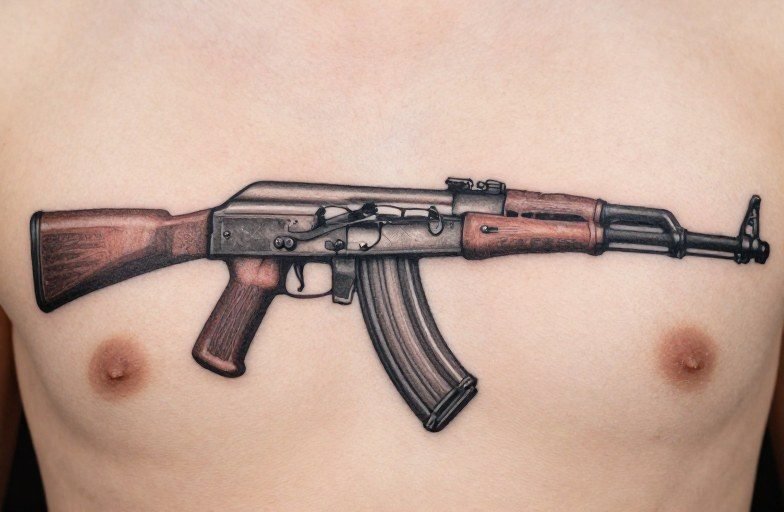
The AK-47 tattoo most commonly signals power, rebellion, or survival, though its meaning shifts dramatically depending on who’s wearing it and where they place it. For some, it honors military service or anti-colonial struggle. For others, it channels outlaw culture, street credibility, or a blunt statement of self-preservation in hostile environments. The gun’s instantly recognizable silhouette makes it a versatile symbol, but that same recognizability means it carries political and social weight you can’t easily shake off.
Symbolism & History
From Soviet Battlefield to Global Icon
The AK-47’s symbolism starts with its origins. Designed by Mikhail Kalashnikov in 1947, the rifle became the most widely produced firearm in history, arming Soviet-aligned nations, liberation movements, and insurgencies across decades. That history gives the tattoo a complex political dimension. In some contexts, it reads as anti-imperialist or revolutionary, think of its presence in flags and emblems from Mozambique to Hezbollah. Elsewhere, particularly in Western urban settings, it codes as gang-affiliated or criminal, thanks to its prevalence in drug trade and organized crime imagery.
The symbol’s meaning also splits along generational lines. Older wearers with military backgrounds may reference actual combat experience, often alongside dates, unit insignia, or national flags. Younger collectors frequently come to the image through hip-hop, video games, or street fashion, where the AK operates more as a generic signifier of toughness than a specific political statement.
Religious and Regional Variations
In parts of Eastern Europe and the former Soviet Union, the AK-47 sometimes appears in Orthodox Christian tattoo contexts, crossed with rosary beads, paired with saint imagery, or inscribed with Cyrillic prayer text. This reflects the rifle’s genuine role in defending homeland, not merely aggression. Conversely, in Central American tattooing, the AK often marks gang membership or prison hierarchy, particularly when rendered in specific color combinations or accompanied by numerical codes.
- Revolutionary/resistance: Paired with raised fists, red stars, or national liberation colors
- Military commemoration: Combined with dog tags, service dates, or unit patches
- Street/outlaw: Rendered with smoke, money, or urban backdrops; often in black-and-grey realism
- Religious/protective: Crossed with crosses, prayer ribbons, or saint medallions
Common Variations & Styles
Design Approaches That Change the Meaning
A hyper-realistic AK-47 with wood grain stock and worn metal finish reads differently than a geometric line-art version or a cartoonish new-school rendering. Realism emphasizes the weapon’s physical weight and lethality, it’s serious, almost documentary. Stylized or geometric treatments distance the image from actual violence, making it more acceptable as abstract symbolism.
Popular compositional additions include:
- Roses or flowers: The classic “beauty and violence” juxtaposition, though this risks cliché if not executed with genuine artistic intent
- Skulls or death’s heads: Mortality, memento mori, or specific military unit traditions
- Quotes or script: Often personal mottos, unit slogans, or memorial text for fallen comrades
- Flags or maps: Geographic or national allegiance, common in immigrant diaspora communities
Technical Execution Considerations
The AK-47’s distinctive curved magazine and gas tube assembly require careful attention to proportion. A poorly rendered magazine curve immediately signals amateur work. For larger pieces, the full rifle length (roughly 34 inches) needs adequate canvas, forearm, thigh, or back placements work better than wrist or ankle attempts that compress the silhouette into unrecognizable shapes.
Line-work versions age more gracefully than heavy black-and-grey realism on small scales. Fine detail in trigger mechanisms and sight assemblies tends to blur over 5-10 years, especially on high-movement areas like wrists or elbows. Bold outlines and simplified shapes hold up better for long-term readability.
Best Placements
Forearm placement dominates for visibility, the AK reads clearly from a distance, and the forearm’s length accommodates the rifle’s proportions without distortion. Outer forearm allows the barrel to point toward the hand; inner forearm reverses this, which some wearers avoid for superstitious reasons (“never point a gun at yourself”).
Thigh and calf offer larger canvases for detailed realism or wrapped compositions where the rifle follows the muscle contour. Ribs and side torso accommodate vertical orientations but hurt significantly more due to bone proximity and thin skin. Chest placement above the heart sometimes carries memorial intent for military losses.
Neck and hand placements are socially loaded. These highly visible spots signal commitment to the symbol’s meaning, there’s no hiding it for job interviews or family gatherings. Many established artists will refuse neck or hand AK-47 tattoos on first-time clients specifically because of this permanence and the doors it closes.
Who Chooses This Tattoo / Personal Meanings
Veterans and Active Military
For service members, particularly those with deployment experience in Iraq, Afghanistan, or Africa, the AK-47 often represents the actual enemy weapon faced in combat. Getting it tattooed can be complicated, some frame it as knowing your adversary, others as trophy or survival symbolism. Many pair it with unit insignia or operation names rather than wearing the rifle alone.
Immigrants and Diaspora Communities
People from conflict zones where the AK-47 was omnipresent, Somalia, Bosnia, El Salvador, Vietnam, sometimes choose the image as documentation of survived experience. This differs from military wearers: the gun wasn’t faced across battlefield distance but encountered in streets, checkpoints, or civil war chaos. The tattoo becomes witness rather than combat narrative.
Street Culture and Subcultural Adoption
In hip-hop and streetwear contexts, the AK-47 operates as generalized anti-authority symbolism. The specific political history matters less than the aura of armed resistance. This usage draws criticism for aestheticizing real violence, but it persists because of the image’s immediate visual punch and recognizability.
Similar Symbols
Collectors considering an AK-47 often evaluate alternatives that carry overlapping but distinct meanings:
- AR-15/M16: American military association, less revolutionary/anti-colonial weight, more domestic gun-culture connotation
- Revolver or six-shooter: Old West individualism, lawman or outlaw duality, less political baggage
- Crossed rifles: Specific military insignia tradition, unit identification, less individual statement
- Sword or blade: Historical warrior tradition, less modern political toxicity, more acceptable in professional settings
- Fist or raised arm: Resistance without the explicit violence association, though politically coded in other ways
The AK-47’s particular advantage as tattoo imagery is its global recognizability, no other rifle silhouette communicates so immediately across language and cultural barriers. That same quality makes it harder to personalize or soften than less loaded alternatives.
Final Thoughts
The AK-47 tattoo demands honest self-assessment about why you’re drawn to it. The image works powerfully when it connects to lived experience, military service, survived conflict, genuine political commitment. It risks hollow posturing when chosen purely for aesthetic toughness or borrowed rebellion. Before committing, consider how the tattoo reads to people who’ve actually faced this weapon’s consequences: veterans, refugees, survivors of gun violence. The best AK-47 tattoos carry that awareness in their execution, whether through memorial context, specific personal detail, or deliberate stylistic choices that complicate rather than celebrate the weapon’s function. Like any loaded symbol, its impact depends on the depth behind it.
Frequently Asked Questions
Will an AK-47 tattoo hurt my job prospects?
In most professional fields, yes. Visible weapon tattoos trigger automatic screening in law enforcement, education, healthcare, and corporate environments. Even covered, they may surface during medical procedures or team activities. Consider placement carefully if career flexibility matters.
What’s the difference between an AK-47 and AK-74 tattoo?
The AK-74 has a straighter magazine and different muzzle brake, but most people can’t distinguish them visually. Artists typically default to the classic AK-47 curved magazine silhouette unless you specifically request the 74 variant with reference images.
Do AK-47 tattoos automatically mean gang affiliation?
Not automatically, but context matters enormously. In some regions and specific stylistic combinations, particular colors, accompanying numbers, placement on face or hands, the image carries established gang coding. Research local tattoo culture or consult experienced artists in your area.
How well does detailed AK-47 realism age?
Poorly on small scales. Fine lines in sight assemblies, trigger mechanisms, and wood grain texture blur significantly within 5-7 years. Bold-outline simplified versions or larger placements (thigh, back) preserve readability much longer. Plan for touch-ups or design accordingly.
Related Tattoo Meanings
- Alamo Tattoo Meaning: Texas Pride, Defiance, and Memory
- Anbu Tattoo Meaning: Hidden Leaf s Shadow Symbolism
- Ant Tattoo Meaning: Hard Work, Teamwork Quiet Strength
- Explore more