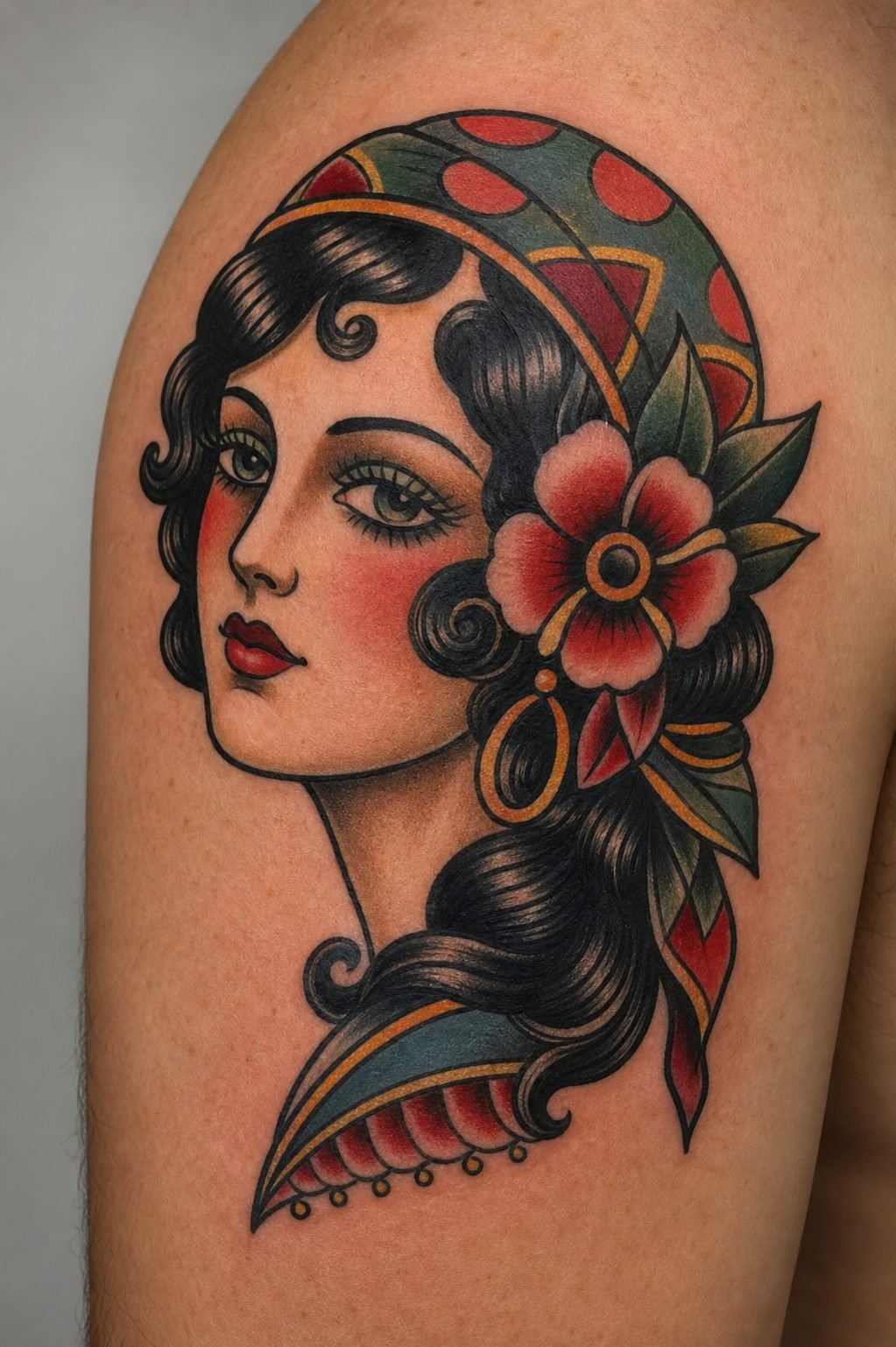
The American traditional lady head is one of the most recognizable images in tattooing. She’s the rose-cheeked woman with the flowing hair, the dagger through her neck, the snake coiled around her throat, or the crown of flowers pinned to her curls. Sailors brought her across oceans, carnival barkers sold her on flash sheets, and she’s still being tattooed today with the same bold lines and limited color palette that defined her a century ago. This guide breaks down what makes this motif work, how it ages, and what to know before you commit.
Origins & History
From Sailor Lore to Shop Staple
Lady heads emerged from the same maritime tradition that gave us swallows, anchors, and clipper ships. Sailors carried portraits of mothers, wives, and lovers, idealized feminine faces that represented what waited at home or what had been lost. The style solidified in the early 1900s through artists like Sailor Jerry, who distilled these portraits into a repeatable, bold-lined format that could be executed quickly and read clearly from a distance. Some trace the dagger-through-the-neck variation to themes of betrayal or heartbreak; others see it as pure visual drama, the contrast of soft features and violent imagery being the whole point.
The Carnival and Flash Sheet Era
By the mid-20th century, lady heads dominated flash sheets in street shops and carnival booths. They were popular because they sold, clients understood the image instantly, and artists could render them efficiently. The “Gypsy” variant, with her headscarf and gold hoop earrings, often linked to Roma imagery, became particularly common, though modern artists are increasingly moving away from that specific stereotype in favor of more neutral or personalized approaches.
Key Characteristics & Motifs
What separates a proper traditional lady head from a generic portrait is structure. These pieces follow rules that make them readable for decades.
- Heavy black outlines: The hair, jawline, and facial features are defined by consistent, weighty lines, typically 7 to 14 needle groupings, that hold up as skin ages and ink spreads slightly.
- Minimal facial detail: Eyes are often simple dots or almond shapes with a single highlight. Noses are suggested with a few lines. Lips are full and red. The effect is iconic rather than realistic.
- Hair as framing device: Flowing waves, curls, or a bob cut create the outer contour of the design. Hair often contains secondary imagery, snakes, roses, daggers, or leaves, integrated into the silhouette.
- Limited color palette: Traditional pieces stick to red, yellow, green, and black. Skin tones are warm peach or left as negative space. There’s no subtle shading, no color gradients.
- Common companion elements: Dagger, snake, rose, banner with lettering, crown, butterfly, or swallow. These aren’t random; they fill space around the head and balance the composition.
The “Dead Lady” Variation
A distinct subset shows the woman with eyes closed, tongue out, or head lolling, clearly deceased. Sometimes she’s a skeleton in a wig. This variant, often linked to memento mori traditions, carries a darker tone but follows the same technical rules. The contrast between the pretty face and the death imagery is deliberately jarring.
Color vs Black and Grey
Traditional lady heads were born in color, but black and grey versions have become equally valid. Here’s how the choice affects the piece.
Color traditional uses flat, saturated pigments: blood red lips, butter yellow hair highlights, emerald green leaves. The red is particularly important, it draws the eye to the mouth, the emotional center of the face. Color ages well if the saturation is dense enough; washed-out color looks muddy faster than solid black. Black and grey traditional relies on whip shading and parallel lines to create depth. Without color, the line weight becomes even more critical. A black and grey lady head needs bolder outlines to avoid looking like a soft grey smear after five years. Many artists now offer “black and grey with a pop of red”, lips and perhaps a rose, keeping the rest monochrome. This hybrid approach ages cleanly while preserving some traditional color identity.
Best Placements
Where the Design Fits
Lady heads are medium-sized pieces. Too small, and the facial details blur into indistinguishable dots. Too large, and the flat color areas start looking empty rather than bold.
- Thigh: The classic choice. Rounded muscle gives the face natural dimension. Plenty of room for hair flow and companion elements. Heals relatively easily on this meaty area.
- Upper arm/shoulder: Traditional placement for sailors. The deltoid curve suits the oval of a face. Can be standalone or integrated into a larger half-sleeve.
- Chest: Centered or off to one side. Large scale allows elaborate hair and multiple secondary images. Sternum placement is painful but visually striking.
- Forearm: Visible, readable, but limits size. Best for simpler compositions without too much surrounding detail.
- Calf: Similar advantages to thigh. Less common, which some clients prefer.
Placement to Avoid
Hands, feet, and neck are poor choices. The small scale forces detail reduction that kills the readability. These areas also see more sun exposure and friction, accelerating fade. Ribs and spine can work for experienced collectors with high pain tolerance, but the twisting of the torso distorts the face when the body moves.
Who It Suits
There’s no gender or aesthetic profile that owns this image. Men have worn lady heads since the style began; women get them now in equal numbers. The question isn’t whether you “can” pull it off, it’s whether you connect to the visual language of American traditional tattooing broadly.
This piece works for you if you already have other traditional work, or if you’re committed to building a cohesive collection in that style. A single lady head surrounded by unrelated realism or fine-line pieces will look isolated. The style also rewards patience with healing. Traditional saturation means heavy saturation, which means a longer, more intense healing process than a delicate single-needle piece. If you’re not prepared for two weeks of careful aftercare and some legitimate discomfort, reconsider.
Modern Variations
Contemporary Twists on Classic Structure
Working artists have pushed the lady head in several directions without abandoning the core rules.
- Portrait integration: Some clients request the face resemble a specific person, a partner, a parent, while keeping the traditional technical framework. This requires an artist skilled at translating real features into simplified, bold-lined forms.
- Non-European features: Historically, lady heads defaulted to a specific Caucasian ideal. More artists now create versions with broader nose shapes, different eye structures, and varied hair textures, still within traditional constraints.
- Mashups and humor: Lady heads with alien antennae, zombie decay, or pop culture references. These walk a line, too silly and the traditional gravity collapses; done with restraint, they become contemporary flash classics.
- Neo-traditional scale: Larger, more detailed, with subtle color transitions. Not pure traditional, but clearly in conversation with it. These pieces need more skin real estate and more sessions.
Choosing an Artist
Not every tattooer who “can” do traditional does it well. Lady heads expose weakness fast.
Look for an artist whose portfolio shows multiple lady heads in healed photos, not just fresh work. Fresh traditional always looks good; the test is six months later, when the swelling’s down and the skin has settled. Check that the faces in their portfolio don’t all look identical, some artists trace the same template repeatedly. You want someone who can vary the expression, the angle, the hair treatment.
Ask specifically about their line weight strategy for facial features. A good answer mentions different needle groupings for hair versus lip outline versus eye detail. Ask about their red pigment choice, some reds fade to pink or orange faster than others. The artist should have an opinion.
Be wary of artists who primarily work in other styles but “can do traditional too.” Lady heads demand muscle memory for whip shading, consistent line weight, and understanding of how traditional color sits in skin. That’s built through repetition, not occasional dabbling.
Final Thoughts
The American traditional lady head persists because it works. The bold lines stay readable, the limited palette ages gracefully, and the image carries enough ambiguity to mean something personal without requiring explanation. It’s not a delicate piece, and it’s not trying to be. If you’re drawn to it, commit to the full traditional approach, find the right artist, give it the space it needs on your body, and heal it properly. The result will outlast trendier styles by decades, which is exactly why people keep coming back to her.
Frequently Asked Questions
How long does an American traditional lady head take to heal?
Expect two to three weeks for the surface to close, with full settling around six weeks. The heavy saturation means more plasma and scabbing than a fine-line piece. Keep it clean, avoid sun, and don’t pick.
Can a lady head be part of a larger traditional sleeve?
Absolutely. It works as a focal point surrounded by smaller fillers like swallows, roses, or banners. Plan the overall flow with your artist so the lady head doesn’t fight adjacent pieces for visual dominance.
Why do some lady heads have a dagger through the neck?
This variant is commonly associated with themes of betrayal, lost love, or mortality, though many clients choose it purely for the visual contrast. The meaning is personal; the image is what endures.
Will the red in the lips fade to pink over time?
Quality red pigment holds for years but does soften. Direct sun exposure accelerates fading to orange or pink. A touch-up every five to ten years keeps the color crisp, which is standard maintenance for traditional work.
Related Style Guides
- American Traditional Religious Tattoos: A Complete Guide
- American Traditional Tattoo Outlines: Complete Style Guide
- Classic Traditional Tattoos: Complete Style Guide
- Explore more