
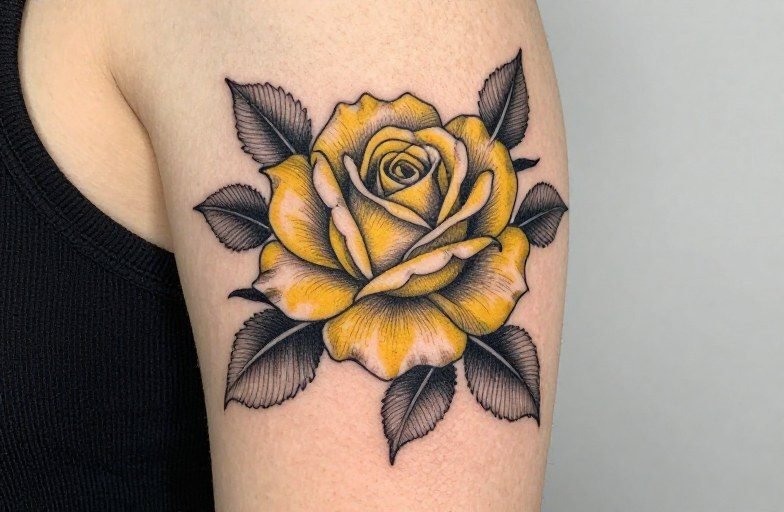
A yellow rose tattoo most commonly represents friendship, joy, and new beginnings. Unlike red roses tied to romance, the yellow variety carries a warmth that sits outside possessive love, it’s the rose you give a longtime friend, a sibling, or yourself after a hard season. The meaning shifts slightly with context, but the core stays consistent: optimism, connection, and the kind of love that doesn’t demand anything back.
Symbolism & History
From Victorian Florigraphy to Modern Skin
Yellow roses earned their association with platonic affection through Victorian florigraphy, the coded language of flowers. In that era, a yellow rose sent a message of friendship and caring without the romantic weight of red. Some trace the color’s link to jealousy or dying love in earlier European traditions, but by the early twentieth century, American growers and cultural usage had firmly repositioned yellow as cheerful and warm.
On skin, this history matters less than personal intent, but it gives the design a layer of genuine tradition. Someone choosing a yellow rose isn’t defaulting to generic flower imagery, they’re tapping into a specific, well-documented symbolic thread.
Regional and Cultural Variations
In Texas, the yellow rose carries extra weight from the folk song and state identity, making it a regional pride piece. In Japanese tattooing, yellow roses appear less frequently than peonies or chrysanthemums, but when they do, they often signal happiness or good fortune alongside other auspicious elements. Mexican folk art sometimes pairs yellow roses with memorial imagery, the color representing celebration of life rather than mourning.
Common Variations & Styles
Traditional American
Think bold black outlines, limited but saturated color palette, and a slightly graphic quality. The yellow reads as a solid fill rather than soft gradient. Traditional pieces age well because the heavy lines hold definition as skin changes. Yellow ink in this style tends to be a warmer, almost orange-leaning gold rather than lemon-bright, which helps it stay visible on most skin tones.
Realism and Neo-Traditional
Realist yellow roses require careful shading to capture the petal’s natural gradient, from deep yellow at the base to pale, almost cream tips. This demands more frequent touch-ups; the lighter yellows fade fastest under sun exposure. Neo-traditional work splits the difference, keeping bold outlines but adding more color variation and decorative elements like jewels, banners, or geometric frames.
Minimalist and Fine Line
Single-needle or fine-line yellow roses strip the design to essentials: a few petals, maybe a stem with minimal thorns. The yellow here is often sparse, an accent rather than a fill, which actually helps longevity since yellow pigment is notoriously less stable than black or red. Small, unshaded yellow highlights on a mostly black line drawing can last years without significant muddying.
- Black and grey with yellow accent: One yellow petal or a subtle wash of color draws the eye without relying on large yellow fills.
- Yellow rose with name or dates: Common for memorial pieces; the yellow keeps the tone celebratory rather than somber.
- Multiple roses in a bouquet: A yellow rose mixed with red or white can represent different relationships, friendship alongside romantic love or family bonds.
Best Placements
Yellow rose tattoos work across virtually any placement, but certain spots favor specific approaches.
Forearm and calf: These cylindrical areas suit traditional and neo-traditional styles well. The design wraps naturally, and the yellow stays visible enough to read clearly from conversational distance. Both areas heal relatively predictably with proper aftercare.
Shoulder and upper arm: Larger pieces with full blooms and leaves fit here. The flat plane of the shoulder cap allows for detailed petal work. Yellow on the outer upper arm sees significant sun exposure over a lifetime, plan for eventual fading and budget for touch-ups.
Ribcage and sternum: Fine-line or smaller traditional roses work here, though the yellow will hurt more to apply given the thin skin and proximity to bone. The placement carries intimacy; it’s not for casual display.
Hand and fingers: Yellow roses here are almost always small and simplified. The high turnover of skin cells on hands means rapid fading, especially for yellow ink. Expect this to need refreshing every few years if you want it to remain legible.
Behind the ear and ankle: Delicate placements that suit small, single-rose designs. The yellow can read as a bright accent against hair or sock line. Ankle pieces, like hand tattoos, face friction and sun challenges.
Who Chooses This Tattoo / Personal Meanings
There’s no single profile. Yellow rose collectors range from people marking sobriety anniversaries to friends getting matching pieces, from Texans claiming state identity to gardeners honoring a specific variety they grew. The unifying thread is that the meaning tends to be affirmative rather than defensive, this isn’t a tattoo chosen to guard against something, but to celebrate or remember something warm.
Some common personal resonances:
- Friendship that outlasted romantic relationships or geographic distance
- Recovery from depression or grief, the yellow marking a return of light
- Connection to a specific person associated with the flower, a grandmother’s garden, a friend’s favorite bloom
- Professional or creative new beginnings, the rose marking a career pivot
The tattoo doesn’t require a dramatic backstory to be valid. Sometimes it’s simply the color someone likes, or a rose shape that fits aesthetically with existing work. The yellow offers enough established symbolic range that it rarely reads as random, even when chosen partly for looks.
Similar Symbols
If you’re drawn to yellow roses but want to explore alternatives or complementary imagery, several related symbols share overlapping territory.
Sunflowers: Also yellow, also optimistic, but bigger and brasher. Sunflowers lean toward adoration and loyalty; roses carry more elegance and historical refinement. A sunflower makes a bolder statement; a yellow rose is more quietly specific.
Marigolds: In Día de los Muertos contexts, marigolds guide spirits with their color and scent. They overlap with yellow roses in celebratory memorial usage but carry stronger cultural specificity.
Buttercups or daffodils: Smaller, simpler yellow flowers that suggest innocence or early spring rather than mature friendship. Good for lighter, more playful designs.
Red or white roses: The classic alternatives. Red for romantic love, white for purity or new beginnings. A design incorporating multiple colors can tell a more complex relational story without requiring additional imagery.
Bee or honeycomb paired with yellow rose: Extends the sweetness and industry themes. The combination works particularly well in traditional or neo-traditional styles.
Final Thoughts
A yellow rose tattoo holds its ground in a crowded field of floral designs because its meaning is specific without being restrictive. It doesn’t default to romance. It doesn’t require tragedy to justify its presence. The color carries enough visual warmth to stand out in black-heavy collections, and the form is recognizable enough to read instantly even in small scales.
If you’re considering one, think about the yellow itself: how much, what shade, how it’ll age against your skin tone and lifestyle. The flower’s meaning is the easy part. Making it work as a tattoo, placing it well, sizing it appropriately, choosing a style that won’t muddy into a yellow blob in ten years, that’s where the real decisions live. A good artist will walk you through how their yellow pigments behave specifically, because not all yellows are created equal, and the best intentioned design can disappoint if the technical choices don’t match the symbolic ones.
Frequently Asked Questions
Does yellow ink fade faster than other colors in rose tattoos?
Yes, yellow pigment generally fades faster than black, red, or blue. It sits lighter in the skin and breaks down more quickly under UV exposure. Placing a yellow rose on a sun-protected area and using sunscreen helps longevity significantly.
Can a yellow rose tattoo work on darker skin tones?
Absolutely, but the approach matters. Deeper, more golden yellows with less white mixing tend to show better than pale lemon shades. A skilled artist will adjust saturation and possibly use bolder outlines to ensure the yellow reads clearly.
What’s the difference between a yellow rose and a sunflower tattoo meaning?
Yellow roses specifically symbolize friendship and joy with historical roots in florigraphy. Sunflowers represent adoration, loyalty, and seeking light. Roses carry more elegance and relational nuance; sunflowers make a bolder, more universal optimistic statement.
Is a yellow rose tattoo only for women?
Not at all. The design works across genders, and traditional American tattooing has long used roses on all collectors. Style choice matters more than gender, bold traditional or graphic approaches read differently than soft watercolor, but none are gender-restricted.
Related Tattoo Meanings
- Adam Levine Head Tattoo Meaning: Butterfly, Rose Cloud Ink
- Anbu Tattoo Meaning: Hidden Leaf s Shadow Symbolism
- Ant Tattoo Meaning: Hard Work, Teamwork Quiet Strength
- Explore more









