
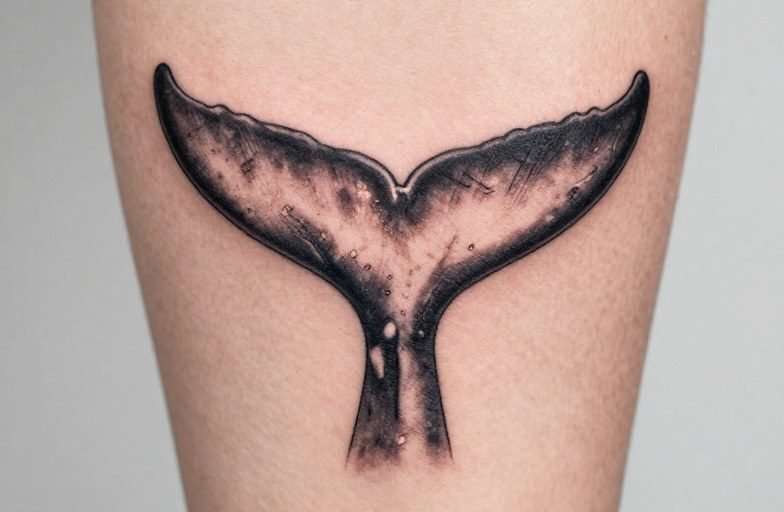
A whale tail tattoo most commonly represents freedom, deep emotional connection, and the vast unknown. The image captures the moment a whale dives, powerful, graceful, and headed somewhere you cannot follow. For many, that split-second glimpse of flukes against water or sky encapsulates a personal relationship with the ocean, a memory, or a philosophy of living.
Symbolism & History
Core Meanings
The whale tail carries layered symbolism that resonates across cultures. In Polynesian tradition, whales and their tails often linked to navigation, ancestry, and the spirit world, guides for those who traveled open water without modern instruments. Some trace the tail specifically to stories of whales as carriers of souls or as manifestations of ocean deities.
More universally, the flukes represent:
- Freedom and wanderlust, the tail disappears below the surface, bound for depths or horizons unseen
- Family and community, whales are deeply social; a tail can signal loyalty to one’s pod, biological or chosen
- Strength tempered by grace, immense power moving with fluid control
- Environmental awareness, a quiet statement of connection to marine ecosystems under threat
Modern Associations
Contemporary wearers often connect the design to specific experiences: a first scuba dive, a parent who sailed, recovery from something that required deep internal diving. The tail works as a memorial piece too, the downward motion suggesting a loved one gone to another place. Unlike more aggressive marine imagery, sharks, kraken, the whale tail reads as contemplative rather than confrontational.
Common Variations & Styles
Visual Approaches
The same symbol reads very differently depending on execution. Line work in black ink keeps the image graphic and timeless, the negative space between flukes becoming as important as the lines themselves. Heavy black fill with minimal detail creates a bold silhouette, striking on forearms, calves, or ribs where the natural curve of the body echoes the tail’s shape.
Watercolor backgrounds behind a structured tail are popular but technically demanding. The soft bleed of color needs crisp edges where it meets the whale form, or the whole piece turns muddy. Dotwork and stippling can suggest the texture of skin or the shimmer of light through water. Geometric versions break the flukes into triangles and lines, often appealing to those who want the symbol without literalism.
Accompanying Elements
- Compass roses or nautical stars, emphasizing navigation, direction, finding one’s way
- Surface ripples or full ocean scenes, contextualizing the moment of the dive
- Script or coordinates, personalizing with dates, names, or locations
- Negative space moon or sun, framing the tail against a celestial body
Small single-needle tails behind the ear or on the ankle have gained traction, though the fine lines will soften faster than bolder work. A tail spanning shoulder to shoulder across the upper back allows for proper fluke spread and detail.
Best Placements
The whale tail’s natural shape, wider at the top, tapering toward the center, fits specific body contours better than others. The calf and forearm are the most common choices because the vertical axis of the tail aligns with the long muscle there. On the calf, the flukes can spread across the gastrocnemius; on the inner forearm, the tail points toward the wrist or elbow depending on orientation.
Ribcage placement works for medium-to-large pieces where the tail curves with the floating ribs. The sternum area between breasts or pectorals accommodates the shape well but hurts significantly more than fleshy areas. Ankle and foot placements are possible but suffer from ink fallout, those areas shed skin rapidly and take abuse from footwear, so expect touch-ups.
Upper back pieces allow for the most anatomically accurate fluke spread, since actual humpback tails span proportionally wide. A small tail on the wrist or behind the ear reads as delicate; the same design at eight inches across the thigh becomes a statement piece. Consider how the tail points: toward the heart suggests introspection, away from the body suggests outward journey.
Who Chooses This Tattoo / Personal Meanings
Common Wearers
Coastal residents and water-sport enthusiasts gravitate toward the design for obvious reasons, but the geography isn’t exclusive. People who’ve experienced profound isolation or return from it, depression, grief, long-distance solo travel, sometimes find the solitary dive of the whale speaks to that specific psychology. The tail is a departure, not an arrival.
Parents, particularly mothers, sometimes choose the design referencing the mother-calf bond in whale species. The calf stays close, swims in the mother’s slipstream, is nudged to the surface to breathe. That biological reality translates cleanly to human attachment without needing additional imagery.
What Changes Over Time
Black linework holds definition for years but may need refreshing after a decade depending on sun exposure and skin type. Shaded greywash softens faster, the subtle gradations blurring into each other. Watercolor backgrounds fade most dramatically, sometimes losing their intended vibrancy within five to seven years. The tail outline itself usually remains readable even as surrounding elements degrade, which is worth considering if you’re building a larger composition around it.
Healing follows standard protocol: two to three weeks of careful moisture management, no soaking, no sun. The webbing between flukes, thin lines connecting broader shapes, can be vulnerable to blowout if the artist works too deep or the skin moves unpredictably during the session.
Similar Symbols
The whale tail occupies a specific niche between several related images. A full whale body in profile emphasizes the creature’s scale and majesty but loses the moment-of-action quality. Shark fins suggest danger, aggression, or resilience against threat, different emotional territory. Mermaid tails trade the whale’s gravitas for sexuality and transformation mythology.
The orca, distinct enough to warrant separate consideration, carries its own cultural weight, often linked to specific Native Pacific Northwest iconography that shouldn’t be appropriated casually. A generic whale tail avoids that particular pitfall while maintaining marine mammal connection.
Abstract wave tattoos share the ocean theme but lack the biological specificity. The tail grounds the abstraction in a real creature’s real movement. For those considering the tail but wanting something more unusual, a fluke print, the actual pattern of scars and markings unique to individual whales, offers a hyper-personalized direction that requires research and often a specific whale’s documentation.
Final Thoughts
The whale tail endures because it functions as both image and action. It’s not a static symbol but a captured moment, something going somewhere, leaving something behind, carrying weight below the visible surface. That ambiguity serves it well. The design works at any scale, adapts to multiple styles, and avoids the trend-cycle obsolescence that hits more decorative or pop-culture-dependent imagery. Choose an artist who understands how the fluke’s geometry interacts with your specific body structure, and the result will hold meaning that outlasts the initial impulse to get it.
Frequently Asked Questions
Does a whale tail tattoo always have to face a certain direction?
No, orientation is personal preference. Pointing downward suggests diving inward or moving on; pointing upward can represent emergence or aspiration. Discuss placement with your artist to see how the flow works with your muscle structure.
How much detail can you fit in a small whale tail tattoo?
Very small tails, under two inches, work best as clean silhouettes or single-line designs. The knuckles and notches between flukes blur together if over-detailed at small scale. Save intricate scar patterns or texture for larger pieces.
Is the whale tail associated with any specific conservation message?
Some wearers intend it as environmental statement, but the symbol isn’t universally recognized as activism-specific like, say, a panda or specific campaign logo. The meaning depends on context you add, coordinates of a protected area, a specific whale’s identification number.
Can a whale tail be covered up or incorporated into a larger piece later?
Yes, the shape adapts well. The tapering center can extend into a full whale body, or the flukes can become part of a larger seascape. Dark, saturated original work limits options somewhat, but a skilled artist can usually build outward.
Related Tattoo Meanings
- Sloth Tattoo Meaning: Patience, Peace Playful Rebellion
- Strawberry Tattoo Meaning
- Killer Whale Tattoo Meaning
- Explore more









