
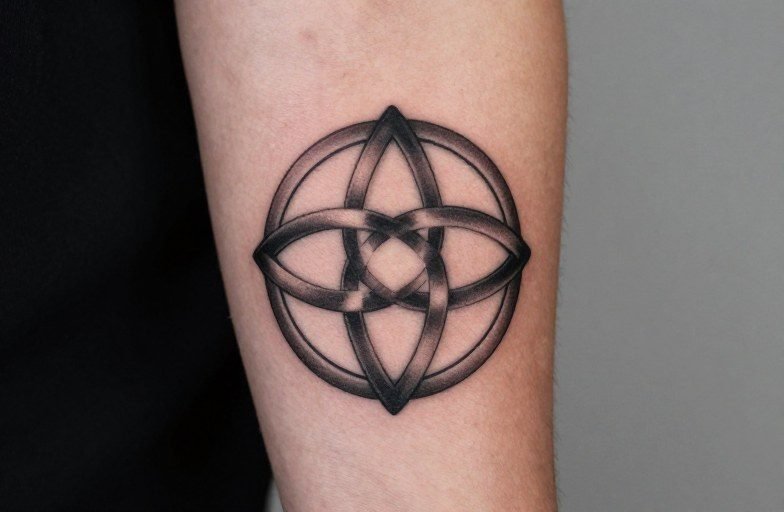
The trinity tattoo most commonly refers to the triquetra, three interlocked arcs, or the Christian Trinity of Father, Son, and Holy Spirit. Beyond religion, the three-part form has become a broader symbol of interconnectedness, past-present-future, and the cycles of life. Its compact geometry makes it adaptable to many styles and sizes, which partly explains its staying power in shops across the US.
Symbolism & History
The triquetra’s origins are often linked to Celtic knotwork and early medieval insular art, though some trace it to older Norse and Germanic visual traditions. What matters for tattoo collectors is that the symbol carried meaning long before it appeared on skin, meaning that has shifted and accumulated over centuries.
Religious Interpretation
In Christian contexts, the three interlaced loops represent the Trinity. The unbroken line suggests unity without dissolution of individual identity. This reading became prominent in Ireland and Britain during the early medieval period, where the triquetra appeared in illuminated manuscripts and carved stone crosses. For believers, the tattoo functions as permanent devotional marker, small enough for concealment, distinct enough for recognition.
Secular and Pagan Associations
Outside Christianity, the three-fold shape commonly associated with triple goddesses, the three realms (land, sea, sky), or the stages of life. Modern practitioners of various pagan traditions sometimes adopt the triquetra as a heritage symbol, though its precise historical use in pre-Christian ritual remains debated among scholars. The tattoo here often signals cultural connection rather than doctrinal commitment.
Common Variations & Styles
The basic triquetra geometry supports surprising visual range. Your choice of style fundamentally changes how the symbol reads on skin.
- Line-only triquetra: Clean, single-weight black lines. Ages well, stays legible at small sizes. Best for wrist, behind ear, or inner bicep. The simplicity reads as modern and intentional.
- Knotwork border: The triquetra centered within a ring of interlaced Celtic patterns. Demands more skin real estate and a steady hand from the artist. Forearm, shoulder cap, or thigh work best. The complexity rewards close viewing but will soften over decades as fine lines blur.
- Shaded or dimensional: Greywash or dotwork creates depth, making the loops appear to weave over and under each other. Requires an artist comfortable with consistent tonal gradation. These pieces need to be large enough for the shading to read, at least palm-sized.
- Incorporated into larger compositions: The triquetra nested within a tree of life, a mandala, or a sleeve filler. The symbol becomes one element in a broader visual system rather than the sole focus.
- Color additions: Green for Irish heritage, purple for spirituality, or the three liturgical colors (white, red, green) worked subtly into the loops. Color holds differently by placement, inner arm retains vibrancy; hands and feet shed it fast.
One practical note: the triquetra’s pointed outer vertices create natural stress points in healing. Clothing friction on shoulder points or waistband pressure on lower back placement can cause uneven healing. Discuss this with your artist when selecting size and location.
Best Placements
The trinity tattoo’s compact core geometry suits many locations, but some placements serve the symbol better than others.
High-Visibility Small Scale
Behind the ear, the side of the finger (not the pad), and the collarbone edge accommodate small, clean triquetras. These spots telegraph personal significance without demanding explanation. Finger placement specifically: the symbol must be tiny, lines will spread, and touch-ups are almost guaranteed within five years. Budget for that maintenance.
Medium Canvas
Inner forearm, outer bicep, calf, and shoulder blade offer enough space for knotwork borders or light shading. The inner forearm remains the most requested, visible to the wearer, easy to show or cover, and the flat skin surface lets lines settle evenly. Shoulder blade placement works well for symmetrical designs but requires mirror-checking during design phase; you won’t see it straight-on without assistance.
Large-Scale Integration
Thigh panels, ribs, and full back pieces allow the triquetra to breathe within elaborate Celtic sleeves or spiritual compositions. The rib cage’s movement and stretch demand slightly bolder line weight than you might choose for a static placement. Artists often recommend adding 10-15% to nominal line thickness for rib work to account for distortion.
Who Chooses This Tattoo / Personal Meanings
There’s no single profile. The trinity tattoo attracts people across belief systems, often for specific life circumstances rather than general aesthetic appeal.
- Heritage markers: Irish, Scottish, Welsh, or Manx descent sometimes prompts the choice as cultural reclaiming, especially among diaspora communities in the US. The symbol functions as visual surname, recognizable to insiders, neutral to others.
- Conversion or reaffirmation: Some Christians select the triquetra at baptism, confirmation, or after a period of renewed faith. The permanence matters as much as the image.
- Triadic life events: Parents of three children, survivors of three significant passages, or those marking a third major chapter sometimes adopt the form as private tally. The meaning stays encoded, viewers see the symbol, not the count.
- Grief and memorial: The three loops can hold three names, three dates, or three qualities of the lost person. Integration with infinity symbols or birth flowers is common in memorial pieces.
What unifies these choices is the symbol’s structural ambiguity. The same form accommodates devotion, genealogy, and abstract philosophy without contradiction. Your artist should ask what the three represents for you, not to police meaning, but to advise on visual emphasis. A heritage piece might benefit from knotwork density; a devotional piece might need the unbroken line to read clearly.
Similar Symbols
Collectors sometimes confuse or combine the triquetra with related forms. Knowing the distinctions helps you choose precisely.
- Valknut: Three interlocked triangles, Norse in association, often linked to Odin and the slain. More angular, more aggressive visually. The triquetra’s curves read softer; the Valknut’s geometry demands attention.
- Triskelion: Three spirals or bent legs radiating from center. Ancient Mediterranean and Celtic precedents, but the visual rhythm differs, movement outward versus the triquetra’s contained interweaving.
- Trefoil knot: Mathematically distinct, the simplest nontrivial knot in topology. Some tattoo collectors with mathematical or scientific backgrounds prefer this pure form stripped of cultural overlay.
- Shamrock: The three-leaf clover shares the “three” concept but offers organic, asymmetrical form versus the triquetra’s rigid geometry. Less symbolically dense, more immediately legible as Irish.
Artists sometimes sketch multiple options side by side during consultation. Ask to see the triquetra adjacent to the triskelion or Valknut if you’re uncertain. The comparison clarifies preference faster than description.
Final Thoughts
The trinity tattoo endures because its geometry is both ancient and adaptable. It compresses complex ideas into a shape that works at quarter-inch scale or across a shoulder. The real decision isn’t whether the symbol carries meaning, it has carried multiple meanings for over a millennium, but which meaning you anchor it to, and how your artist renders that commitment in line, weight, and placement. Choose an artist who has worked knotwork before, whose healed photos show consistent line quality, and who asks what the three loops hold for you. The rest is needle, ink, and the patience to heal.
Frequently Asked Questions
Does a trinity tattoo have to be religious?
No. While the triquetra carries Christian associations, many people choose it for secular reasons, heritage connection, personal triads, or appreciation of Celtic design. The symbol’s long history allows for multiple legitimate readings.
How well does a small triquetra tattoo age?
The simple interlaced loops actually age better than complex knotwork. At small sizes, stick to clean black lines without interior shading. Avoid going smaller than one inch across, or the central negative space may close up over time.
What’s the difference between a triquetra and a trinity knot?
In tattoo usage, the terms are often interchangeable. Technically, the triquetra is the three-lobed shape itself, while ‘trinity knot’ emphasizes the Christian interpretation. Discuss with your artist which term to use for reference images.
Can a trinity tattoo be covered up or modified later?
The triquetra’s compact form makes it relatively adaptable for cover-ups, though the central triangle of negative space can limit options. Bold reworking into a larger knotwork piece or floral design is usually more successful than laser-first approaches.
Related Tattoo Meanings
- Chevron Tattoo Meaning: Symbolism, Styles Placement Guide
- Flor de Lis Symbol Tattoo Meaning: History, Style Placement
- Three Dot Hand Tattoo Meaning: Symbolism, Styles Placement
- Explore more









