
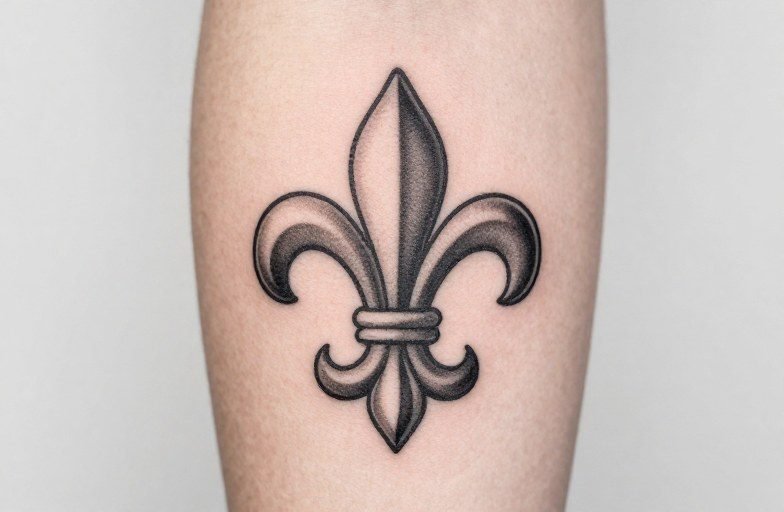
The fleur-de-lis, or flor de lis, functions as a layered emblem. Most commonly, it signals French heritage, spiritual devotion, or regional pride, particularly for those connected to Louisiana, Quebec, or French-Canadian roots. Its three petals have been read as faith, wisdom, and chivalry, though the symbol’s meaning shifts noticeably depending on context and personal attachment.
Symbolism & History
Understanding what the fleur-de-lis represents requires looking at its dual track: heraldic and religious. The symbol predates its formal adoption by French monarchy, with some tracing it to Gaulish lilies or Near Eastern botanical motifs. What matters for tattoo work is how these strands braid together into something visually compact but semantically dense.
Royal and Civic Associations
French kings used the fleur-de-lis from roughly the 12th century onward as a dynastic badge. In tattoo form, this lineage appeals to those with documented French ancestry or an affinity for heraldic aesthetics. The symbol also appears on flags, sports logos, and military insignia, most visibly with the New Orleans Saints and on Quebec’s flag. Someone sporting this as skin art may be marking civic identity rather than claiming noble blood.
Religious Readings
The three petals map neatly onto Christian trinitarian symbolism. Catholic tradition often linked the fleur-de-lis to the Virgin Mary, with the central petal as her figure and the outer pair as her virtues. This makes the symbol a frequent choice for believers wanting something less overt than a crucifix but still recognizably devotional. The band at the base, sometimes rendered as a crossbar, reinforces this reading.
Common Variations & Styles
Not all fleur-de-lis tattoos look alike. The basic geometry (two outer petals curving outward, one central petal, bound at the base) accommodates substantial stylistic range without losing recognition.
- Blackwork / bold line: Heavy outlines with minimal interior detail. Ages cleanly, reads well at small sizes. The silhouette stays legible even as lines soften over years.
- Stippled or dotwork: Texture built from density rather than solid fill. Creates a vintage, almost etched quality. Slower to execute, but distinctive on forearms or ribs.
- Ornamental / filigree: The fleur-de-lis as anchor point for scrollwork, mandala elements, or Art Nouveau extensions. Demands larger skin real estate, upper back, thigh, or sternum work best.
- Watercolor or painterly: Color fields bleeding outside or behind the form. Risky for longevity; the symbol’s structure can get lost if the wash dominates. Best reserved where the core shape stays defined by strong line.
- Combined imagery: Paired with Louisiana state outlines, saxophones, crawfish, or sports team colors. These hybrid designs trade some timelessness for specific personal reference.
Line weight matters disproportionately here. The fleur-de-lis relies on its tapered petals and precise base. Too thin, and the central petal collapses into a blur within five years. Too thick, and the symbol becomes a blob. Experienced artists typically recommend medium-weight outlines with selective shading to maintain that critical silhouette.
Best Placements
The fleur-de-lis suits vertical orientation naturally, which influences where it sits well on the body.
High-Visibility Spots
- Forearm (inner or outer): Vertical alignment matches the form. Outer forearm catches more sun, expect faster fading if not protected. Inner arm keeps finer detail longer but sees more flexing and moisture.
- Upper arm / deltoid: Classic military or fraternal placement. Room for a slightly larger piece with banner text or surrounding elements.
- Behind the ear / neck nape: Small, discreet. The symbol’s recognizability carries even at thumbnail size. Neck skin moves and stretches; touch-ups are common here.
Contained or Expandable Areas
- Chest / sternum: Centered placement emphasizes symmetry. Can anchor a larger chest piece or stand alone. Pain level runs high; the bone proximity makes itself known.
- Ankle / calf: Lower leg offers flat, stable skin for clean lines. Ankle placement risks rubbing from footwear during healing.
- Hand or fingers: Bold choice, high commitment. Finger skin sheds ink rapidly; fleur-de-lis details often blur into indistinct shapes within a few years. Solid black miniatures hold up better than fine-line versions.
One practical consideration: the fleur-de-lis reads as a badge. Placement signals intent. Forearm or hand says “this is part of how I present myself.” Ribs or thigh say “this is mine.” Neither is better, but the difference matters for satisfaction long-term.
Who Chooses This Tattoo / Personal Meanings
After years of seeing this design requested, patterns emerge without hard rules. The appeal tends to cluster around several lived connections rather than abstract aesthetic preference.
- Geographic roots: Louisiana natives, New Orleans transplants who stayed, Quebecois diaspora, French Cajun families. The symbol functions as shorthand for “from here” without needing text.
- Recovery and resilience: Post-Katrina, the fleur-de-lis took on specific weight in New Orleans as a mark of rebuilding and survival. Some carry it for that chapter specifically.
- Military and service: Scout organizations, certain Army units, and fire departments have used the emblem. Veterans sometimes choose it to mark unit affiliation without the full regalia.
- Spiritual marking: Catholics seeking a devotional symbol less common than the cross or ichthys. The Marian association resonates particularly with those who had strong maternal figures in their religious upbringing.
- Fraternal or organizational: Freemasonry, certain college Greek systems, and medieval reenactment communities have adopted the form. Context determines whether this reads as genuine membership or borrowed aesthetic.
The symbol’s ambiguity cuts both ways. It can feel deeply personal or vaguely appropriated depending on the wearer’s actual connection. A good consultation digs into whether the attraction is visual, familial, or aspirational.
Similar Symbols
Clients sometimes arrive wanting a fleur-de-lis but leave with something adjacent, or combine it with related forms. Understanding the distinctions helps clarify intent.
- Lily (fleur-de-lys literal): The botanical iris or lily from which the stylized form derives. More naturalistic, less geometric. Appeals to gardeners or those wanting floral softness over heraldic sharpness.
- Trinity knot / triquetra: Another tripartite symbol, Celtic rather than French. Shares the three-fold structure but carries different cultural weight. Some combine both in heritage-mashup designs.
- Ankh: Egyptian looped cross, sometimes confused due to similar vertical emphasis. Completely separate lineage; mixing them without purpose looks muddled.
- Iron cross / cross pattée: Shared military heraldic context, but politically loaded in ways the fleur-de-lis generally isn’t. Important distinction for clients drawn to “cross-like” symbols.
- Acadian star: Related regional symbol for French-Canadian diaspora, particularly the Cajun community. Sometimes appears alongside or instead of the fleur-de-lis.
Final Thoughts
The fleur-de-lis endures because it compresses multiple identities into a shape that reads instantly. French or Francophone, Catholic or secular, native or adopted, survivor or celebrant, the same outline holds different weights. For tattoo purposes, its strength lies in structural clarity: it can be rendered small, large, ornate, or stark without losing itself. The risk is choosing it for surface aesthetics without the underlying connection, which tends to breed regret when the novelty fades. Match the style to the meaning, place it where the geometry flatters the body, and respect that this symbol already carries centuries of accumulated significance before the needle touches skin.
Frequently Asked Questions
Does the fleur-de-lis tattoo have negative connotations?
In most contexts, no, it’s broadly viewed as heritage or regional pride. However, some European far-right movements have occasionally co-opted heraldic symbols broadly, so context and accompanying imagery matter. In American tattoo culture, the association remains overwhelmingly neutral to positive.
How well does a small fleur-de-lis tattoo age?
Aging depends heavily on execution. Solid black versions with medium line weight hold up for years; fine-line or highly detailed small pieces tend to blur as the central petal loses definition. Expect touch-ups after 5-10 years on high-wear areas like fingers or wrists.
Can the fleur-de-lis be part of a larger sleeve or back piece?
Absolutely. It works well as a repeating motif, a central anchor, or integrated into scrollwork and filigree. Its vertical symmetry makes it useful for filling gaps between other elements or bridging shoulder to chest compositions.
What’s the difference between fleur-de-lis and fleur-de-lys in tattoo terminology?
The terms are interchangeable in modern usage; both refer to the stylized lily emblem. “Lis” is the more common spelling in French and American tattoo contexts, while “lys” appears in older English heraldic texts. Either spelling requests the same symbol.
Related Tattoo Meanings
- Gladiolus Tattoo Meaning: Strength, Memory, and August Births
- Iris Tattoo Meaning: Symbolism, Styles Placement Guide
- Khmer Tattoo Meaning: Sacred Symbols Modern Ink
- Explore more









